How to Map Utility Lines Before Overpass Demolition
192,000 Strikes Per Year, Most of Them Preventable
The Common Ground Alliance, referenced by GPRS, reports more than 192,000 utility damages annually on U.S. construction and demolition sites, with a societal cost exceeding $30 billion. The vast majority of those strikes occur within projects that had some utility location information available. The utility data existed — the failure was in translating it into the sequence of operations where the risk was live.
Utility line mapping for overpass demolition has a different scope than utility mapping for new construction. Effective pre-demolition utility locating for overpass projects requires treating each detected service as a phase-specific constraint, not a static survey finding — because the underground utility survey for bridge demo must capture mounted deck utilities, buried corridor services, and below-grade crossings simultaneously. Buried cable detection for bridge removal must address all three categories to be complete, and utility conflict resolution for overpass projects depends on the completeness of this survey.
Bridges often carry utilities within the deck or below the soffit — gas, electric, telecom, and water lines mounted to the bridge structure itself. They sit adjacent to buried utilities in the road corridor below. They cross over underground utility easements at multiple angles. The underground utility survey for bridge demolition must capture all three categories: mounted utilities, buried corridor lines, and below-grade crossings at angles that may not appear in utility company records.
Pre-demolition utility locating for overpass work is more than a site safety step — it is the data collection phase that makes the demolition score accurate. Without it, the score is a structural sequence with invisible conflicts. With it, buried cable detection for bridge removal populates the score with protective cues that govern every measure where equipment operates near a utility. The score's accuracy is directly proportional to the completeness of the utility survey that precedes it.
National Academies research on addressing utility issues in bridge projects found that early utility investigation reduces conflicts. Projects that completed comprehensive utility surveys before the design phase — not just before construction — avoided the most costly conflicts. For demolition, the same principle applies: utility conflict resolution for overpass projects is easiest when conflicts are identified in the planning room, not discovered by an excavator. Survey data gathered before the demolition phase plan is written allows the survey findings to inform the sequence directly.
Building the Utility Map That Feeds the Score
Buried cable detection for bridge removal is the foundation of any safe demolition sequence — accurate horizontal and depth data for every service is what allows protective cues to be written at the correct phase measures rather than applied generically. Utility conflict resolution for overpass projects begins here: when conflicts are identified in the map rather than discovered by equipment, the resolution options are broader and the cost is lower.
Underground utility mapping for overpass demolition begins with ground-penetrating radar (GPR) survey — a detection method the EPA describes as capable of identifying subsurface conditions without excavation. A ScienceDirect study on locational accuracy of underground utility mapping confirms GPR accuracy thresholds that matter for demolition planning: horizontal position accuracy within centimeters when survey parameters are optimized. This level of accuracy allows utility lines to be plotted against the demolition equipment's operational envelope with confidence.
Surface and aerial utility documentation. GPR addresses buried lines, but overpass demolition also involves surface-mounted and overhead utilities. Gas lines bracketed to bridge girders, fiber conduits strapped to deck undersides, and transmission lines that cross the overpass envelope are all captured in a pre-demolition visual survey supplemented by utility owner records. The Demolition Symphony Planner's utility register collects all types — buried, surface-mounted, overhead — as a unified record rather than separate lists.
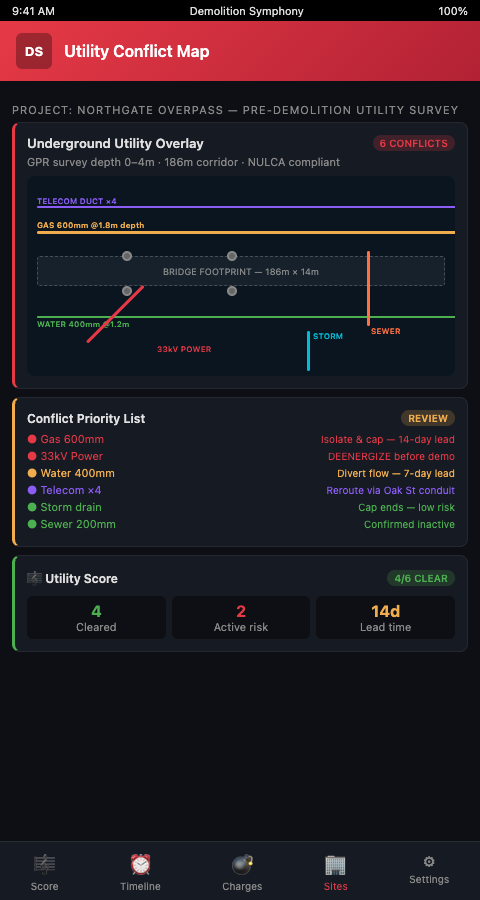
Translating survey data into cue notation. A utility map that stays as a PDF attached to a project folder does not protect the crew. The Demolition Symphony Planner imports utility locations and translates them into cue annotations tied to specific phase measures. A gas main running at 1.2 meters depth parallel to pier 2's footing generates a shielding cue on every substructure measure where excavation or breaking equipment operates within 3 meters of that coordinate. The cue is visible on the score, not buried in the survey report.
Phase-specific utility conflict resolution. FHWA Bridge Planning Chapter 3 requires early permit acquisition and utility coordination. The Demolition Symphony Planner uses that coordination data to assign each utility conflict a resolution action written into the specific phase where the conflict is live. Resolution options include physical protection (shielding, standby shutdown), method substitution (no mechanical breaking within the clearance zone), or utility relocation completed before the phase opens. Each option is written as a score annotation, not a verbal instruction.
GPR survey parameter optimization. A multicriteria GPR survey optimization study from MDPI demonstrates that survey parameters — antenna frequency, grid spacing, scan depth — directly affect utility detection accuracy. For demolition planning, this matters most at pier footings and abutment foundations, where buried utility crossings are most likely and detection at depth is most difficult. The Demolition Symphony Planner's pre-demolition checklist specifies the survey parameters required for each zone of the project based on expected utility density and depth.
Teams that complete utility mapping as a precondition to writing the demolition score also generate the documentation needed to manage the adjacent infrastructure risks that extend beyond utilities to vibration-sensitive structures and rail corridors. The utility register feeds directly into the broader adjacency cue layer of the score.
The connection to traffic management scoring is practical: utility shutdown and restoration windows often require lane closures that must be coordinated with the traffic sequence. A gas line shutdown that requires 6 hours must be written into both the utility cue timeline and the traffic window plan. The Demolition Symphony Planner keeps both timelines in the same score, so the coordination is built in.
Advanced Tactics for Utility-Safe Demolition
Utility owner engagement as a gate condition. Some utility conflicts cannot be resolved by protective measures alone — the utility must be shut down, rerouted, or temporarily supported by the utility owner during the demolition phase. The Demolition Symphony Planner writes utility owner confirmation as a gate condition on the affected measures: the measure cannot open until the owner has confirmed the protection or shutdown arrangement. This prevents demolition from advancing into a phase where a live utility owner action is still pending.
Buried cable detection beyond the bridge footprint. Utility lines that parallel the bridge at depth may not cross the demolition footprint directly but still fall within the vibration influence zone of high-energy demolition methods. The survey scope should extend at least 10 meters beyond the structural footprint on each side, particularly for explosive or high-impact mechanical demolition. The Demolition Symphony Planner's survey zone specification defaults to this extended boundary unless the project engineer overrides it with documented justification.
Integrating as-built records with survey data. Utility owner as-built records are typically accurate in plan position but unreliable in depth. GPR survey data is accurate in depth but sometimes misidentifies utility type. The Demolition Symphony Planner's utility register merges both sources, flagging discrepancies between record position and survey position so the project team investigates before the demolition phase reaches the conflict zone.
Lessons from urban implosion utility disconnection. Teams with experience in utility disconnection for implosion schedules will recognize the sequence discipline: utilities are disconnected in a defined order, with confirmation steps between each disconnection, before any demolition work begins on the structure. The same discipline applies to overpass utility conflict resolution — each utility's protective action is confirmed before the phase that requires it opens.
Post-survey verification before the score is published. Utility surveys conducted months before demolition begins may not reflect the current as-built condition. New utility installations, lateral relocation by utility owners, and previous project disturbances can move utility positions. The Demolition Symphony Planner includes a pre-mobilization verification step where the utility register is checked against current utility owner records and a visual field inspection, with any discrepancies resolved before the score is distributed to field crews.
The Map That Protects the Score
The utility line mapping overpass demolition requires is not a compliance checkbox — it is the data source that makes the demolition score accurate. A complete underground utility survey bridge demo teams run before drafting the score is what populates those cues; pre-demolition utility locating overpass teams complete before any structural measure is written converts that survey into sequenced protective notation. Buried cable detection bridge removal depends on provides the depth accuracy that makes cue placement precise, and utility conflict resolution overpass teams achieve when conflicts are visible on the score prevents the delayed discoveries that generate stop-work orders.
The Demolition Symphony Planner is built to convert survey data into scored, sequenced, phase-specific protective actions — the step that converts knowledge of utility locations into operational protection for the crew.
Pre-demolition utility locating for overpass projects also creates the legal record that utility conflict claims require. When a utility owner alleges that demolition activities damaged an infrastructure line, the project team's pre-demolition survey documentation — embedded in the score as the baseline against which protective cues were set — is the primary defense. A utility conflict resolution record that shows when each utility was identified, what protection was specified, and when that protection was confirmed in place provides the defensible record that verbal survey notes cannot. Underground utility survey records for bridge demo projects that are managed through the Demolition Symphony Planner are automatically structured as project documentation, not as field notes that may or may not survive the project lifecycle.
Map First, Then Score
Bridge and overpass demolition teams beginning project planning should treat utility mapping as a precondition for writing the demolition score, not a parallel activity. Start your utility mapping process with the Demolition Symphony Planner and translate every buried line, overhead cable, and surface-mounted conduit into a phase-specific protective cue before any structural measure is written — so your bridge and overpass demolition team works from a score that reflects every utility risk in your corridor.
Utility line mapping for overpass demolition that feeds directly into the scored phase plan also satisfies the pre-demolition utility survey requirements that state DOTs and OSHA impose on bridge demolition projects. The FHWA's guidance on utility conflict identification requires documentation of the identification process, not just the results. When buried cable detection for bridge removal is managed through the Demolition Symphony Planner's survey integration workflow, the project record includes when each utility was identified, what survey method confirmed its location, and when the corresponding protective cue was added to the score — satisfying the documentation requirement as a byproduct of the planning process. Build your utility-safe bridge demolition plan with the Demolition Symphony Planner and give your bridge and overpass demolition team a score where every pre-demolition utility locating result is translated into an operational protective cue before any structural measure is written.