5 Risks of Ignoring Adjacent Infrastructure During Bridge Demo
The Costs Start Before the First Strike
The Common Ground Alliance, as cited by GPRS, reports more than 192,000 utility strikes annually across U.S. construction and demolition sites, with a societal cost exceeding $30 billion. A significant share of those strikes occur not because the utility was unmarked but because the demolition plan did not translate utility location data into protective actions tied to specific demolition phases. Knowing a gas main is present is not the same as writing a shielding cue into the phase where the demolition tool operates within two meters of it.
A thorough bridge demolition zone assessment must extend beyond the bridge footprint to capture the full adjacent risk landscape. A bridge in an urban corridor sits adjacent to gas, electric, telecom, and water utilities; traffic infrastructure including signal systems and light poles; rail lines that may share the same corridor; masonry and concrete structures within the vibration influence zone; and waterways whose flow could be altered by debris or cofferdam operations. Each of these adjacencies carries a specific risk category — from nearby utility damage bridge demo crews encounter to vibration damage adjacent buildings sustain — and each requires a specific protective action integrated into the demolition sequence.
WJE's overview of risks in adjacent demolition identifies structural, vibration, noise, and settlement risks as the primary categories for demolition adjacent to existing infrastructure. For bridge demolition specifically, all four categories activate simultaneously, and the interactions between them compound the risk.
Risk 1: Unprotected Utility Corridors
Utilities that cross or parallel a bridge deck are rarely confined to the structural envelope. National Academies research on strategies to address utility issues documents case studies where bridge project utility conflicts caused delays averaging 4.9 months and cost overruns in the millions. The adjacent infrastructure risks bridge demolition teams face from nearby utility damage during bridge demo include service interruptions to hospitals and emergency services, environmental releases from gas mains, and excavation damage to fiber conduits that carry regional data traffic.
The Demolition Symphony Planner scores each utility corridor as a standing cue — a notation that remains active across all measures where demolition activity is within the influence zone. Unlike a one-time pre-demolition survey note, the cue is visible at every phase where equipment operates near the utility. The cue includes the utility type, depth, horizontal clearance from the work zone, and the required protective action — physical shielding, equipment restriction, or standby utility crew.
Mapping these cues properly requires coordination with the full utility line mapping process, which identifies buried and overhead lines before the demolition score is written. The two planning steps are designed to connect: utility survey data flows directly into cue notation in the score.
Risk 2: Vibration Damage to Adjacent Structures
J.S. Held's research on vibration impact confirms that pre-construction photo surveys are required for any demolition project where equipment operates within the vibration influence zone of existing structures. For bridge demolition, that zone typically includes adjacent residential or commercial buildings, retaining walls, abutments that continue to serve adjacent road sections, and masonry structures whose mortar joints are sensitive to low-frequency vibration.
The risk is not only structural. Vibration damage to adjacent buildings is one of the most costly consequences of bridge demolition zone assessment gaps — triggering liability claims and regulatory scrutiny that outlast the project by months. A vibration crack in a historic masonry building discovered after demolition is complete — and after the pre-construction survey was skipped — is an unquantifiable cost exposure. Surrounding structure protection demolition teams must provide is not an afterthought; it is the third constraint, alongside structural sequencing and traffic management, that governs method selection at every phase. Effective surrounding structure protection demolition planning requires that every vibration-sensitive adjacency be identified and threshold-checked before equipment arrives on site. The adjacent infrastructure risks in bridge demolition that stem from vibration are compounded when the bridge demolition zone assessment has not mapped the full vibration influence zone before equipment arrives.
In the Demolition Symphony Planner, vibration-sensitive adjacencies are marked as threshold cues. High-impact demolition methods — hydraulic breaking, explosive charge, heavy drop — trigger vibration monitoring requirements at these cue points. If the monitored level approaches the threshold, the score automatically flags the adjacent structure and presents the option to switch to a lower-vibration method for that measure. The connection between vibration management and nearby utility damage during bridge demolition is direct: vibration events that fracture mortar joints can also shift soil around buried conduits, producing secondary utility damage in zones that the direct-strike survey flagged as safe.
Risk 3: Debris Impact on Nearby Infrastructure
FHWA safety guidance on bridge demolition projects addresses falling debris as a primary hazard. On urban overpasses, the debris footprint must be assessed not only downward but laterally — pieces of deck concrete, steel rebar, and formwork can travel significant horizontal distances depending on the demolition method and height.
Adjacent infrastructure at risk from debris includes active lanes that remain open during partial bridge removal, overhead utilities, rail lines running parallel to the bridge corridor, and pedestrian paths. Each of these adjacencies requires a debris exclusion zone specific to the demolition method and the height of the work.
The Demolition Symphony Planner writes debris exclusion zones as geometric annotations tied to specific demolition method measures. When the method changes — from saw-cutting to hydraulic breaking, for example — the exclusion zone annotation updates to reflect the new debris profile. Teams do not need to manually recalculate the zone; it is built into the method notation.
Risk 4: Rail Line Disruption
Active rail lines adjacent to bridge demolition projects represent a specific risk category that the BNSF Railway Bridge Demolition Guideline addresses with continuous shoring requirements over active rail. The risk is two-directional: demolition debris or equipment encroachment can disrupt rail operations, and train-induced vibration can affect the stability of partially demolished bridge elements.
Protecting rail lines during adjacent bridge removal requires coordination with the rail operator, physical shielding over the active corridor, and demolition sequencing that avoids high-risk operations during peak rail traffic periods. The Demolition Symphony Planner maps rail windows as timing constraints in the score — measures that cannot proceed while train movements are active in the adjacent corridor. This connects directly to the rail line protection planning process, which defines the shielding and coordination requirements per phase.
Risk 5: Settlement and Groundwater Disruption
STRUCTURE Magazine's risk mitigation framework identifies settlement as a risk category distinct from vibration — particularly relevant when bridge substructure demolition involves dewatering, cofferdam removal, or excavation near existing foundations. Adjacent buildings or infrastructure with shallow foundations are at settlement risk when groundwater conditions change.
For overwater spans, cofferdam removal after pier demolition can alter local water table conditions. For land bridges, substructure demolition adjacent to existing retaining walls or building foundations requires monitoring of lateral earth pressures.
The Demolition Symphony Planner includes settlement monitoring cues tied to substructure demolition measures. These cues specify the monitoring instrument type, reading frequency, and threshold value that triggers a hold. Like the vibration cues, they remain active across all measures where substructure work is in progress.
Advanced Tactics for Adjacent Infrastructure Protection
Layered cue zones. For bridges with multiple adjacent infrastructure types — utility, rail, and occupied building — the score can apply layered cues that compound protective requirements within an overlap zone. A measure in the overlap zone requires simultaneous utility protection, rail timing compliance, and vibration monitoring. The planner flags these overlap zones so the project team can decide whether to subdivide the measure or add resources to meet all requirements simultaneously.
Pre-demolition condition documentation. Connecting to the pre-blast structural assessment discipline from dust control methods and adjacent infrastructure protection work, the Demolition Symphony Planner includes a pre-demolition condition register: a checklist of documented conditions for every adjacent structure within the influence zone. This register becomes the baseline for any post-demolition damage claim.
Method substitution triggered by adjacency. When a cue threshold is breached — vibration too high, debris zone too wide — the score offers method substitution at the affected measure. Instead of hydraulic breaking adjacent to a sensitive foundation, the score suggests diamond-wire cutting. Instead of explosive-assisted drop adjacent to an active rail corridor, it suggests crane-assisted controlled lowering. These substitutions are pre-written by the engineer of record, not improvised in the field.
Protecting Adjacencies Before Equipment Arrives
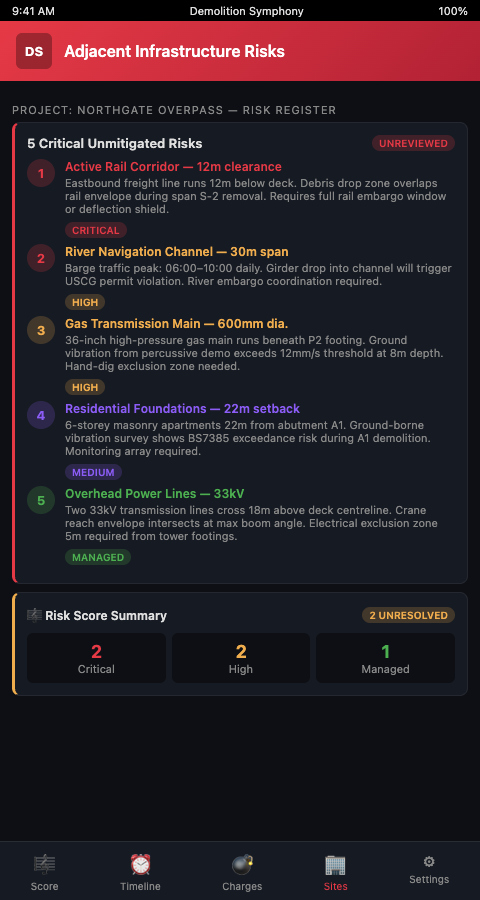
The five risk categories — utility strike, vibration damage, debris impact, rail disruption, and settlement — are not unpredictable events. They are foreseeable consequences of demolition activity in a constrained corridor, and they are manageable when they are written into the project plan before equipment arrives. The Demolition Symphony Planner makes each adjacency risk visible as a notation on the demolition score, giving project managers, structural engineers, and field supervisors a shared reference that reduces the gap between what the plan specifies and what the crew executes.
Bridge and overpass demolition teams working near rail lines, utilities, occupied buildings, or active waterways should assess all five risk categories before the first measure of their demolition score is written. Plan your adjacent infrastructure protection with the Demolition Symphony Planner and build every utility cue, vibration threshold, and debris exclusion zone into the same score that drives your structural sequence — so protective actions are never separated from the work that makes them necessary. Start your adjacent infrastructure risk assessment with the Demolition Symphony Planner and give your bridge and overpass demolition team a unified score where every proximity hazard is a notated constraint before the first cut is authorized.