Protecting Neighborhoods from Stadium Demolition Dust
The CDC/NIOSH silica research estimates that approximately 2.3 million US workers are exposed to crystalline silica dust each year — a number that includes demolition crews breaking concrete at stadium scale, where a single high-reach excavator can pulverize thousands of square feet of reinforced concrete in a single shift. At that production rate, uncontrolled silica dust becomes a neighborhood health event, not just an occupational hazard. The OSHA silica health effects documentation links chronic crystalline silica inhalation to silicosis, lung cancer, and kidney disease — conditions that develop over years of exposure and are irreversible by the time symptoms appear.
Stadium demolition dust control neighborhoods protection is a regulatory requirement, a public relations obligation, and a project risk management imperative simultaneously. A complaint-driven stop-work order from a municipal health authority can cost more in schedule delay than the entire dust suppression budget. Getting the dust plan right before concrete breaking begins is the lowest-cost risk mitigation available.
Why Generic Dust Suppression Fails at Stadium Scale
Venue teardown airborne particulate suppression fails when planners apply standard construction site dust control protocols — perimeter water misting and wheel wash — to a demolition operation that generates dust at an order of magnitude greater volume. A standard construction site adds dust primarily from earthwork and traffic. A stadium demolition site adds dust primarily from mechanical breaking of reinforced concrete at heights of 40–120 feet, where wind dispersion carries particulate far beyond the perimeter misting radius before suppression can occur.
Three factors make stadium concrete demolition dust mitigation uniquely demanding. First, the concrete volumes are enormous — a 60,000-seat stadium may contain 100,000 to 200,000 cubic yards of concrete, all of which generates silica-bearing dust when broken. Second, the breaking occurs at elevation, where wind speeds are higher and particulate disperses faster than at grade. Third, demolition site perimeter dust barriers that work for a 2-acre construction site are geometrically overwhelmed by a stadium footprint that may span 10–20 acres.
The PMC research on occupational silica exposures in demolition documents that measured dust concentrations at active breaking fronts regularly exceed OSHA's permissible exposure limit (PEL) of 50 micrograms per cubic meter — in some cases by a factor of 10 or more — when control measures are absent or inadequate. Effective dust management also requires integrating with the recycling-first planning framework from the start: wet suppression methods must be calibrated to the crusher's moisture tolerance so that dust control doesn't degrade the recycled aggregate quality downstream.
The Demolition Symphony Score for Dust Suppression
Demolition Symphony Planner treats dust suppression as a scored parallel track: every salvage window, recycling stream, and structural cut becomes musical notation on a visual demolition score, and dust control measures are notated as sustained chords that must be active throughout any measure containing concrete breaking activity. The score makes suppression coverage visible — if a demolition measure runs without a corresponding dust control measure, the system flags the gap.
The framework sequences dust suppression across four operational layers.
Layer 1 — Source Suppression at the Break Point. Atomized misting cannons are positioned within 20 feet of the active breaking front for every high-reach excavator operation. BossTek's demolition dust control documentation establishes that 50–200 micron droplet size optimizes particulate capture — large enough to carry dust to ground, small enough to remain airborne long enough to intercept fine silica particles before they escape the immediate break zone. Demolition Symphony Planner assigns misting cannon positions as score notations that advance with the breaking front as the demolition sequence progresses through each structural bay.
Layer 2 — Mid-Zone Suppression Curtain. Between the breaking front and the site perimeter, a secondary suppression curtain addresses the particulate that escapes source suppression. On a stadium site, this typically requires a ring of oscillating misting units positioned at 30–40% of the distance between breaking front and fence line. The OSHA control of silica in construction publication recommends wet methods at all stages of concrete breaking as the primary engineering control; the mid-zone curtain operationalizes that recommendation at the scale of a multi-acre site.
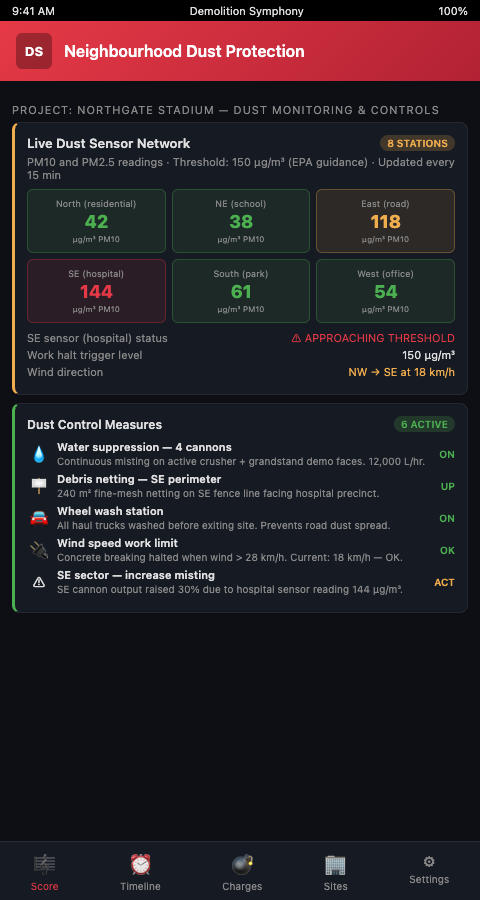
Layer 3 — Perimeter Monitoring. Demolition site perimeter dust barrier effectiveness is verified in real time rather than assumed. Particulate monitors at the site boundary feed readings to the project dashboard every 15 minutes. When a monitor exceeds a pre-set threshold — typically set at 50% of the OSHA PEL to provide action lead time — Demolition Symphony Planner escalates to increased source suppression deployment before the community-facing fence line is breached.
Layer 4 — Wind-Responsive Sequencing. The silica dust management demolition site plan includes wind-triggered hold conditions: when sustained winds exceed 15 mph from a direction that blows breaking-front particulate toward residential zones, breaking operations in the upwind section are halted until wind conditions change. The score displays wind holds as rests in the affected zone measures, keeping the rest of the site productive while the highest-risk operation pauses.
Advanced Tactics for Urban Venue Dust Control
Three advanced tactics address the scenarios that standard dust planning underestimates on urban stadium sites.
Coordinate dust suppression windows with the noise abatement scheduling plan. The highest-dust activity — mechanical concrete breaking — is also the highest-noise activity. Scheduling dust-intensive breaking phases during daylight hours when neighbors are less likely to be outdoors, and coordinating those windows with the noise ordinance schedule, concentrates the community impact into the smallest number of hours and demonstrates regulatory good faith to permit authorities.
Integrate dust control into the recycling-first planning framework. Wet suppression methods that are appropriate for dust control add moisture to concrete rubble that must subsequently be crushed and sorted. Coordinating suppression intensity with the on-site crusher's moisture tolerance prevents the situation where dust control measures wet the concrete so thoroughly that it clogs screening equipment. The demolition score cross-references suppression water volume with the crusher's operating parameters, adjusting suppression intensity in the final breaking passes before material reaches the crushing circuit.
Apply the dust cloud propagation modeling approach from implosion planning. Urban highrise implosion teams model dust cloud propagation before a blast event to predict where particulate will travel and at what concentration. The same modeling approach — adapted for continuous rather than instantaneous particulate release — provides stadium demolition planners with neighborhood-level impact predictions that inform both suppression system placement and the community notification schedule. BossTek's military demolition case study demonstrates that projects that model particulate dispersion before breaking begins consistently achieve lower boundary concentrations than projects that design suppression systems reactively.
Protecting the Neighborhood and the Project
Stadium demolition dust control neighborhoods protection is not optional — OSHA enforcement, state environmental agencies, and municipal health authorities all have jurisdiction over demolition particulate, and enforcement actions on large public projects attract media attention that amplifies community concerns. The PMC occupational silica research documents that even well-run demolition sites generate exposures that exceed health-based thresholds when suppression systems are sized for construction rather than demolition.
Demolition Symphony Planner exports a dust management plan that documents every suppression layer, every monitor position, every wind hold condition, and every coordination point with the noise abatement schedule. Permit authorities receive a plan that demonstrates engineering rigor. Community liaisons receive a summary that explains the control system in plain language. Crews receive shift-specific suppression deployment instructions tied to the day's breaking sequence. Score Your Stadium Teardown with Demolition Symphony Planner and build the dust suppression architecture into the demolition score before the first concrete breaks. Get started with a neighborhood dust management plan that layers suppression systems, boundary monitoring, and wind-hold protocols into every phase of the concrete demolition sequence.