Building a Recycling-First Demolition Plan for Concrete Stadiums
The construction and demolition waste management market is growing at a 5.69% compound annual rate (GlobeNewswire, 2024), driven in part by regulatory pressure and in part by the simple economics of aggregate supply: in dense urban markets where large stadiums are typically sited, crushed concrete reuse is a more cost-effective aggregate source than quarried virgin material transported from outside the region. A concrete stadium generates an enormous volume of the right feedstock — but only if the demolition plan is structured to capture it.
The EPA's sustainable management framework for C&D materials confirms that concrete constitutes the largest single material stream in stadium demolition by weight, and ScienceDirect research on recycled aggregate quality documents that structural concrete recycling achieves 30–50% substitution rates in new construction — provided the source material is not contaminated with rebar, coatings, or mixed waste during demolition. A recycling-first concrete stadium demolition plan is the operational document that determines whether those substitution rates are achieved or abandoned in favor of landfill disposal under schedule pressure.
What Recycling-First Actually Means in Concrete Demolition Sequencing
A recycling-first approach to stadium concrete waste reduction is not a policy statement — it is a demolition sequencing constraint that shapes every equipment selection and phase timing decision in the concrete demolition plan. It means that the demolition sequence is organized around the requirements of the downstream concrete recycling workflow rather than around the sequence that minimizes crane picks or equipment repositioning time.
In practice, that means three specific sequencing requirements. First, embedded steel must be removed before mechanical concrete demolition begins in each bay — rebar extraction before hydraulic breaking keeps the concrete stream clean and maximizes aggregate value. Second, surface coatings, waterproofing membranes, and architectural finishes must be stripped before structural concrete is demolished — coating contamination in recycled aggregate reduces its value and may disqualify it for structural applications. Third, concrete demolition phases must be sized to match confirmed recycler intake capacity rather than to maximize daily tonnage output — a crusher that receives contaminated or oversized loads rejects material that could otherwise have been processed.
King County's demolition diversion planning guidance formalizes this as a pre-demolition recycling plan requirement: the recycler's specifications for acceptable feedstock must be obtained before demolition begins, and the demolition sequence must be designed to produce material that meets those specifications.
Building the Concrete Deconstruction Recycling Strategy
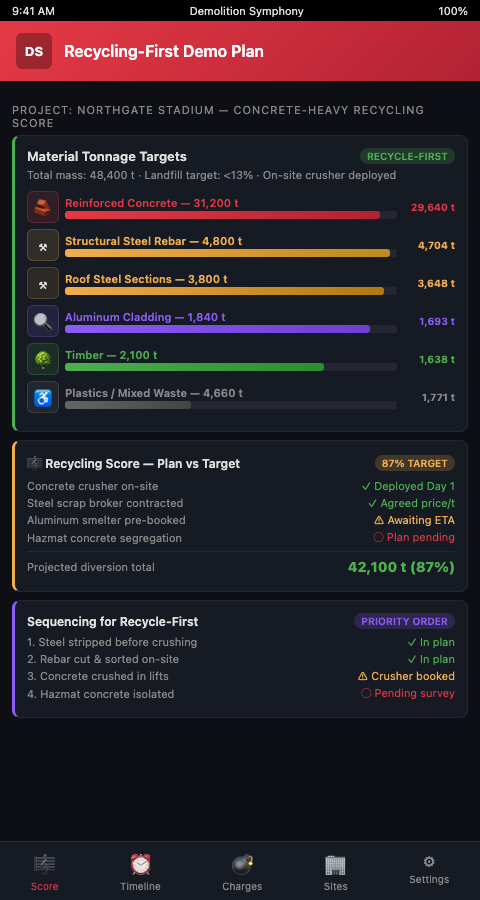
Demolition Symphony Planner structures the concrete deconstruction recycling strategy around four scored movements that correspond to the four phases of a recycling-first concrete demolition.
Movement 1 — Pre-phase preparation. For each demolition zone, the concrete recycling preparation sequence is scored before any structural demolition begins: surface coating removal, embedded MEP system extraction, and rebar exposure assessment. The system flags any zone where pre-phase preparation is incomplete, preventing structural demolition from advancing until the feedstock quality conditions are met.
Movement 2 — Controlled demolition sizing. The green demolition planning concrete venues approach specifies maximum demolition fragment size for each concrete element type, keyed to the crusher inlet dimensions of the contracted recycling processor. Demolition Symphony Planner logs the fragment size specification for each zone and includes it in the equipment operator's phase work order — preventing the field decision to "break it however it comes" that produces oversized fragments that require secondary processing.
Movement 3 — Sorted accumulation. Crushed concrete reuse stadium site logistics require that demolished concrete accumulates in designated sorted zones — separated from rebar bundles, coating waste, and mixed demolition debris. The score notation system flags any accumulation zone that has reached capacity before the recycler transport is confirmed, pausing demolition in that zone to prevent material commingling.
Movement 4 — Verified transport and diversion documentation. Each recycler pickup is logged against the zone that generated the material, building a phase-level diversion record that demonstrates compliance with LEED v4.1 waste management credits and sustainability reporting requirements. The USGBC's LEED v4.1 waste management framework specifies documentation standards that require material-type-specific diversion records — Demolition Symphony Planner's logging system generates this documentation automatically from transport verification data. USGS research confirms that recycled concrete aggregate produces eight times less CO2 than virgin quarry aggregate, giving projects that achieve LEED diversion documentation both a compliance and a carbon-reduction story to tell.
Connecting Recycling-First to the Broader Material Recovery Plan
A recycling-first concrete demolition plan does not exist in isolation — it is one track in the full material recovery score for the stadium teardown. The material recycling workflow plan coordinates concrete logistics with steel, aluminum, and specialty material streams. The material recovery rates module provides the tonnage forecasts that size the accumulation zones and confirm recycler capacity requirements before each phase begins.
Wikipedia's concrete recycling documentation notes that crushed concrete is used in road base, drainage aggregate, and new concrete production — applications with different quality specifications. Demolition Symphony Planner's recycler capacity module distinguishes between these application tiers and routes material to the highest-value application for which it qualifies, maximizing net recovery value rather than treating all recycled concrete as equivalent.
Advanced Tactics for Green Demolition Planning at Concrete Venues
Pre-demolition core sampling. ScienceDirect research on recycled aggregate quality (2022) documents how aggregate properties vary significantly across different pours within the same stadium — field-level concrete placed in the 1960s has different characteristics than bowl concrete placed during 1990s renovations. Pre-demolition core sampling maps these quality variations, allowing the recycling plan to route different concrete zones to the appropriate application tier before demolition begins.
On-site primary crushing. For large-volume concrete demolition, on-site primary crushing before transport reduces haul truck trips by a factor of three to five compared to transporting unprocessed fragments. The logistics economics shift significantly when on-site crushing is incorporated — the capital cost of crusher mobilization is recovered within the first few phases for any project generating more than 20,000 tons of concrete. Demolition Symphony Planner's phase logistics module includes crusher mobilization as a scored pre-phase event, ensuring the equipment is in position before the demolition volume that justifies it begins.
Cross-project coordination with debris footprint planning. Stadium sites in dense urban contexts must manage recycled concrete logistics within a constrained footprint — the same constraint that governs implosion debris management in high-rise demolition. Debris footprint prediction methodology developed for urban implosion projects applies directly to stadium concrete accumulation zone planning: the footprint available for sorted concrete stockpiles is finite, and the demolition sequence must be designed so that transport clears material before the next phase generates more.
Recycling as Structural Engineering
The highest-performing concrete recycling operations treat recycling logistics with the same rigor as structural engineering: specifications are documented, tolerances are defined, verification is required before advancement. Demolition Symphony Planner applies this discipline to recycling-first concrete stadium demolition planning, building a scored recycling workflow that is as precise as the structural removal sequence it runs alongside. That precision matters financially: a green demolition planning concrete venues approach that achieves LEED diversion thresholds and produces market-grade recycled aggregate creates a demonstrable return that the project owner can quantify against the incremental cost of the scoring discipline — making the case for recycling-first not as an environmental policy but as a project economics decision.
The concrete deconstruction recycling strategy, when executed as a scored operational track rather than a goodwill effort, consistently outperforms ad-hoc approaches on both diversion rate and net material value. Score Your Stadium Teardown with Demolition Symphony Planner and turn your stadium's concrete mass into a clean, documented, high-value aggregate stream rather than a landfill burden. Get started with a recycling-first demolition sequence that locks fragment size specifications, sorted accumulation zone assignments, and recycler capacity bookings into the score before the first bay is broken.