How to Estimate Material Recovery Rates for Large Venues
A 2020 study published in Frontiers in Built Environment identified a persistent problem in construction and demolition data: publicly reported diversion rates at project completion often bear little relationship to the material quantities actually diverted during the project, because documentation systems weren't designed to capture the data needed to verify the claims. For stadium and arena demolition specialists, that documentation gap has direct financial consequences: unverified diversion rates generate compliance risk on LEED-certified projects, create liability exposure under sustainability-linked contract provisions, and — most practically — prevent project owners from accurately forecasting the revenue contribution from salvage and recycling against demolition cost.
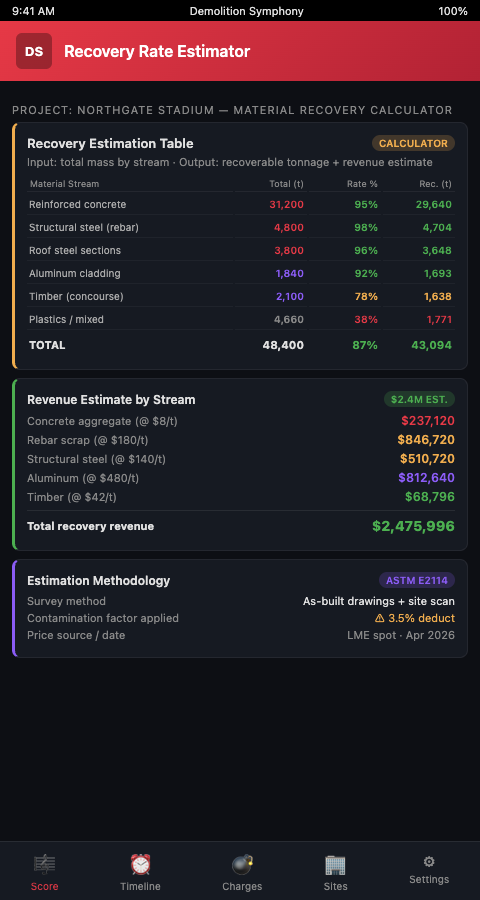
Material recovery rate estimation for large venues requires a methodology that produces defensible, verifiable tonnage forecasts before demolition begins and tracks actual recovery against those forecasts in real time. Demolition Symphony Planner integrates this estimation framework into the demolition score, treating arena material yield forecasting as a financial planning function that informs every phase decision from salvage crew allocation to recycler capacity booking.
The Estimation Framework: Four Input Variables
Accurate stadium demolition diversion rate calculation requires four input variables that most waste audits capture at insufficient resolution for large-venue projects.
Gross material tonnage by type. A stadium's structural drawings, renovation records, and as-built surveys provide the data needed to estimate gross material quantities by category: structural steel, rebar, concrete, aluminum cladding, glass, copper MEP, specialty materials. The EPA's 2003 study on estimating building-related C&D material amounts provides the baseline factors for converting structural quantities to material weight estimates — factors that Demolition Symphony Planner applies by structural system type to generate zone-level tonnage estimates from the demolition zone map.
Condition-adjusted recovery factor by material. Not all structural steel in a 40-year-old stadium is recoverable at the same rate as new-generation structural steel. Corrosion, fatigue, and connection damage reduce the proportion of material that meets the quality threshold for reuse or recycling. The MSU cost prediction model for deconstruction documents how condition-adjusted recovery factors differ systematically by material age, exposure, and structural role. Demolition Symphony Planner applies material-specific condition assessment factors during the pre-demolition waste audit, generating a condition-adjusted recovery estimate rather than a theoretical maximum.
Extraction method and contamination rate. SteelConstruction.info's 96% recovery rate for steel assumes clean extraction — torch cutting of structural members with rebar and attachments removed before processing. Mixed demolition that shreds steel-reinforced concrete and separates materials at a downstream facility recovers significantly less than 96%, at significantly higher processing cost. The demolition tonnage recovery planning framework in Demolition Symphony Planner pairs each material category with an extraction method and applies the contamination penalty that the method produces, generating a net recovery estimate that reflects actual field conditions rather than best-case assumptions.
Market availability for recovered material. PMC circular economy C&D research documents how regional market capacity for recovered materials varies significantly by material type and project location — recycled concrete aggregate commands a higher price in aggregate-scarce urban markets than in regions with abundant quarry supply. Demolition Symphony Planner's material recovery module incorporates regional market data to generate a net financial recovery estimate alongside the tonnage forecast, enabling project owners to evaluate the salvage investment against the revenue projection for each material stream. This market-integrated forecast also enables the team to time material releases — holding sorted steel until market pricing improves, or confirming concrete aggregate buyers before the demolition phase that generates the volume — rather than accepting spot prices under schedule pressure at the end of a project.
Integrating the Estimate Into the Demolition Score
Arena material yield forecasting only improves project decisions if the forecast is integrated into the demolition score rather than documented in a standalone report that nobody consults after pre-construction planning. Demolition Symphony Planner embeds the tonnage forecast for each zone into the phase plan: before each phase begins, the system displays the projected material yield, the confirmed recycler capacity, and the gap between them — prompting logistics adjustment before the phase produces more material than the recovery system can process.
The material recycling workflow module uses the zone-level tonnage forecast to size accumulation zones and schedule transport, ensuring that recycler bookings are confirmed before demolition phases generate the material they are designed to handle. The salvageable component mapping audit provides the component-level detail that refines the aggregate tonnage forecast — distinguishing between material that will be reused at full structural value and material that will be recycled at commodity value, a distinction that significantly affects the financial forecast.
Advanced Tactics for Demolition Tonnage Recovery Planning
Phase-level forecast variance tracking. Rather than evaluating material recovery performance only at project completion, advanced teams track forecast-versus-actual variance by phase, identifying recovery shortfalls in real time and adjusting sorting protocols or extraction methods before the next phase begins. Demolition Symphony Planner displays phase-level variance on the project dashboard, converting a lagging completion metric into a leading operational signal.
Ellen MacArthur Foundation commercial deconstruction benchmarks. The Ellen MacArthur Foundation's commercial deconstruction and reuse acceleration research provides material-type recovery benchmarks from high-performing deconstruction projects — benchmarks that Demolition Symphony Planner uses to set recovery targets for each material stream. Projects that track against these benchmarks can demonstrate to project owners and permit authorities that their recovery planning is calibrated against the best-performing comparable projects, not against self-set targets with no external reference.
Cross-project learning from industrial teardown order planning. The building teardown order methodology developed for multi-building industrial decommissioning projects includes material recovery sequencing frameworks that determine which buildings are demolished first based on the material streams they generate and their compatibility with the recovery logistics established for the overall project. Applied to stadium demolition, this logic suggests that sections with the highest-value, cleanest material streams should be sequenced early — while the recovery logistics infrastructure is fresh and crews are sharpest — rather than left to the end when schedule pressure typically degrades sorting discipline.
Recovery Rate as a Project Financial Metric
The Ellen MacArthur Foundation research documents that commercial deconstruction projects with systematic recovery rate estimation and tracking outperform those without it on net material value recovered — not marginally, but by factors that affect project profitability. A stadium teardown that treats material recovery rate estimation as a serious financial planning discipline — with phase-level variance tracking and market-calibrated benchmarks — rather than a sustainability reporting exercise, generates demonstrably better financial outcomes. The distinction matters contractually as well: waste audit pre-demolition stadium documentation that quantifies expected diversion by phase gives project owners a defensible basis for sustainability-linked contract incentives, creating alignment between the recovery forecast and the financial structure of the demolition contract itself.
Demolition Symphony Planner integrates stadium demolition diversion rate calculation into the project's financial dashboard from day one of planning — making arena material yield forecasting a driver of phase sequencing decisions rather than a post-project accounting exercise. The material recovery rate estimation large venue discipline embedded in the platform connects the waste audit pre-demolition stadium findings directly to the financial forecast, so project owners can evaluate recovery investment decisions against projected revenue in the same interface where structural phases are sequenced. Score Your Stadium Teardown with Demolition Symphony Planner and build a material recovery estimation framework that turns your demolition tonnage into a tracked financial asset, not a landfill liability. Get started with a phase-level diversion forecast that integrates material yield projections into your project budget before contract award.