How to Prioritize Building-by-Building Teardown Order
The DOE's Portsmouth Gaseous Diffusion Plant decommissioning program involves 415 facilities requiring sequenced teardown—one of the most complex multi-building decommissioning sequences ever managed in the United States. The sequencing decisions at Portsmouth took years of engineering analysis, regulatory coordination, and contractor planning before the first structure came down. The lesson is not that every industrial campus decommissioning requires that level of effort, but that the building teardown order is a technical decision with cascading consequences—not a scheduling convenience.
On a 20-building industrial campus, the choice of which building to demolish first determines which crane paths are available, which haul routes remain open, which hazmat abatement crews can mobilize next, and which structural systems remain in place to support adjacent buildings. A wrong sequencing decision does not just affect the first building—it propagates through the entire industrial campus demolition sequencing plan.
The U.S. demolition and wrecking market is valued at $9.8 billion, with multi-building industrial campus teardown representing a significant and growing share. The project teams that complete these projects on schedule and within budget are the ones that treat building teardown order as an engineering decision, not a default.
The Four Prioritization Criteria
Building demolition order on an industrial site is determined by four criteria that must be evaluated together, not independently:
Criterion 1: Hazmat abatement completion sequence. Buildings where abatement can begin earliest—because survey results are available, regulatory notifications have been submitted, and abatement contractors are qualified for the specific materials—should be prioritized for early demolition. Demolition cannot begin until abatement clears, and abatement has a fixed minimum duration. Buildings on the critical path from a hazmat standpoint are the buildings that should enter the demolition sequence first.
Criterion 2: Structural interdependency. Buildings that provide lateral support to adjacent structures, share utility trenches or process bridges, or contain structural elements that pass through building boundaries cannot be demolished until those interdependencies are resolved. OSHA 1926.850 requires that a structural engineer assess each building before demolition to identify load-bearing relationships and hazardous conditions. That assessment must map interdependencies between buildings, not just within them.
Criterion 3: Logistics corridor preservation. Buildings that contain primary crane pads, haul route segments, or decontamination station locations must remain standing until the buildings they serve have been demolished. Demolishing a logistics-critical building early to simplify hazmat sequencing may lock out crane access to three other buildings. The Alpine Demolition engineered demo plan guide identifies logistics infrastructure as the most frequently underplanned element of building teardown priority decisions.
Criterion 4: Owner redevelopment timeline. Some buildings on the campus may be targeted for earlier site preparation because they occupy land needed for new construction or environmental remediation. Owner-driven priority buildings must be flagged in the demolition sequence, and their sequencing must be reconciled with the technical constraints from Criteria 1–3. Owner priority does not override structural interdependency or hazmat completion requirements—but it does influence which technically feasible sequence is selected.
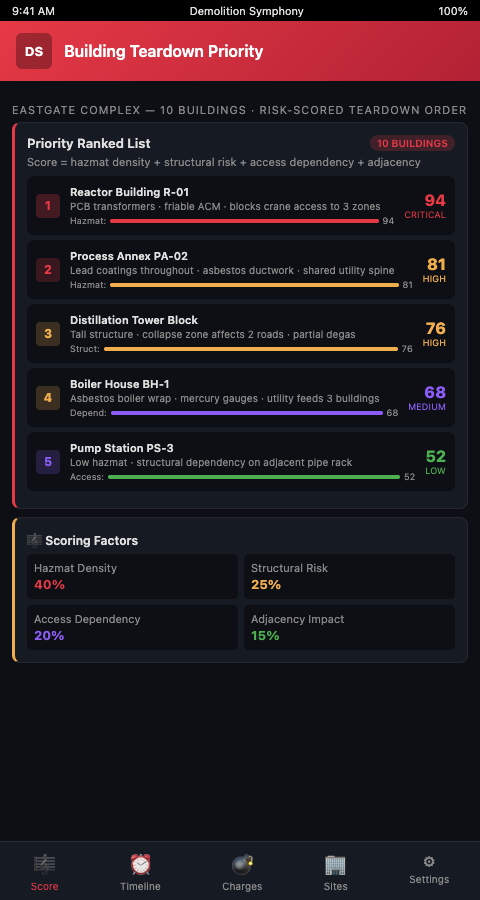
Constructing the Priority Matrix in Demolition Symphony Planner
Demolition Symphony Planner generates the building teardown priority order through a weighted priority matrix. Each building is scored on all four criteria, and the aggregate score determines its position in the multi-building decommissioning priority sequence.
The matrix is not fully automated—it requires engineering input to assess structural interdependencies and hazmat survey completeness per building. But once that data is entered, Demolition Symphony Planner generates the sequencing recommendation automatically and displays it as a numbered overlay on the campus map. Project managers can adjust weightings for specific project priorities (e.g., increase the owner timeline weight when a key building needs to clear first) and see how the sequence changes.
Buildings & Cities research on demolition versus retention decisions notes that demolition sequencing decisions are increasingly subject to sustainability scrutiny: which buildings contain salvageable materials, which have reuse potential, and which demolition sequences minimize embodied carbon waste. Those factors can appear in Demolition Symphony Planner as a fifth scoring dimension for projects where sustainability targets are an owner requirement.
The NYC Buildings demolition plan requirements provide a jurisdictional example of how building-specific demolition plans are reviewed: each building must have a separate engineered demolition plan, and the plans for adjacent buildings must demonstrate that the demolition sequence is safe for both structures simultaneously. On multi-building campuses, this creates a plan submission sequence that mirrors the demolition sequence—the plan for Building A must be approved before the plan for Building B (which depends on A being demolished first) can be filed.
For the upstream connection, decommissioning scoring for chemical processing facilities provides the per-building complexity scores that feed directly into the priority matrix—a building with a high complexity score may need to be sequenced later despite high contamination priority, because its extraction and structural complexity make an early start logistically impractical.
Advanced Sequencing: Managing the Demolition Front
On large industrial campuses, the building teardown order creates a "demolition front"—the advancing edge of cleared land as buildings come down. Managing that front is a facility teardown order optimization problem: the front should advance in a direction that continuously opens new crane access, haul routes, and staging areas, rather than creating isolated cleared areas that are inaccessible from the active demolition zone.
The demolition front should advance away from the primary site access point, so that haul trucks always have an unobstructed exit route. It should also advance in a direction that maintains the largest possible cleared zone adjacent to the active demolition buildings—this cleared zone is where crane equipment, debris processing, and temporary decontamination facilities are located.
Zone-based decommissioning workflow planning provides the framework for managing the internal zone sequence within each building as the demolition front advances—the zone-based system and the building priority matrix are the two levels of the same sequencing hierarchy.
For cross-niche comparison, the span removal order in bridge demolition follows identical prioritization logic: structural interdependency, logistics corridor preservation, and regulatory completion sequence determine which span comes down first—the same four-criteria framework applied to a linear structure rather than a campus.
The EPA Brownfields program requirements for 450,000 properties underscore the long-term consequence of building priority decisions: the sequence in which buildings are demolished determines which portions of the site are available for environmental assessment and remediation first, which affects when the full site achieves regulatory clearance and when redevelopment can begin.
Building Priority Decision Checklist
Before finalizing the multi-building demolition priority sequence in Demolition Symphony Planner, confirm each input below is current. Missing any of these creates a priority conflict that surfaces during active demolition — when the cost of resequencing is measured in contractor standby charges and schedule recovery events rather than planning hours.
- Hazmat survey complete for all buildings; completion timeline per building entered in priority matrix
- Structural interdependency assessment complete; shared structural elements and process bridges mapped
- Logistics infrastructure buildings identified; crane pad and haul route dependency chains traced
- Owner redevelopment priorities entered with specific deadline constraints where applicable
- Demolition front advancement direction confirmed; cleared zone progression analyzed for haul route continuity
- Per-building demolition plans submitted or on submission schedule aligned with the priority sequence
- Adjacent building demolition plan compatibility confirmed by structural engineer for each sequenced pair
Updating Priority as Conditions Change
Building teardown priority is not a fixed document set at project inception. Field conditions—unexpected structural deterioration, additional ACM discovered during abatement, buyer timeline changes for resalable equipment—routinely require priority adjustments after the project is underway. The priority matrix must be a living document in Demolition Symphony Planner, updated when conditions change and reviewed weekly against the actual project state.
When a priority adjustment is made—for example, moving Building K from fourth to second in the sequence because a structural engineer has determined that it must be demolished before Building L can safely proceed—Demolition Symphony Planner propagates the change through the full sequence. Buildings affected by the change see their estimated start dates update automatically, shared resource conflicts created by the resequencing are flagged, and contractors with work in the resequenced buildings receive schedule update notifications.
This dynamic priority management capability is what separates a decommissioning orchestration tool from a static project plan. On projects that last 18–36 months, the conditions at project inception are never the conditions at project completion. A priority matrix that cannot be updated without rebuilding the entire schedule is not a management tool—it is a historical record.
The facility teardown order optimization that Demolition Symphony Planner provides is iterative, not one-time. Project managers who review and update the priority matrix at each project milestone—after major abatement completions, after equipment extraction phases, after structural milestones—maintain a schedule that reflects reality rather than original assumptions.
A monthly priority matrix review adds approximately two hours to the project manager's workload but prevents the multi-week schedule recovery events that result from discovering a sequencing conflict after it has already affected field operations. On a $20M industrial campus demolition, a two-week schedule recovery event typically costs $200,000–$400,000 in additional contractor standby, equipment mobilization, and abatement re-sequencing. The monthly review is not overhead—it is insurance.
Demolition Symphony Planner makes the priority matrix review operationally simple: the review interface shows the current priority ranking, the conditions on which each ranking is based, and any field updates since the last review that may affect the ranking. Project managers can complete the review and generate a revised priority schedule in a single session, with all affected contractors notified automatically.
Set your teardown sequence before the first crane arrives. Load your campus layout and building assessment data into Demolition Symphony Planner and generate the priority-weighted building demolition order with sequencing rationale for every stakeholder review. Start your building priority matrix today and get the hazmat-weighted, logistics-verified teardown order before your first structural contractor mobilizes.