Building a Decommissioning Score for Chemical Processing Facilities
CE Interim's chemical plant shutdown analysis found that chemical plant decommissioning projects routinely underestimate complexity by 30–50% when they use a simplified project management approach rather than a systematic readiness assessment. Chemical processing facilities are categorically different from general industrial plants: process vessels may contain residual reactive chemicals, utility systems are deeply interdependent, and the hazmat density per square foot is typically 3–5 times higher than a manufacturing facility of equivalent size.
The industrial demolition service market is valued at $10.5 billion and growing, driven in part by aging chemical processing infrastructure across the United States and Europe. That growth has not been matched by commensurate improvement in decommissioning readiness practices—most projects still rely on experienced project managers to intuit complexity rather than on systematic scoring frameworks that make complexity explicit.
A decommissioning score for a chemical processing facility translates the qualitative judgment of experienced practitioners into a quantitative readiness assessment that can be communicated to owners, regulators, insurance underwriters, and contractors. The score does not replace engineering judgment. It structures it.
The Five Scoring Dimensions
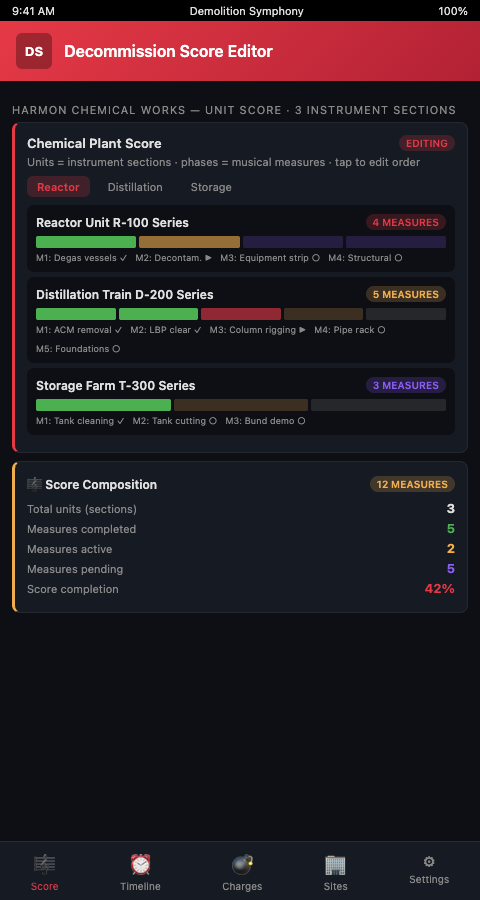
Demolition Symphony Planner uses five dimensions to generate a chemical plant teardown complexity score. Each dimension is scored on a 1–5 scale, and the aggregate score determines the recommended sequencing approach and minimum buffer durations between phases.
Dimension 1: Hazmat density. The number of distinct regulated material types present, weighted by quantity and location. A facility with asbestos pipe insulation only scores a 1. A facility with asbestos, PCBs in transformers, lead-based paint, mercury in instruments, residual process chemicals in vessels, and contaminated soil under the slab scores a 5. Higher hazmat density scores require more abatement voices on the score and longer sequencing lead times.
Dimension 2: Equipment extraction complexity. Determined by the weight and dimensions of the largest equipment, the number of crane-dependent extractions, confined space access requirements, and the percentage of equipment requiring pre-extraction hazmat abatement. A facility where equipment can be forklift-extracted through standard doorways scores a 1. A facility where 20-ton reactors require wall openings and overhead crane rail installation scores a 5.
Dimension 3: Structural interdependency. The degree to which demolishing one structural element removes support from adjacent elements. A simple box-frame building scores a 1. A facility with process bridges, shared utility trenches, and structural elements that cross building boundaries scores a 5. The IAEA Safety Assessment for Decommissioning uses structural interdependency as a primary complexity indicator for nuclear facility decommissioning—the same logic applies to chemical processing facilities.
Dimension 4: Regulatory lead time. The aggregate notification, permitting, and agency approval lead time before any work can begin. A facility in a jurisdiction with a standard 10-day NESHAP notification scores a 2. A facility requiring air quality permits, state brownfield approval, EPA PCB facility approval, and multiple agency coordination meetings scores a 5. Regulatory lead times are mandatory rests in the score that cannot be compressed regardless of schedule pressure.
Dimension 5: Site access constraints. Limitations on crane path, haul route, and debris staging that affect the sequencing of work. An open-campus facility with multiple access points scores a 1. A facility in an urban industrial corridor with a single access road, utility easements, and adjacent active operations scores a 5.
How the Score Drives Sequencing Decisions
A low aggregate score (5–10) permits an accelerated sequencing approach with shorter buffer durations between phases and parallel phasing across multiple buildings. A high aggregate score (20–25) requires extended buffer durations, more conservative spatial separation between concurrent activities, and additional contractor coordination checkpoints in the schedule.
ScienceDirect research on risk assessment methods in industrial decommissioning identifies that quantified risk scoring improves schedule accuracy by giving project managers a structured basis for contingency buffer sizing. Projects that sized buffers based on complexity scores rather than historical averages had 40% lower schedule overrun rates.
The IAEA prioritization methodology for decommissioning nuclear facilities provides a parallel framework for high-complexity facilities, including the use of interdependency matrices to identify which buildings or systems must be cleared before adjacent work can begin. Demolition Symphony Planner adapts this interdependency matrix concept for chemical processing facility teardown: each scored building generates dependency relationships to adjacent buildings, and the aggregate dependency graph determines the optimal building-by-building sequencing order.
For plant decommissioning readiness assessment, the Chemical Processing safety decommissioning guide recommends completing the readiness assessment before engaging contractors, so that the complexity score informs contractor selection and contract scope rather than being discovered during mobilization.
The connection to zone-based planning is direct: for zone-based decommissioning workflow planning, each zone's complexity score determines its minimum phase durations and buffer requirements—a zone with a high hazmat density and equipment complexity score gets longer mandatory rest bars than a low-complexity zone.
The OSTI Systematic Approach to Chemical Processing Decommissioning
An OSTI systematic approach to industrial decommissioning developed for DOE facilities emphasizes that the readiness assessment must be updated continuously throughout the project, not just performed once at the outset. As abatement progresses and structural conditions are revealed, the complexity score for individual zones may change—a floor slab that was rated low complexity may contain embedded asbestos-containing pipe insulation that was not visible in the pre-demolition survey.
Demolition Symphony Planner supports dynamic score updates: when field conditions reveal new complexity factors (additional ACM, structural deterioration, unexpected equipment), the affected zone's score is updated and the phase schedule adjusts automatically to reflect the revised buffer and sequencing requirements.
For cross-niche comparison, the beginner's guide to implosion scoring provides a parallel introduction to complexity scoring in a very different demolition context—the scoring dimensions differ (structural analysis replaces hazmat density) but the underlying logic is the same: quantify what makes this project complex before building the schedule, so the schedule reflects reality rather than optimism.
The multi-phase industrial plant decommissioning planning framework sits downstream of the complexity score: once the score is complete, it feeds directly into the phase boundary design and buffer duration assignments for the full project schedule.
Scoring Your Chemical Processing Facility in Demolition Symphony Planner
To generate a chemical processing demolition sequencing plan:
- Enter the facility's hazmat survey results to populate Dimension 1 scores per building
- Load the equipment catalogue to populate Dimension 2 scores per building
- Upload structural drawings and enter shared-element relationships to populate Dimension 3
- Enter regulatory notification and permit requirements per jurisdiction to populate Dimension 4
- Map site access constraints and haul route limitations to populate Dimension 5
- Review the aggregate score by building and zone; confirm phase buffer durations and sequencing approach
- Generate the full score with phase voice assignments, buffer bars, and contractor access windows
The industrial facility decommissioning risk score that results from this process is not just a planning tool. It is a communication document that owners, regulators, and insurers can review to understand why the decommissioning schedule is structured as it is—and what the consequences of schedule compression would be.
Using the Score to Communicate with Non-Technical Stakeholders
Chemical plant teardown complexity scoring serves a communication function that is as important as its planning function. Owners, boards, and insurance underwriters frequently push back on decommissioning timelines that appear longer than their expectations. A complexity score gives the project team a structured, defensible basis for explaining why a 30-month schedule is appropriate for a specific facility—and why a 12-month schedule would create regulatory and safety risks that cost more than the time saved.
Demolition Symphony Planner generates a complexity score summary report that translates the five-dimension score into plain language: this facility has a high hazmat density because of X materials in Y locations; abatement of those materials requires Z months of regulatory notification, work, and clearance; compressing that timeline below the minimum required by 40 CFR Part 61 would constitute a regulatory violation. That report format serves non-technical decision-makers who need to approve the schedule before work begins.
The plant decommissioning readiness assessment process also surfaces decisions that owners may not have considered. A chemical processing facility with residual process chemicals in vessels may require neutralization and purging before abatement can begin—an activity that adds weeks to the front of the schedule and requires its own regulatory notification in some jurisdictions. The readiness assessment makes these preliminary steps visible before the project budget and timeline are committed.
Demolition Symphony Planner scores these preliminary activities as Dimension 6 items (pre-decommissioning readiness tasks) that appear at the front of the project schedule as mandatory predecessors to all other work. Owners who understand why those tasks exist—and what happens if they are skipped—are far more likely to approve realistic timelines than owners who receive a schedule with unexplained lag at the beginning.
Score your facility before your first contractor meeting. Load your survey data, equipment catalogue, and site constraints into Demolition Symphony Planner and generate the complexity-weighted decommissioning score that drives every sequencing decision downstream. Start your readiness assessment today and get a defensible complexity score before your first contractor or owner meeting.