Introduction to Zone-Based Decommissioning Workflow Planning
An industrial plant decommissioning project that spans 50 buildings and 200 acres cannot be managed as a single work sequence. The physical scale, the variation in hazmat content across buildings, and the interdependencies between equipment extraction, abatement, and structural demolition make site-wide scheduling impractical. Zone-based decommissioning workflow planning solves this by dividing the site into discrete work theaters—each with its own phase state, contamination status, and access rules—that can be managed independently while remaining synchronized on a shared visual score.
The EPA estimates 450,000 brownfield properties await remediation or redevelopment across the United States. Many of those properties are former industrial sites where decommissioning was either incomplete or poorly documented, leaving contamination zones unmarked and demolition debris mixed with hazardous waste. Zone-based workflow planning prevents that outcome by making decontamination zone isolation a formal sequencing step rather than an informal assumption.
Zone-based approaches are embedded in regulatory frameworks. OSHA's HAZWOPER standards require formal exclusion zones, contamination reduction zones, and support zones on hazardous waste sites. EPA safety zone guidance defines the physical and procedural requirements for each zone type. Demolition Symphony Planner maps these regulatory zone categories onto the facility layout and links them to the decommissioning phase schedule.
Zone Classification: The Foundation of the Score
Before any zone enters the decommissioning schedule, it must be classified. Demolition Symphony Planner uses a four-class zone taxonomy adapted from the regulatory frameworks:
Class 1: Hot Zone. Active abatement in progress. Negative pressure containment active. Entry restricted to abatement crew in full PPE. No other work activities permitted. This zone's staff line in the score shows only the abatement voice—all other voices are silenced.
Class 2: Warm Zone. Abatement complete, awaiting air monitoring clearance. Decontamination corridor still active. Demolition and extraction crews may stage equipment at zone boundary but cannot enter the zone. The contamination buffer rest bar is active on this zone's staff line.
Class 3: Active Demolition Zone. Air monitoring clearance confirmed. Structural demolition or equipment extraction underway. Adjacent zones may not perform any activity that disturbs the active demolition zone boundary (new openings, vibration-generating work) without a zone boundary conflict assessment.
Class 4: Cleared Zone. All planned work complete. Air monitoring confirms clearance. Debris has been classified and removed. Zone is available for access without PPE restrictions and can be used for logistics staging, crane pad construction, or access corridor routing for adjacent zones.
This four-class system appears on the Demolition Symphony Planner zone map as a color-coded overlay on the facility floor plan. Project managers and crew supervisors can see the current class of every zone at a glance without reviewing individual work orders.
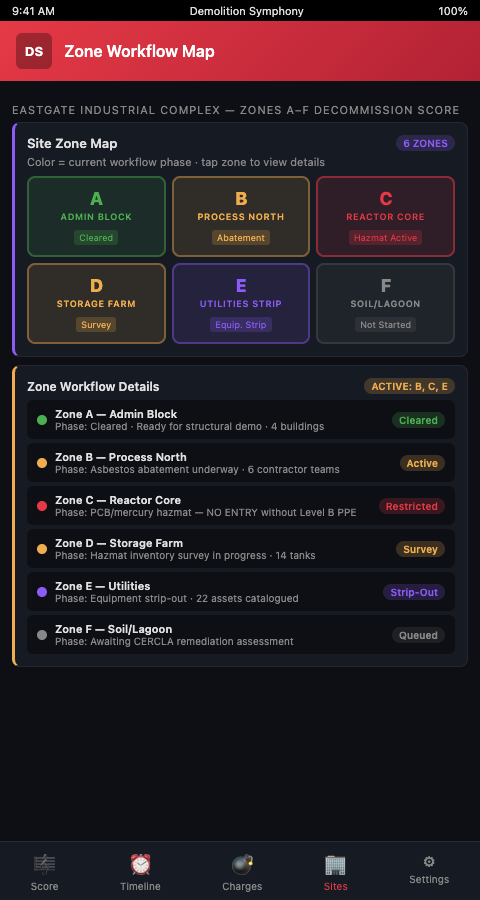
Facility Zone Sequencing: Determining the Order
The order in which zones enter the decommissioning sequence is not arbitrary. The plant teardown zone management logic must account for four factors:
Contamination containment priority. Zones with the highest contamination risk—process areas with multiple regulated materials, chemical storage areas, utility corridors with heavy pipe insulation—should enter the sequence first. Clearing the highest-risk zones early reduces the site's overall regulatory exposure and gives abatement contractors the most flexibility in scheduling.
Equipment extraction dependencies. Some zones cannot be demolished until equipment in adjacent zones has been extracted, because the extraction crane path traverses the demolition zone. Zone sequencing must account for these crane path dependencies so that demolition zones do not activate before the extraction voice in dependent zones has completed.
Structural stability cascade. Demolishing Zone A may remove lateral support from Zone B, requiring Zone B to be shored before Zone A demolition can proceed—or Zone B must be demolished concurrently with Zone A in a controlled sequence. The O6 Environmental industrial facility decommissioning guide identifies structural stability cascade as the most technically complex element of zone sequencing on large industrial campuses.
Logistics corridor preservation. Zones that contain primary access routes—haul roads, crane pads, decontamination stations—must remain active (Class 4 or Class 3) until the zones they serve have completed their work. The logistics voice on the demolition score must be sequenced alongside the work voices, not treated as a fixed infrastructure layer.
For the downstream implications, building-by-building teardown priority order extends zone sequencing logic to the full campus demolition order—how to rank entire buildings, not just zones within a building, based on contamination priority, structural dependencies, and logistics requirements.
Decommissioning Zone Isolation: Physical and Procedural Controls
Zone isolation is not just a spatial designation. It requires both physical barriers and procedural controls that enforce the zone class throughout the active phase.
Minnesota DOH's negative pressure guidance specifies that negative pressure containment must be physically continuous—no gaps in the barrier system—and that pressure differentials must be monitored continuously during abatement. Physical barriers between Class 1 zones and adjacent zones must account for shared wall penetrations, utility penetrations, HVAC connections, and floor drains that may provide unintended pathways for fiber or contaminant migration.
FEMA's site localization and decontamination planning guidance adds procedural controls: personnel logs for zone entry and exit, equipment decontamination records at zone boundaries, and air monitoring logs that are maintained per zone rather than per site. Those records establish a zone-by-zone chain of custody that demonstrates regulatory compliance for each zone independently.
Demolition Symphony Planner stores these zone-level records in the project file and generates per-zone compliance documentation for regulatory submittals. When a zone achieves Class 4 clearance, the compliance record for that zone is complete and available for owner or regulatory review without requiring review of the entire project file.
For the cross-niche parallel, selective deconstruction in stadium demolition faces an analogous zone management challenge: isolating active salvage zones from structural demolition zones in a large-footprint venue where multiple crews are working simultaneously.
The zone-based approach works for both contexts because the core logic is the same: each work theater has defined entry conditions (what must be true before work can start), active-phase rules (what activities are permitted while work is in progress), and exit clearance conditions (what must be verified before the zone transitions to its next class).
Zone Sequencing and the Phase Interleaving Connection
Zone-based sequencing and phase interleaving are two dimensions of the same planning problem. Zone sequencing determines which zones are active at which times across the campus. Phase interleaving determines which work activities—abatement, extraction, structural demolition—overlap within and between zones. The two systems must be designed together, because a zone sequence that works perfectly in isolation may create interleaving conflicts when multiple zones are simultaneously active.
For interleaved scheduling of equipment and structure removal, the zone classification system determines which zones are available for extraction crew routing and crane path allocation at any given time. An extraction crew that needs to traverse a Class 1 (Hot Zone) to reach their extraction target has a routing conflict that must be resolved in the zone sequence before the extraction is scheduled—not on the day the crew arrives.
Demolition Symphony Planner connects the zone classification layer to the phase interleaving layer through a shared constraint model. When a zone changes class, all scheduled activities that route through or are adjacent to that zone are checked for constraint compatibility. Activities that become incompatible with the new zone class are flagged immediately for rescheduling.
Geosyntec's Facility Decommissioning Framework
Geosyntec's facility decontamination and decommissioning practice advocates for a zone-based approach that integrates regulatory compliance tracking directly into the zone status system. Rather than tracking compliance as a separate administrative process, each zone's phase state encodes its current compliance status.
Demolition Symphony Planner implements this integration: when a zone's phase state changes (e.g., from abatement to buffer), the associated regulatory documentation requirements automatically update. The project manager sees not just the phase state but the outstanding compliance tasks required before the next state transition.
Zone-based compliance tracking also changes how project closeout works. Rather than assembling a full-project compliance record at the end of a 24-month project—when memories are imprecise and some documentation may be missing—Demolition Symphony Planner closes each zone's compliance record when the zone achieves Class 4 status. By the time the last zone is cleared, the complete project compliance documentation is already assembled, zone by zone, and ready for regulatory submittal or owner transfer.
Regulatory documentation is the most commonly neglected output of the zone-based system. Each zone's compliance record—survey results, notification confirmations, abatement clearance certificates, air monitoring logs, debris manifests—must be maintained per zone, not per project. When a regulator asks for documentation of a specific zone's decommissioning status, the answer must be available zone by zone, not as a summary of overall project progress. Demolition Symphony Planner generates zone-level compliance packages that can be submitted to regulators or provided to property owners as part of the decommissioning record.
Lay out your decommissioning zones now. Import your facility floor plan into Demolition Symphony Planner, classify each zone by contamination category and extraction dependency, and generate the zone sequencing score before your pre-construction meeting with abatement and demolition contractors. Start your zone classification today and get every zone's entry conditions, active-phase rules, and exit clearance mapped before the first crew mobilizes.