Creating Interleaved Schedules for Equipment and Structure Removal
A 2022 IBISWorld report valued the U.S. demolition and wrecking market at $11.2 billion—a figure that includes significant rework costs from schedule failures on large industrial sites. The most common schedule failure pattern is treating equipment strip-out and structural demolition as strictly sequential when they could legally and safely run concurrently with proper sequencing. Project teams that default to sequential scheduling add 20–40% to their timeline without reducing risk.
The challenge is that concurrent equipment structural removal creates real collision points if it is not choreographed carefully. A rigging crew extracting a 40-ton reactor from the east bay of a process building cannot work safely if structural demolition has already removed the roof sections that protected that bay's crane rail. The equipment voice and the structural voice must overlap in the score—but they cannot occupy the same measure at the same time in the same physical zone.
MDPI research on fast-track overlapping construction risks identifies shared access paths, crane conflicts, and incomplete work handoffs as the three primary causes of schedule acceleration failures. Each of those failure modes has a direct analog in industrial plant removal sequencing.
The Interleaved Schedule Architecture
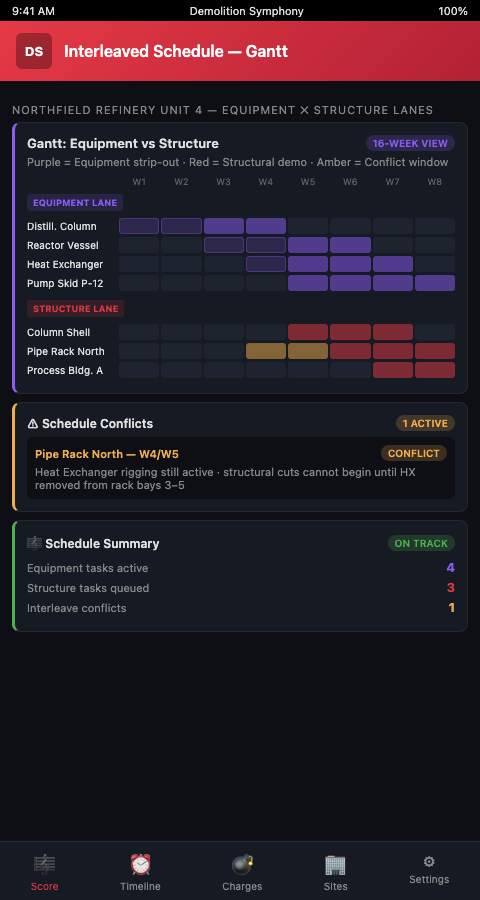
Equipment strip-out scheduling and structural demolition scheduling share the same physical space but must be separated in time and zone. The interleaved schedule architecture that Demolition Symphony Planner uses assigns each building to one of three interleaving states at any given time:
State A: Equipment-active, structure-locked. The riggers are working. Structural demolition is prohibited in this building because overhead crane paths, rigging attachment points, or floor load ratings require intact structural members. The structure is a voice that is resting while equipment performs.
State B: Structure-active, equipment-cleared. Structural demolition is underway. All equipment with extraction value has already been removed or has been identified as scrap. The equipment voice has completed its performance in this building, and the structure is free to be demolished.
State C: Transition buffer. A short window between equipment clearing and structural activation. The rigging crew has completed extraction, the structural engineer has confirmed remaining load paths are adequate for demolition equipment, and any secondary equipment—conveyors, piping, electrical cabinets—has been evaluated for salvage versus demolition. This buffer is the rest bar in the score.
The AIChE guide to plant shutdowns in the chemical industry notes that transition buffer management is the least-planned element of equipment decommissioning projects. Teams plan the extraction work in detail but treat the handoff to structural demo as an automatic event rather than a scheduled task with its own duration and dependencies.
Building the Interleaved Equipment and Structure Removal Schedule
The phase interleaving demolition timeline requires four inputs for each building before the schedule can be constructed:
Equipment extraction sequence. Which equipment comes out first, and why? Beck & Pollitzer's equipment decommissioning guide distinguishes between equipment that must be extracted before structural work begins (crane-dependent, large-footprint machinery) and equipment that can be removed with structural demolition equipment after walls are open. The extraction sequence determines how long the equipment voice occupies each building.
Structural load path analysis. An engineer must confirm which structural members are required to support the crane paths and rigging loads for equipment extraction, and which can be demolished concurrently. Members that are required for extraction support are locked until extraction is complete. Members that are not required can enter demolition while extraction continues in adjacent bays.
Crane path allocation. The crane that extracts equipment from Building C may need to traverse the demolition zone of Building B to reach Building D. That crane path must appear on the phase interleaving demolition timeline as a constraint that locks the traversal zone during extraction operations.
Equipment disposition status. Equipment cleared for resale must be extracted intact and on a schedule that aligns with buyer timelines. Equipment designated for scrap can be demolished in place if structural demolition equipment can reach it without a rigging setup. Disposition status determines whether the equipment voice requires a full extraction window or can be collapsed into structural demolition.
For the broader context of running multiple contractors simultaneously, multi-phase planning addresses how to layer abatement, extraction, and structural phases across an entire campus—the interleaved schedule for a single building is one measure in that larger score.
Concurrent Equipment Structural Removal: Where Teams Go Wrong
RSIS research on fast-track construction risk management identifies four patterns in fast-tracked projects that consistently generate rework. On industrial plant removal sequencing, those patterns manifest as:
Starting structural demo before equipment disposition is finalized. A structural crew opens a wall to begin demolition and discovers that the equipment on the other side was scheduled for extraction, not in-place demolition. The structural work must stop, the equipment crew re-mobilizes, and the schedule expands by whatever extraction time remains.
Crane path conflicts discovered in the field. The rigging crew arrives at Building D to extract the primary compressor and discovers that Building C's structural demolition has created a debris field that blocks the crane path. Neither crew's schedule accounted for the other's physical footprint.
Transition buffer treated as zero-duration. The structural crew is scheduled to begin the day after extraction completes, without accounting for the structural engineer's inspection, load path confirmation, and crane rail removal. That inspection takes 3–5 business days. The structural crew sits idle.
Secondary equipment missed in extraction planning. The primary equipment extraction plan covers major process equipment but misses conveyors, elevated platforms, piping manifolds, and electrical switchgear that must be removed before structural demolition can proceed safely. These items are discovered during structural demolition and require re-sequencing.
Demolition Symphony Planner's equipment strip-out scheduling module requires a disposition decision for every catalogued asset before releasing a building to structural demo. Items without a disposition status block the State C transition and prevent structural work from being scheduled.
For teams coordinating multiple subcontractors on a large campus, parallel workstreams for multi-acre industrial sites extends this logic to the full campus level, where the interleaved schedule for each building must also account for shared resources—cranes, decontamination stations, debris haul routes—that are simultaneously active on other buildings.
The cross-niche comparison to multi-contractor coordination on highrise demolition is instructive: in both contexts, the core challenge is not the work itself but the shared infrastructure (crane paths, access corridors, debris staging) that creates invisible dependencies between contractors who each believe their schedule is independent.
Building the Schedule in Demolition Symphony Planner
To construct an interleaved equipment and structure removal schedule in Demolition Symphony Planner:
- Load the equipment catalogue with disposition status for every asset
- Assign each building an extraction sequence and estimated extraction duration per piece of major equipment
- Mark structural members required for extraction support as locked until extraction State A is complete
- Draw crane paths and mark traversal zones as constraints on the phase timeline
- Set transition buffer duration per building based on structural engineer inspection requirements
- Review the full score for crane path conflicts and shared-resource collisions before any crew mobilizes
The phase interleaving demolition timeline that results from this process shows which buildings are in each state on any given week and surfaces conflicts before they reach the field.
Shared Resource Management Across Interleaved Buildings
The interleaved schedule creates a shared resource demand profile that is not visible in per-building schedules. If Buildings A, C, and E are all in extraction State A during the same two-week window, and all three require the same 100-ton crawler crane, the schedule has a resource conflict that no individual building schedule would reveal. The interleaved schedule must be reviewed at the site level—not just the building level—to identify shared resource bottlenecks before they become field delays.
Crane demand is the most visible shared resource, but not the only one. Rigging crews with specific qualifications (certified riggers for large-vessel extraction, confined space entry certification for below-grade equipment) are often the limiting resource on large industrial sites. If the interleaved schedule assigns three concurrent extraction activities that each require a confined space entry team, and only one qualified team is contracted, the schedule has a staffing conflict independent of any structural or physical constraint.
Demolition Symphony Planner's resource layer assigns crew types and equipment to each scheduled extraction activity and generates a resource demand histogram across all buildings and all weeks. Weeks where demand exceeds available supply appear as resource conflicts on the score—separate from physical constraint conflicts but equally important for schedule integrity.
The Fieldwire demolition software comparison notes that resource conflict visibility is one of the primary differentiators between basic project management tools and purpose-built demolition scheduling platforms. In a fragmented scheduling environment, resource conflicts are discovered when two foremen call the same crane operator on the same morning. In Demolition Symphony Planner, they are visible six weeks in advance.
For teams where the resource constraint is the hazmat abatement crew rather than the extraction crew, the logic is identical: abatement crew demand must be modeled against the building phase windows across the full campus to ensure that the interleaved schedule is achievable with the contractors actually under contract. Resource demand histograms for abatement crews follow the same logic as crane demand histograms—weeks where abatement demand exceeds available crew capacity require either schedule adjustment or contract expansion, and that decision is far cheaper made in planning than discovered during mobilization.
The resource layer in Demolition Symphony Planner covers all crew types, all equipment categories, and all shared facilities (decontamination stations, debris processing areas, crane pads) in a single integrated demand model. The interleaved equipment and structure removal schedule is only achievable if the resource model confirms that every required resource is available in every week it is needed.
Ready to build your interleaved sequence? Load your equipment catalogue and building layout into Demolition Symphony Planner and generate the extraction-to-demo transition schedule before your first site mobilization. Start your interleaved schedule today and give every extraction crew a collision-free window before the structural demolition voice enters.