Managing Parallel Workstreams Across a Multi-Acre Industrial Site
A Crew Console case study documented a 30% reduction in scheduling conflicts after a precision demolition company replaced disconnected crew schedules with a unified coordination platform. That 30% represents something specific on a multi-acre site: crews showing up to zones not yet cleared, equipment queued behind a phase gate that closed two days ago, and logistic corridors blocked by a parallel workstream that nobody told the second crew about. Large-scale plant demolition workstream management fails in the coordination layer, not in individual crew execution.
The industrial plant decommissioning challenge at scale is not complexity—it is visibility. A single 400-acre chemical plant may have 40 active work fronts running simultaneously: asbestos abatement in the north tank farm, equipment extraction in the processing building, structural demolition in the warehouse block, and soil remediation in the southeast corner. Each crew reports to a different contractor. Each contractor submits progress against their own schedule. The project manager synthesizes those reports at the weekly coordination meeting, by which point three days of field-level conflicts have already compounded.
Diamond Demolish's analysis of industrial site challenges identifies multi-crew coordination as the top driver of schedule overruns on large industrial sites. BHH Demolition Services' safety guidelines note that concurrent operations across different phases—particularly when hazmat and structural work run in adjacent zones—create exposure risks that no single contractor can manage in isolation. The multi-acre site problem is fundamentally a shared-state problem: every crew needs to see the current phase state of every zone, not just their own.
The Parallel Workstream Coordination Problem
Think of a multi-acre industrial decommissioning site as an orchestra with eight sections playing simultaneously. Each section has its own part, its own tempo markings, and its own dynamic range. A conductor who only listens to one section at a time will not catch when the brass is playing fortissimo against a pianissimo passage in the strings. Managing parallel workstreams across a multi-acre industrial demolition site requires the same simultaneous visibility: every zone, every crew, every phase state, on one score.
The coordination problem compounds across three dimensions. The first is zone interdependency: a crane path in Zone A is a logistics corridor for Zone B. When Zone A's structural demolition generates unexpected debris volume, Zone B's crane schedule shifts—but Zone B's crew doesn't know that until their crane doesn't show up. The second is phase boundary ambiguity: "extraction complete" in Zone C means different things to different contractors. Does it mean equipment is gone, or does it mean the equipment is on the ground but not yet loaded? That ambiguity determines whether structural demolition can start this week or next. The third is cumulative float consumption: parallel workstreams each consume schedule float independently, but they share the same critical path. When three parallel workstreams each absorb two days of float simultaneously, the project is suddenly six days behind on the critical path with no single visible cause.
MDPI research on multi-objective scheduling documents that multi-objective optimization of parallel construction workstreams requires explicit modeling of resource dependencies—not just task dependencies—to prevent concurrent crews from competing for shared equipment, corridors, and staging areas. MATEC's coordination framework establishes that formal zone-state protocols reduce multi-crew coordination failures by removing the ambiguity in phase boundary definitions.
Applying the Score to Multi-Zone Coordination
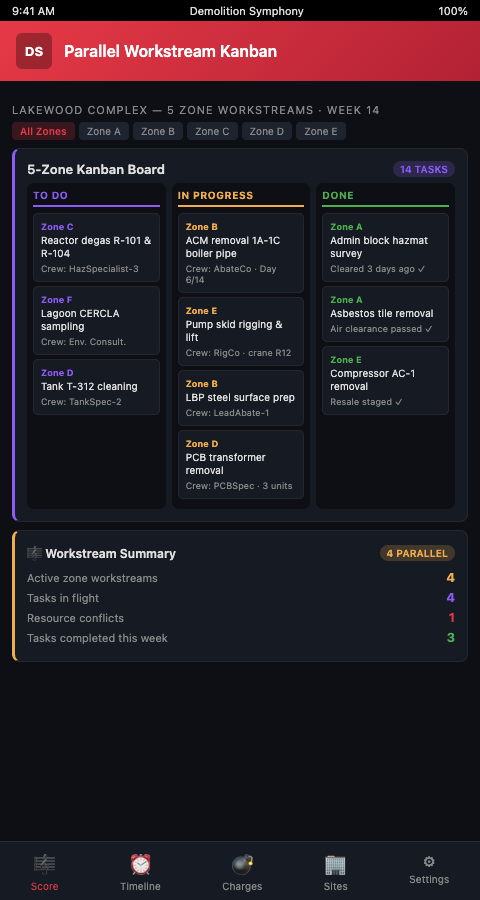
Demolition Symphony Planner renders the full multi-acre site as a score where each zone is a staff line and each workstream is a voice. A project manager looking at the score sees not just where each crew is scheduled to work, but what phase state each zone currently holds, which logistics corridors are allocated to which workstream, and where interdependencies between zones will cause a cascade if one workstream slips.
The score enforces three coordination rules automatically. First, zone-state locking: when Zone A is in active hazmat abatement, any workstream in an adjacent zone that requires shared corridor access must either route around or wait. The conflict appears on the score before it appears in the field. Second, phase boundary definitions: each project uses a standard phase-completion checklist that all contractors must satisfy before the zone state advances. "Extraction complete" means equipment removed, floor cleared, and rigging points documented—not just equipment on the ground. Third, float transparency: the score shows each zone's remaining schedule float, and when parallel workstreams collectively consume more than 80% of available float, the system flags the critical path risk before it becomes a delay.
For multi-contractor orchestration across overlapping zones, the shared score becomes the contract between crews: every contractor can see the phase state of every zone and cannot claim ignorance of a conflict that was visible on the score three days before it materialized.
ScienceDirect's resource allocation research demonstrates that dynamic resource reallocation across parallel workstreams—responding to real-time phase state changes rather than static schedules—reduces project duration by 12-18% on complex multi-site projects. Demolition Symphony Planner supports that dynamic reallocation by surfacing available float in adjacent workstreams whenever one workstream is blocked.
Advanced Tactics for Large-Scale Site Execution
CONEXPO's guidance on managing multiple construction projects emphasizes pre-mobilization coordination meetings as the single highest-leverage investment on large parallel workstream projects. For multi-acre demolition sites, those meetings need the full score as their artifact—not a Gantt chart or a zone map, but a visual representation of every crew's schedule against every zone's phase state, with conflicts flagged before anyone leaves the room.
The practical execution structure for a multi-acre site: divide the site into sectors of no more than 8-10 zones each, assign a workstream lead per sector, and run daily sector coordination calls that feed into a weekly project-wide score review. The sector leads are responsible for resolving intra-sector conflicts; the project manager reviews the score for cross-sector logistics corridor conflicts and critical path exposure.
For interleaved scheduling of hazmat and structural phases, the parallel workstream structure must account for the contamination buffer between adjacent phases. Two zones running in parallel cannot both be in active hazmat if they share a ventilation system—the abatement enclosure pressure in one zone will influence air movement in the other. The score flags this as a voice conflict: two hazmat voices on adjacent staff lines with shared acoustic space cannot play at the same time.
Cross-niche application: the parallel workstream coordination logic translates directly to lean scheduling on bridge demolition projects, where concurrent work on multiple bridge spans requires the same zone-state visibility and logistics corridor management that characterizes large industrial sites.
Managing concurrent demolition crews on a multi-acre site demands industrial site parallel phase execution tools that show every crew the same truth at the same time. A schedule that lives in a project manager's spreadsheet is a single point of failure — when that spreadsheet is not updated after a field change, the next contractor to mobilize is working against outdated phase state information. A score that every contractor reads from is a coordination system.
Ready to coordinate your parallel workstreams? Load your site layout into Demolition Symphony Planner and map every zone's phase state, crew schedule, and logistics corridor allocation onto one score before your first contractor mobilizes. Start your multi-zone coordination score today and get every concurrent crew's phase state visible on a single shared schedule before mobilization begins.