Managing Multi-Contractor Coordination During High-Rise Demolition
The Coordination Gap That Sequence Math Cannot Solve
Research reviewing real-life controlled demolition cases identifies multi-party coordination gaps as a primary driver of sequence failures — not errors in explosive calculation, but errors in execution that stem from information not reaching the right person at the right time. Multi-stakeholder complexity and subcontractor fragmentation are leading drivers of construction cost overruns, and in demolition the consequences are more immediate than budget variance: an out-of-sequence detonation can redirect a collapse toward an occupied structure. Multi-contractor coordination high-rise demolition projects require demolition project team management structures that are more formal than those used for standard construction — the consequence of a missed communication in the 24 hours before the shot is not a schedule slip but a potential safety incident.
A typical 40-story urban implosion involves at minimum a primary demolition contractor, an explosives subcontractor, a structural engineering firm, an environmental abatement crew finishing in parallel, a utility disconnection team, and a security perimeter contractor. Each of these parties has its own project management system, its own daily briefing cadence, and its own interpretation of what "cleared for shot" means. Fragmentation from split responsibilities across subcontractors is a root cause of project failures — and in implosion work, there is no equivalent of a construction punch list to catch what slipped through the gap.
The specific failure mode is almost always the same: a late-stage design change — a timing adjustment on one floor, a charge relocation after structural assessment, a delay added for vibration compliance — gets documented in one team's records but not in another's. The sequence gets executed with mixed-version plans.
The Multi-Contractor Coordination Framework
Think of the implosion sequence plan as the conductor's score. Every contractor is a section of the orchestra. The conductor does not let the strings read a different edition of the score than the brass — but on most high-rise demolition projects, that is functionally what happens when sequencing changes are tracked in email threads rather than a shared master document.
Establish a single version-controlled sequence document as the authoritative source. Every timing adjustment, charge relocation, or delay modification must be entered into this document before it is communicated to any subcontractor. The document carries a version number and a timestamp. If a contractor has a different version number on their site copy, they do not proceed. This sounds elementary, but urban high-rise demolition coordination challenges in dense city environments — compressed timelines, regulatory pressure, simultaneous abatement work — create constant temptation to communicate changes verbally and update the document later.
Assign a single coordination lead per shift who owns cross-contractor communication. This person's only job during active demolition prep is ensuring that every subcontractor team lead has received, acknowledged, and signed off on the current sequence version. They do not do technical work during this window. The lead is the point of failure detection — the person who notices that the utility disconnection team has not confirmed floor-22 isolation before the explosives crew begins wiring floor-22 charges.
Structure daily briefings around sequence dependencies, not crew status. Most demolition project briefings cover what each crew accomplished yesterday and what they plan to do today. That structure misses the critical question: what does Crew A need from Crew B before Crew A can proceed? Scheduling, stakeholder engagement, and subcontractor accountability are the core pillars of effective demolition project management. Reframe the daily briefing as a dependency review: list every inter-crew dependency for the next 24-hour window, confirm each one is on track, and flag any that are at risk of creating a downstream delay.
Use the Demolition Symphony Planner score as the shared visual reference in briefings. When every crew lead can see the same floor-by-floor charge map with delay intervals and completion status marked in real time, version confusion becomes visible rather than invisible. If the explosives crew's floor-22 wiring is marked complete on the shared score but the utility team's floor-22 isolation is still marked pending, the conflict is on screen before anyone fires a circuit. The sequence score becomes the single source of truth that replaces parallel documentation systems.
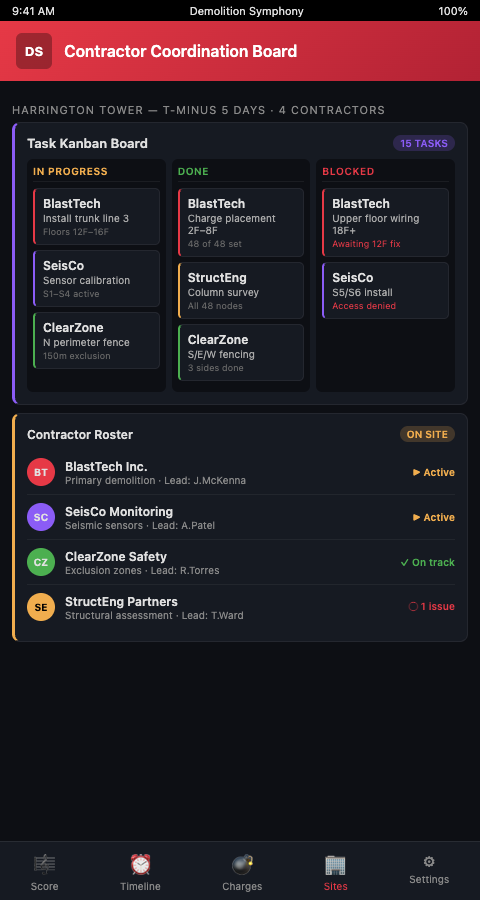
Tie utility disconnection scheduling directly into the sequence gate structure. Utility disconnection has its own lead times — gas can take up to 8 weeks for service termination certification — and these lead times create hard sequence gates that all other contractors must plan around. If your explosives subcontractor is scheduling wiring work on floors where gas isolation is not yet certified, you have a coordination gap that pre-blast inspection will catch too late. The utility disconnection schedule should appear as a constraint layer on the implosion sequence plan, visible to all contractors, not as a separate workstream managed by a different team.
Advanced Tactics: Data Silos, Change Management, and Cross-Niche Lessons
Enforce a pre-shot sign-off protocol with physical signatures. Data silos between subcontractors cause cascading schedule failures — and the most effective circuit-breaker is a physical sign-off requirement. Before any wiring or final preparation begins on a given floor block, each contractor whose work must be complete on that floor block signs the current sequence version. If a signature is missing, work does not proceed. This creates a paper trail that also functions as a real-time coordination checkpoint.
Account for shift handoffs as coordination failure points. Most sequence failures in multi-contractor demolition do not happen within a shift — they happen at shift transitions, when the outgoing crew does not fully brief the incoming crew on late-day changes. Require written shift-end summaries from each contractor lead, covering any sequence changes made during the shift, any incomplete dependencies, and any anomalies observed. These summaries feed into the coordination lead's morning dependency review.
Integrate lessons from multi-contractor orchestration in industrial plant decommissioning, where overlapping zone conflicts between crews are a parallel problem. Plant decommissioning projects have developed zone isolation protocols — no two contractors working in overlapping areas without explicit clearance — that translate directly to multi-floor demolition prep. Apply zone isolation logic to floor blocks: define which floors each contractor owns during each preparation phase, and require explicit clearance before any other crew enters that zone.
Common mistake: treating the explosives contractor as the sequence authority for all decisions. The explosives contractor owns the firing sequence and the charge design. They do not own utility isolation, structural assessment sign-off, or environmental clearance. When the explosives contractor becomes the de facto coordinator for decisions outside their scope — because they are the most visible party on site — critical items from other workstreams get filtered through a team that is not equipped to track them. Each domain needs a responsible party; the coordination lead integrates them.
Build the neighbor communication plan into the contractor coordination schedule, not just the client's public affairs calendar. Neighbor notifications have regulatory deadlines in many jurisdictions — Chicago's ordinance requires 60-day public comment and 90-day lead time. If those deadlines slip because the project coordination timeline slipped, the permit is at risk. Include notification milestones in the contractor coordination schedule with the same weight as technical milestones.
Use the MDPI Buildings review of controlled demolition cases as a reference document for your project kick-off. Walking all contractor leads through documented cases where coordination gaps caused failures — rather than starting from the assumption that their crew will not make that mistake — creates shared awareness of the specific failure modes your coordination protocols are designed to prevent.
Coordinate Your Entire Demolition Crew from One Score
Urban high-rise implosion coordinators managing multiple contractors need one place where every team reads the same sequence, sees the same dependency status, and signs off against the same version. Demolition Symphony Planner is building that shared score.
Implosion contractor scheduling that integrates all contractor timelines into the same sequence document — rather than managing each contractor's calendar in isolation — is what allows the coordination lead to see a utility disconnection delay before it affects the explosives crew's installation window. Multi-team blast project management at this level requires demolition crew coordination software built specifically for the non-negotiable sequence dependencies that define implosion work. Unlike standard construction coordination tools, the sequence plan must be the authoritative document: every crew signs off against the same version, and any field deviation requires formal re-approval before work continues.
Join the waitlist to get early access and bring every crew on your next high-rise implosion onto the same page — before the first detonator goes in the ground.