Coordinating Utility Disconnection with Implosion Schedules
Why Utility Disconnection Controls the Entire Implosion Schedule
OSHA's technical manual specifies that all utility lines must be disconnected and capped before demolition begins. This is a legal requirement, not a best practice recommendation — and it applies to all utilities: gas, electric, water, sewer, telecommunications, steam, and any other service lines serving the structure or passing through it. For an urban high-rise, the list of utility services is typically long, and each service provider has its own disconnection procedure, documentation requirement, and lead time that operates entirely independently of your project schedule.
The core problem is that utility lead times are not negotiable in the way that contractor schedules are. A subcontractor can accelerate their schedule if you pay for additional shifts. A gas utility cannot accelerate its service termination process because their internal procedures govern the sequence of steps required to safely depressurize, purge, and certify a disconnection. Gas disconnection certification from a major utility can take up to 8 weeks, and this timeline starts from when the utility receives a complete application — not from when the project team decides to submit one. Gas electric disconnection before implosion is the single longest lead-time item in most urban high-rise demolition projects — and it is the item most commonly treated as a background task rather than a critical path milestone.
The implosion schedule must be built backward from the utility disconnection dates, not forward from the contractor mobilization date. If the shot date is set before the utility timeline is confirmed, the shot date is a guess.
The Utility Disconnection Coordination Framework
Think of each utility service as a separate instrument in the pre-implosion orchestra that must complete its part before the conductor can raise the baton for the shot. Electric disconnects first — its absence allows the building to be entered safely. Gas disconnects second and requires the longest lead time. Water and sewer come next, followed by telecommunications. Each instrument has its own timeline, and the conductor — the implosion project manager — must track all of them simultaneously against the fixed shot date.
Step 1: Inventory all utility services in the structure within the first week of project mobilization. Do not rely on the client's utility records or the building's original drawings. Conduct a physical survey of all utility entry points, meter locations, and interior distribution systems. A 40-story building may have utility services that were added, rerouted, or abandoned during its occupancy life, none of which appear in the original as-builts. Different utilities have staggered lead times requiring sequenced disconnection, and you cannot sequence what you have not inventoried.
Step 2: Submit disconnection applications to all utilities simultaneously, as early as possible. Do not submit gas after electric is confirmed. Submit all applications on the same day, in the first week of project mobilization. The longest lead time controls the schedule — typically gas — and every week of delay in submitting that application is a week added to the minimum possible shot date.
Step 3: Build utility certification milestones into the implosion sequence plan. The implosion sequence plan should include a pre-shot milestone checklist that lists each utility, the certification required, the responsible party, and the deadline required to support the planned shot date. When the multi-contractor coordination schedule is built, utility certification milestones appear as hard constraints — not advisory reminders — that gate downstream contractor activities.
Step 4: Assign a dedicated utility disconnection coordinator. On projects with three or more utility services, the coordination overhead is enough to require a dedicated person whose primary responsibility is tracking disconnection status across all providers. This person maintains the utility certification log, follows up with each utility weekly, flags delays before they affect the shot date, and escalates any certification hold to the project manager immediately.
Step 5: Confirm post-disconnection verification for each service. Utility disconnection is not complete when the meter is pulled. Gas disconnection requires pressure testing of the capped service to confirm the line is fully isolated. Electric disconnection requires verification that the building's internal distribution system is de-energized at all levels, including emergency generator circuits that may not be on the primary service. OSHA's demolition technical manual covers utility hazard identification at every stage of the disconnection process.
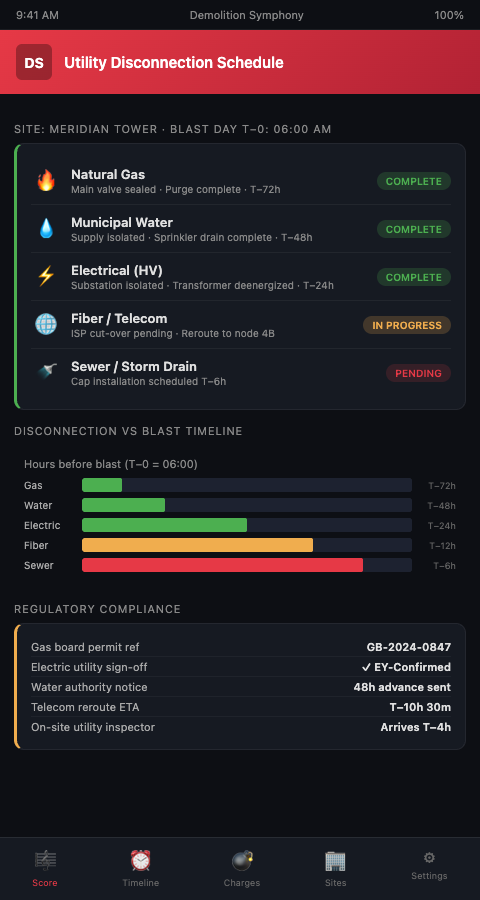
Step 6: Integrate the Demolition Symphony Planner schedule view with utility milestone tracking. The implosion sequence plan is the technical document; the utility disconnection schedule is a constraint that sits above it. When utility certification milestones appear on the same timeline as the pre-shot sequence preparation activities — charge design review, structural assessment sign-off, exclusion zone establishment — you can see in real time whether a utility delay is about to compress a preparation activity that cannot be compressed. The visual score shows not just what happens during the shot but what must happen before the shot is authorized.
Advanced Tactics: Abandoned Lines, Pass-Through Services, and Phased Disconnection
Treat abandoned utility lines as active until proven otherwise. Older high-rise buildings frequently contain utility lines that were reportedly abandoned during previous renovations but were never physically cut, capped, and documented. An electric conduit marked "abandoned" on a drawing may still be energized if the circuit it served was replaced by a new circuit that shares the same source panel. Step-by-step guidance on coordinating shutoffs with demolition timelines consistently identifies abandoned line verification as a critical early task. Require the client to provide written confirmation from each utility that all services — including abandoned ones — have been addressed in the disconnection application.
Address pass-through utility services separately. In a dense urban high-rise, it is common for utility lines serving neighboring buildings or underground distribution systems to pass through the basement or lower floors of the target structure. These pass-through services are not building utilities — they are infrastructure assets owned by a third party. They cannot be simply disconnected; they must be rerouted before the building can be demolished. Identifying pass-through services requires coordination with the utility company's infrastructure mapping team, not just the customer service disconnection team, and the rerouting schedule may be longer than any building utility disconnection.
Connect utility disconnection status to the neighbor communication plan. Neighbors who receive disruption notices for gas, electric, or water service during the disconnection process often contact the demolition project team for explanation. Having the utility disconnection coordinator aware of the neighbor communication plan — and vice versa — prevents a neighbor's complaint about a service interruption from creating a regulatory or public affairs problem that delays the shot.
Apply the OSHA demolition utility guidance in conjunction with National Grid's gas utility disconnection procedures. Different utilities have different hazard profiles. Gas disconnection failure modes are explosive; electric disconnection failure modes include arc flash and electrocution during demolition work. Both require separate documented procedures, separate verification protocols, and separate sign-off chains. Combining them into a single "utilities complete" checkbox on the pre-shot checklist obscures whether each hazard has been individually addressed.
Cross-reference with utility line mapping for bridge and overpass demolition. Bridge overpass demolition regularly encounters utility lines — gas, electric, telecommunications — that run inside bridge superstructures or along bridge abutments. The same mapping, sequencing, and certification approach applies. The principle that utility disconnection must precede any structural demolition, and that the disconnection timeline must be built into the project schedule from day one, applies across demolition types.
Never treat utility disconnection as a parallel activity that will resolve itself. The most common scheduling error in implosion projects is assuming that utility disconnection will proceed on its own timeline and arrive at completion approximately when needed. It will not. Utility disconnection is a critical path item that requires the same active management as charge design or structural assessment. If it slips, the shot date slips — and in an urban implosion with public notifications, permitted exclusion zones, and contractor crews mobilized, a shot date slip is a project-level failure, not a scheduling inconvenience.
Lock Your Utility Timeline Before You Plan Your Shot
Demolition Symphony Planner gives urban high-rise implosion coordinators a pre-shot milestone framework where utility disconnection certifications appear as hard sequence gates — visible on the same timeline as charge preparation and structural sign-off. Join the waitlist to be among the first urban high-rise implosion teams to build the utility disconnection schedule directly into the implosion sequence plan, so no shot date gets set before the utility lead times are confirmed.
The utility disconnection implosion schedule is the document that makes the shot date real. Until every service has a certified disconnection date — not a target date, a certified date — the shot date is an estimate. Pre-demolition utility shutoff coordination that treats the utility timeline as a parallel track managed by a different team routinely produces shot date delays, because the delay surfaces at the pre-shot sign-off stage rather than weeks earlier when it could have been addressed without schedule impact. Building utility isolation before blast sign-off is the final gate in the pre-shot checklist because it is the final safety prerequisite — but utility service cutoff demolition planning must begin on day one of project mobilization, not in the weeks before the planned shot date.