How to Plan Multi-Phase Industrial Plant Decommissioning
The U.S. Department of Energy manages more than 5,000 surplus facilities awaiting deactivation and decommissioning—and that backlog exists not because budgets are absent but because sequencing those facilities correctly is genuinely hard. A 2001 National Academies review found that overlapping abatement, extraction, and demolition work was the leading driver of cost overruns and schedule failures in D&D programs. Industrial plant decommissioning fails most often not in the field but in the planning file.
The core problem is fragmentation. Hazmat crews, equipment riggers, and demolition contractors each submit their own schedules, and a project manager stitches those schedules together with a Gantt chart that treats every phase as sequential. Abatement finishes building A, riggers move in, structural demo follows. In reality, a 400-acre refinery or chemical campus has dozens of buildings in various states of contamination, equipment density, and structural condition. Waiting for one phase to complete before starting the next turns a 24-month project into a 48-month project—and still produces cross-contamination events because the handoffs aren't clean.
OSHA's Subpart T and the EPA's plant decommissioning framework both require that hazardous material surveys, utility isolation, and structural engineering reviews precede active work. But neither standard tells you how to schedule those phases when they legitimately need to run in parallel across different buildings on the same campus.
The Multi-Phase Sequencing Problem
Think of a full industrial plant decommissioning as a musical score. Hazmat abatement, equipment extraction, and structural demolition are separate instrument voices—each with its own tempo, dynamic range, and rest requirements. A conductor who lets each section play independently produces noise. One who coordinates them into a single visual score produces a performance.
The contamination buffer between abatement and structural work is not a delay to be minimized—it is a mandatory rest between movements. Cutting that rest short is how asbestos fibers migrate from cleared zones into active demolition debris. The Beck & Pollitzer decommissioning guide notes that poorly sequenced handoffs between abatement and structural work are responsible for the majority of regulatory stop-work events on industrial sites.
Multi-phase industrial plant decommissioning planning requires three sequencing decisions made before any crew mobilizes:
1. Phase boundaries by building, not by discipline. Rather than running hazmat abatement across all 40 buildings before equipment extraction starts anywhere, assign each building a phase window. Building A enters hazmat in week 1, extraction in week 6, structural demo in week 12. Building B lags by three weeks. Crews rotate across buildings while contamination buffers are observed in each.
2. Interdependency mapping between voices. Equipment extraction in Building B cannot start if the crane path crosses an active asbestos abatement containment in Building A's courtyard. Chemical Processing's safety decommissioning guide identifies crane path conflicts and shared decontamination corridor access as the two most common sequencing failures in multi-building teardown.
3. Buffer tempo as a scheduling constraint, not a contingency. Every transition between abatement clearance and the next activity requires air monitoring, third-party clearance, and physical barrier removal. Plan those as fixed-duration tasks, not floats.
Applying the Score Metaphor in Practice
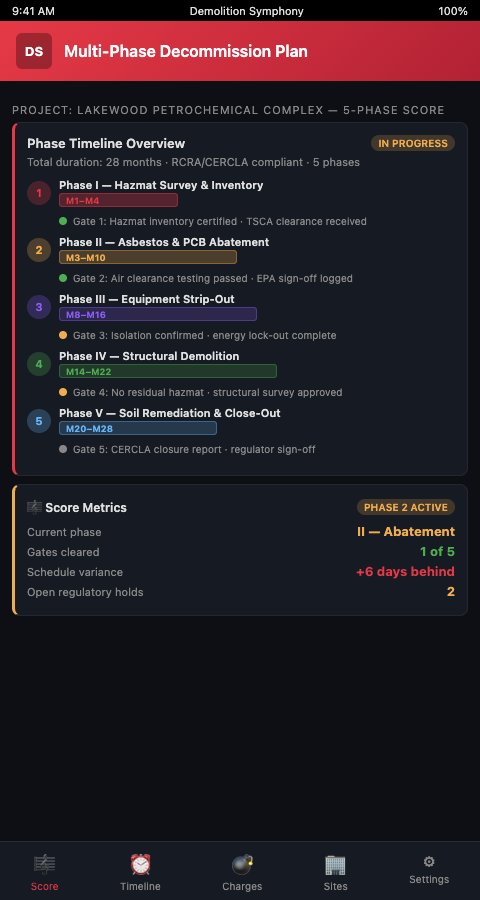
Demolition Symphony Planner renders the multi-phase industrial plant decommissioning plan as sheet music. Each row on the visual score is a building or zone. Each column is a time window. Three color-coded voices—hazmat (red), extraction (blue), structural (gray)—occupy the rows, and the software enforces rest rules between voice transitions automatically.
When a project manager marks Building C's hazmat abatement complete, Demolition Symphony Planner does not immediately unlock extraction. It inserts the required contamination buffer—configurable by material type (asbestos, PCB, lead paint) and jurisdiction—and surfaces the earliest valid start date for extraction crews. If that date conflicts with a crane path already allocated to Building D's extraction, the conflict appears on the shared score before it becomes a field incident.
This is what distinguishes orchestration software from a project management tool. A PM tool tracks tasks. An orchestration tool models the physical and regulatory constraints between tasks and prevents collisions before crews are on site.
For zone-based workflow planning, the score metaphor extends naturally: each zone becomes a staff line on the score, and the planner can see at a glance which zones are in hazmat rest, which are in extraction, and which have cleared for structural work.
Advanced Tactics for Large-Campus Sequencing
On a multi-acre industrial site, the phase interleaving industrial demolition schedule must account for logistics corridors that span multiple phase states simultaneously. A truck route that serves active structural demolition in the north sector passes through a hazmat buffer zone in the central sector. That corridor must be either closed during buffer periods or rerouted—and either decision changes the extraction schedule in the north.
The Demolition Association's power plant considerations guide addresses this explicitly for large footprint facilities: access roads, crane pads, and debris staging areas must be sequenced alongside abatement and structural work, not treated as static infrastructure.
Demolition Symphony Planner handles this through logistics layer overlays. Access corridors, crane pads, and decontamination stations appear as a fourth voice on the score. When a logistics corridor is scheduled for dual use across conflicting phases, the software flags it as a rest violation.
For teams coordinating multiple contractors on interleaved scheduling, the shared score becomes the single source of truth—every contractor sees the same phase state for every building and cannot schedule work that violates a buffer period held by another crew.
The industrial site shutdown planning challenge on large campuses also involves regulatory notification timelines. OSHA 1926 Subpart T and EPA NESHAP asbestos notification requirements impose fixed lead times before abatement can start. Those notification windows must appear on the score as non-negotiable rests at the front of each building's hazmat voice.
For cross-niche context, the same logic applies to sequential phase planning in multi-span bridge removal: the constraint isn't the work itself but the mandatory separation between phases that share a physical corridor.
Contractor Communication Across the Score
One of the least-discussed challenges in multi-phase industrial plant decommissioning is contractor communication. On a large campus with separate abatement, extraction, and structural contracts, each contractor's project manager views the schedule through the lens of their own scope. An abatement PM focused on throughput does not naturally consider whether the clearance sequence they propose creates crane path conflicts for the extraction contractor scheduled to follow them in Building D.
Demolition Symphony Planner's shared score resolves this by giving every contractor access to the phase state of every building—not just their own buildings. When the abatement PM proposes to accelerate Building D clearance by two weeks, the scheduling interface immediately shows whether that acceleration creates a conflict with the extraction contractor's crane, which was allocated to Building E during that window. The PM can resolve the conflict in planning rather than discovering it when both contractors arrive on site with equipment.
This shared visibility also changes how delay events propagate. In a fragmented scheduling environment, an abatement delay in Building A is communicated informally to the extraction contractor, who then informally communicates to the structural contractor, and schedule recovery is negotiated in a series of field conversations. In Demolition Symphony Planner, the abatement delay in Building A updates the buffer completion date, which automatically adjusts the earliest extraction start date, which the extraction contractor sees immediately in their schedule view—without any phone calls.
The National Academies D&D review identified coordination failure between subcontractors as the second most common cause of D&D schedule overruns after initial sequencing errors. Shared score visibility addresses both: correct initial sequencing prevents the first category of failure, and real-time constraint propagation prevents the second.
Execution Checklist
Before mobilizing on a multi-phase industrial plant decommissioning plan, confirm:
- Hazardous materials survey complete for all buildings, results loaded into phase scheduler
- Phase boundaries assigned by building with contamination buffer durations set by material type
- Logistics corridor states mapped for each phase window
- Regulatory notification windows entered as fixed-duration tasks on the score
- Contractor access schedules cross-referenced against phase states for each building
- Air monitoring and clearance tasks scheduled as dependencies before buffer release
- All contractor PMs granted access to shared Demolition Symphony Planner score view
Demolition Symphony Planner's decommissioning project orchestration software automates the dependency graph between these checklist items. A project manager who updates a single clearance date sees the downstream ripple across all affected buildings before approving the change.
Industrial facility teardown sequencing at this scale is not a scheduling problem—it is a composition problem. The crew that treats it as a score, with mandatory rests, synchronized voices, and a conductor reviewing the full arrangement before any note is played, is the crew that finishes on time and without contamination events.
Ready to map your decommissioning sequence? Load your facility layout into Demolition Symphony Planner and let the scoring engine assign phase windows, buffer durations, and conflict flags across every building before your first contractor meeting. Start your decommissioning plan today and get a collision-free phase schedule before your first contractor meeting.