How to Plan Multi-Span Bridge Removal in Sequential Phases
The High Stakes of Getting the Sequence Wrong
In 2012, the Hongqi Viaduct in China collapsed during demolition operations, killing nine workers. Investigators traced the failure to an incorrect span removal sequence that redistributed loads in ways the site team had not anticipated. The viaduct was a continuous multi-span structure, and removing the wrong span first destabilized the remaining bays before temporary supports could compensate. A progressive collapse study of multi-span bridges confirms this mechanism: improper sequencing can initiate domino failures across interconnected spans.
The problem is not isolated. The ASCE Infrastructure Report Card reports that 6.8% of U.S. bridges are rated in poor condition, with 168 million vehicle crossings made daily on structurally deficient spans. Many of those structures are aging multi-span bridges queued for replacement or removal. As the pace of bridge demolition accelerates, the planning frameworks teams use to order the work become a direct determinant of safety outcomes.
Traditional approaches rely on linear Gantt charts, isolated structural models per span, and narrative phase documents that team members interpret differently on site. When structural self-weight, prestress forces, and temperature loads interact across spans — as documented in the Intelligent Safety Assessment for Long-Span Bridge Demolition — no static Gantt chart captures what happens to span 3 when span 1 comes down. The NCHRP Synthesis 536 found that 84% of state DOTs responded on managing demolition risk, yet specialized planning tools remain underused. The gap between what engineers know and what field teams execute is where sequences break down.
Turning Phases into a Visual Score
The Demolition Symphony Planner treats multi-span bridge removal as a composition where each span, pier, traffic window, and structural hold is a note written on a shared demolition score. Just as a conductor reads the full orchestral sheet to understand how each instrument's entry affects the whole performance, an engineer reads the visual score to see how each span removal shifts load into adjacent bays before the next cut begins.
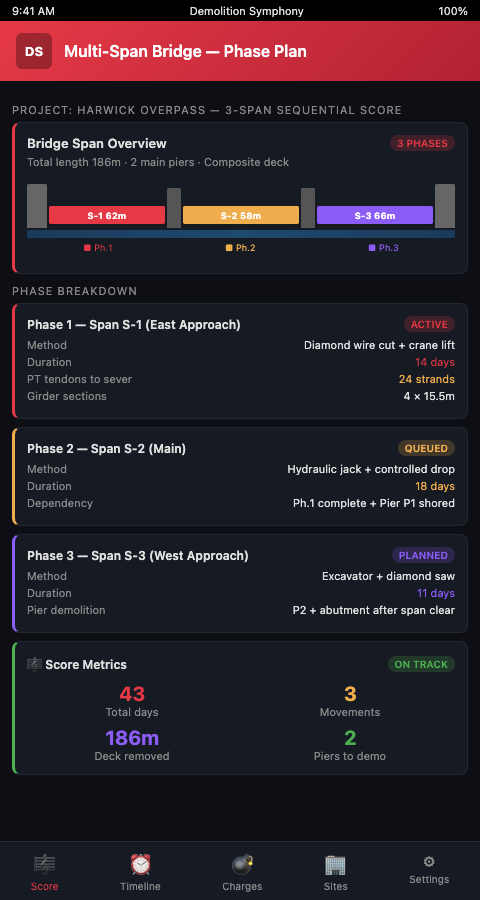
The score layout maps spans horizontally across the top as columns and phases vertically down the left as rows. Within each cell, the planner encodes: the structural action (saw-cut, crane lift, controlled drop), the load state at that moment (active prestress, temporary shoring in place, dead load transferred), and the traffic condition that governs the work window. This is the core of multi-span bridge removal sequencing — not just knowing what to do but understanding the live context in which each note is played.
Phase 1 — Structural Interdependence Assessment. Before any note is written, the score requires a complete mapping of how spans share load. Continuous-beam bridges transfer moments across piers; removing a span without isolating that load path first introduces unexpected tension in the adjacent span. The assessment logs each span's structural relationship to its neighbors: whether they share a pier cap, whether prestress tendons cross the joint, and whether the deck acts compositely. This data fills the top row of the score — call it the "key signature" — so every subsequent phase is read against the correct structural baseline.
Phase 2 — Sequencing the Score. With interdependencies mapped, phases are written as measures. The safest multi-span bridge demolition phase planning generally runs in reverse construction order: the last span built is typically the first removed, because it carries fewer cumulative dependencies. Each phase-measure specifies the span identity, the removal method, the required shoring position, and the structural check that must pass before the next measure begins. Engineers who need to understand how span removal order affects stability at each intermediate state will find the measure-by-measure layout more actionable than a flat phase list.
Phase 3 — Traffic and Environmental Notations. Overwater spans add tidal hold cues. Urban overpasses add traffic-window rests — periods where work pauses while lanes are restored. These are written as rests and ties in the score, notations that govern timing without changing the structural sequence. A crane swing over an active lane is marked differently than a crane swing over a closed corridor. The score makes these distinctions visible to every stakeholder reading it.
Phase 4 — Real-Time Verification Gates. Digital twins connected to sensor arrays have demonstrated that real-time data can update a demolition sequencing plan mid-project, as shown in the Digital Twin-Driven Strategic Demolition Plan. The Demolition Symphony Planner integrates verification gate symbols between phase-measures: a structural reading must clear a threshold before the next measure begins. If the gate fails — say, a pier deflects beyond tolerance after span removal — the score halts and the next phase is locked until the structural condition is resolved.
Advanced Tactics for Complex Spans
Staggered-entry demolition for continuous decks. On continuous-beam bridges, a common failure point is removing an end span before isolating the negative moment zone over the first interior pier. Staggered-entry sequencing writes the first measure as a shoring installation over the interior pier before any end-span cutting begins. The score makes the shoring a prerequisite note that must be "played" before the saw-cut note is permitted.
Span-skipping for traffic continuity. On multi-lane overpasses where one direction must remain open, alternate-span demolition sequences keep non-adjacent spans in service while adjacent ones come down. The Demolition Symphony Planner marks skip spans in a different color register, so field crews can see at a glance which spans are in active removal, which are in shored standby, and which remain load-bearing for traffic.
Sensor-triggered measure transitions. Rather than time-gating phase transitions, experienced teams gate on structural readings. A strain gauge at the pier cap must register below a set threshold after the adjacent span is removed before the next measure opens. This approach, supported by the Intelligent Safety Assessment for Long-Span Bridge Demolition, eliminates the false confidence of schedule-based checkboxes. The score encodes the sensor ID and threshold directly into the gate notation.
Cross-span load-path continuity checks. Bridges with structural interdependence across multiple bays require a continuity check at each gate: has the load path to the removed span been fully severed, and has the load path to the remaining spans been validated? The planner logs each check as an annotated symbol on the score, creating an auditable record that mirrors what a structural engineer would document in a calculation set — but visible to the full project team in real time.
Floor-by-floor sequencing analogy from high-rise work. Teams migrating from vertical demolition projects will recognize the logic of phase gating from floor detonation sequencing, where each floor level must collapse within a predicted footprint before the sequence advances. The same principle applies horizontally on a bridge: each span must reach a defined state before the adjacent span's measure begins.
What Happens Without a Shared Score
When multi-span bridge removal runs from disconnected documents — a structural engineer's phase sketch, a contractor's traffic plan, and a crane operator's lift sequence issued separately — the gaps between them are where sequences drift. Field crews interpret a structural note as "span 2 can come down after span 1 is cut" without knowing that span 2's prestress anchor block sits on the same pier cap as span 3, and removing span 2 while span 3 carries full dead load will overload that cap. No individual document captured the interaction because no individual document covered the full score.
The NCHRP Synthesis 536 found that state DOTs managing demolition risk most effectively were those with standardized documentation that unified structural, traffic, and environmental constraints into a single project record. The Demolition Symphony Planner is built to be that record — not as a post-project report but as the live planning instrument that drives each day's work.
Getting Your Score Written Before the First Cut
Bridge and overpass demolition teams working on multi-span removals face a consistent pressure: get the bridge down fast, keep traffic disruption short, and contain costs. The Demolition Symphony Planner lets you meet all three constraints without sacrificing the structural rigor that keeps the sequence safe. Every span removal, every shoring placement, every traffic window, and every sensor gate is written into the score before any equipment moves on site.
If your next project involves a continuous or semi-continuous multi-span structure with lane traffic above or below, start your score with the Demolition Symphony Planner. Join the bridge and overpass demolition teams that are replacing disconnected documents with a single visual score — one that keeps every span removal, structural interdependence check, and traffic window in lockstep from the first cut to the final lift. Reach out to schedule a walkthrough and see how your specific bridge's interdependence map translates into a phase score your full team can read and execute.