How to Assess Structural Interdependence in Multi-Span Bridges
When One Span Falls and Takes the Others With It
The Hongqi Viaduct collapse in China killed nine people. The ScienceDirect domino-type progressive collapse analysis establishes the mechanism: failure of one span triggered progressive collapse across the remaining structure because the structural interdependence in multi-span bridges had not been accounted for in the demolition sequence. The spans were not independent structural elements that could be removed in any order. They were a coupled system, and treating them as independent units was the planning error that made the collapse possible.
FHWA Bridge Condition data from NBI 2024 shows thousands of multi-span bridges in poor structural condition across the U.S. Many of those bridges are continuous beam structures where demolition analysis must account for moment redistribution across spans as elements are removed. Continuous beam bridge demolition analysis is not a single calculation — it is a sequence of analyses, one per removal state, because the moment distribution changes with every span that comes down. As these structures are removed, the bridge span dependency analysis is the foundational engineering task that governs every subsequent planning decision. Without a complete dependency map, every removal sequence is a guess. Load path continuity during bridge demo must be confirmed at each intermediate state, not assumed to persist from the original design.
NCHRP Report 458 on Redundancy in Highway Bridge Superstructures defines three types of redundancy relevant to multi-span demolition analysis: structural redundancy (alternate load paths), load-path redundancy (multiple members carrying the same load), and internal redundancy (multiple elements within a member). During demolition, all three types erode as elements are removed. Maintaining load path continuity during bridge demolition requires tracking which redundancy types remain active at each phase — the structural coupling assessment for the bridge must map how that redundancy picture changes with every removal step, so the sequence never advances past a point where insufficient redundancy remains to sustain a safe intermediate state.
Mapping Coupling Before Writing the Score
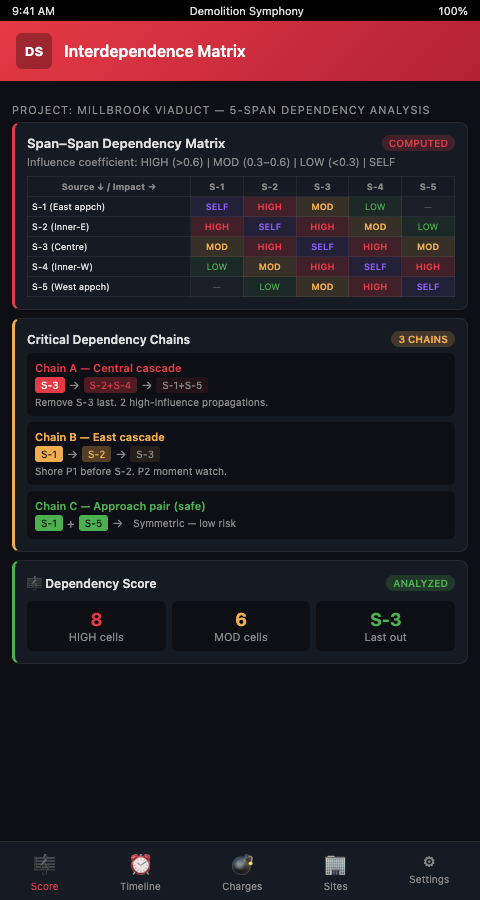
The Demolition Symphony Planner begins every multi-span bridge demolition project with a structural coupling assessment bridge engineers complete before any phase planning — the process of identifying how each span transfers forces into adjacent spans through the mechanisms available in that bridge type. Understanding structural interdependence multi-span bridges exhibit is the foundational task this assessment addresses: the coupling map it produces is the "key signature" of the demolition score, governing how every subsequent measure is written. Load path continuity bridge demo teams must verify at each phase is the outcome the assessment protects.
Moment Continuity Analysis. Continuous-beam bridges transfer negative moment over interior supports — meaning that removing an interior span without first interrupting the continuity at the adjacent joints will transfer unintended hogging moment into the adjacent spans. ScienceDirect Topics on Structural Redundancy confirms that continuous bridges redistribute moments across spans under loading changes. The Demolition Symphony Planner's coupling map records the moment distribution before and after each planned removal, annotating the adjacent span's moment change as a load annotation within the corresponding score measure.
Prestress and Temperature Coupling. The Intelligent Safety Assessment for Long-Span Bridge Demolition study from Springer identifies self-weight, prestress, and temperature as the three dominant parameters in long-span bridge demolition — and notes that they interact across spans, not just within individual members. Prestress tendons that cross span boundaries must be de-tensioned or cut before the connected span is removed; failure to interrupt prestress coupling is a common source of uncontrolled cracking in adjacent spans during demolition.
Pier Cap Sharing Assessment. Where two adjacent spans share a pier cap — a common configuration in multi-span bridges with monolithic pier-cap connections — removing the superstructure of one span while the other remains loaded creates an asymmetric loading condition on the pier cap. The Demolition Symphony Planner maps pier cap sharing as a coupling flag on both connected spans: any score measure that addresses one span automatically displays the coupling flag referencing its pier-cap-sharing neighbor.
Load Path Continuity Interruption Sequence. For each coupled span pair or group, the assessment identifies the sequence of load-path interruptions required before removal can proceed safely. These interruptions — bearing releases, joint separations, tendon cuts — are written as sub-step notes within the affected span's removal measure. The FHWA Redundancy in Long-Span Bridges report notes that wider pier spacing reduces cross-span load redistribution capacity, which affects how urgently each load-path interruption must occur before the physical removal begins.
Continuous-Beam Moment Analysis. The ASCE Continuous-Beam Analysis for Highway Bridges methodology provides the analytical framework for calculating moment continuity across spans under partial loading conditions — the exact condition present during phased bridge demolition. The Demolition Symphony Planner applies this methodology at each removal step, recording the calculated moment distribution in the adjacent spans as an annotation that the structural engineer of record reviews before that measure opens.
Understanding structural interdependence across all spans is the prerequisite for correctly writing the load transfer analysis that governs each intermediate structural state. The two planning steps are connected: the coupling map defines which spans are interdependent, and the load transfer analysis quantifies the force redistribution that occurs at each removal step within those coupled relationships.
The coupling assessment also governs the multi-span phasing plan at the project level: spans within a coupled group cannot be phased independently. The coupling map determines which spans must be addressed together within a single project phase.
Advanced Assessment Tactics for Complex Structures
Damage-propagation modeling. A multi-damage identification study of multi-span bridges from MDPI demonstrates that damage in one span shifts the dynamic response across all spans — a finding relevant to bridges where deterioration is unevenly distributed across the structure. For demolition planning, this means that the coupling assessment must account for current structural condition, not just the original design. A corroded pier cap connection that was designed for full continuity may no longer transfer moment effectively, which changes the coupling map and the required interruption sequence.
Segment-boundary analysis for segmental bridges. Segmental construction creates coupling through post-tensioning that crosses segment joints. The Demolition Symphony Planner maps post-tensioning layouts across all segments and identifies which tendon groups cross span boundaries. These cross-boundary tendons are flagged in the coupling map and their interruption is written as a precondition note in the affected span measures.
Real-time sensor integration during removal. For long-span or complex multi-span structures, static coupling analysis performed before demolition begins may not fully capture the actual structural response at each removal step. Sensor arrays — strain gauges, tiltmeters, acoustic emission monitors — provide real-time data that can be compared against the analytical predictions in the coupling map. When sensor readings deviate from predicted values, the Demolition Symphony Planner flags the deviation and holds the next measure until the discrepancy is investigated.
Connecting to industrial teardown order. Teams with experience in building-by-building teardown order at industrial plants will recognize the dependency-mapping discipline. Industrial teardown order planning identifies which buildings share structural connections or utility dependencies and uses those dependencies to govern the removal sequence. Structural coupling assessment for multi-span bridges applies the same logic at the span level: interdependent spans are a cluster, and the cluster's internal removal sequence is governed by the coupling relationships, not by schedule convenience.
Documentation for regulatory review. The coupling assessment, when recorded in the Demolition Symphony Planner's structural annotation layer, creates a traceable engineering record for each span's position in the removal sequence. Regulatory agencies reviewing the demolition plan — state DOT bridge engineers, OSHA compliance officers — find a structural justification record per span that documents why each span was removed in its specified order and what load state was verified before each removal began.
The Assessment That Makes the Score Valid
A demolition score written without a structural coupling assessment is a sequence that happens to have been chosen, not a sequence that has been engineered. The coupling assessment is what makes the score valid — it is the engineering basis for every span's position, every precondition note, and every gate annotation in the sequence.
The Demolition Symphony Planner treats the coupling assessment as the first step of every multi-span bridge demolition project, not as a background document that gets filed with the project record. It is the key signature that every subsequent measure is written against.
Structural interdependence in multi-span bridges is also the analysis that reveals hidden schedule risks before the project is planned. When the coupling map identifies that spans 3 and 7 share a load path through the pier cap at column 4, the project team knows in advance that those two spans must be sequenced with care relative to each other — and that any delay on one will affect the available window for the other. Bridge span dependency analysis done before the schedule is built prevents the downstream discovery of structural constraints that require schedule rebuilds after crane commitments and traffic management permits are already filed.
Start With the Coupling Map Before You Write a Single Phase
Bridge and overpass demolition teams planning multi-span removal projects should complete the structural interdependence assessment before any phase planning, crane scheduling, or traffic management coordination begins. The Demolition Symphony Planner's coupling assessment workflow takes your bridge's structural characteristics — span types, continuity conditions, pier sharing, prestress layouts — and generates the structural coupling assessment map that the demolition score is built on.
The structural coupling assessment for bridge demolition also creates the documentation record that state DOT bridge engineering reviews and owner quality management programs require for complex multi-span removals. When continuous beam bridge demolition analysis results — identifying which spans are structurally coupled, what load path continuity exists across the full bridge, and what intermediate structural states are created by each span removal — are embedded in the phase score rather than filed in a separate calculation set, the field team has access to the structural rationale throughout the project rather than only during the pre-demolition briefing.
Start your multi-span bridge demolition with the Demolition Symphony Planner and build a structural coupling assessment map before writing a single phase measure — so your bridge and overpass demolition team executes a sequence that engineering has validated for load path continuity at every intermediate removal state, with the coupling analysis embedded in the same document as the operational plan.