How Floor-by-Floor Detonation Sequencing Works
What "Floor-by-Floor" Actually Means Structurally
The phrase "floor-by-floor detonation sequencing" is used loosely to mean that charges are placed on multiple floors and fired in succession. The structural engineering behind it is more precise. ScienceDirect's 3D progressive collapse analysis confirms that the load redistribution pathway through a building depends on the per-floor removal sequence — not just which floors are charged, but the specific interval between each floor's detonation. Change the interval by 200 milliseconds and the load redistributes through a different structural path, which changes the collapse direction.
The Springer study on sequential column removal found that sequential column removal induces larger section forces than simultaneous removal in adjacent columns. This matters for floor-by-floor planning: coordinators who fire entire floor plate column groups simultaneously, rather than sequencing within the floor, generate higher peak forces in the transition floors above and below. These peak forces increase the probability of asymmetric failure — one side of the floor collapsing before the other, which redirects lateral momentum outside the intended footprint.
True floor-by-floor detonation sequencing means designing the within-floor timing (which column groups fire first within a single floor) and the between-floor timing (how long after floor N fires before floor N+1 fires) as integrated variables. These are two distinct parameters in the per-floor blast timing control framework — and conflating them is one of the most common errors in high-rise demolition sequencing plans.
The Floor-by-Floor Score: Notch Position and Delay Windows
The ScienceDirect folding implosion study specifies the canonical floor-by-floor parameters: a 1-3 second delay between upper and lower notch blasts, with notch position per floor controlling the collapse kinematics. The notch is the floor level at which the structural continuity is severed. Set the notch too high and the lower floors don't develop enough downward momentum before the upper floor loads arrive. Set the notch too low and the upper floors free-fall before the lower floors have cleared the collapse footprint.
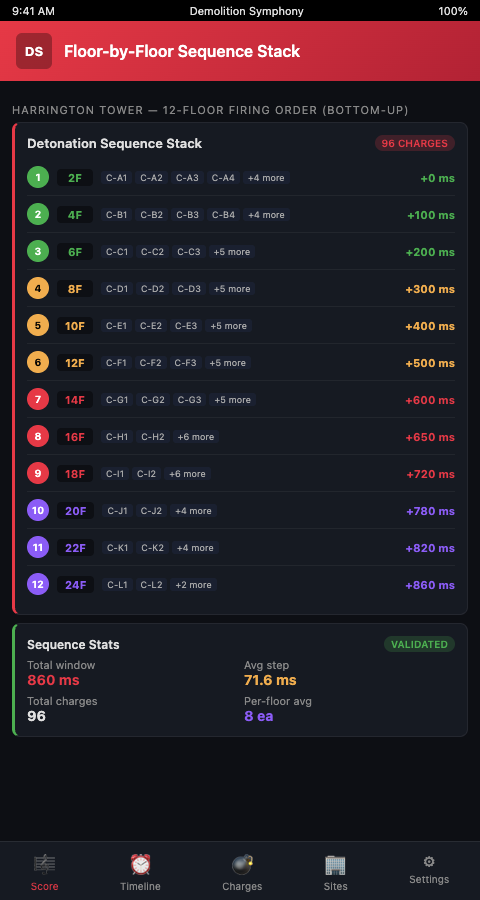
This is where the musical score metaphor reaches its most precise application. In the Demolition Symphony Planner, each floor is a horizontal track. The notch position on that floor appears as a note on the track — positioned vertically to indicate which column group on that floor is the primary notch point. The 1-3 second delay between floors appears as the spacing between measures. A coordinator reading the score can verify the notch progression across all 40 floors at a glance — checking that the notch positions form a consistent progression from lower floors to upper floors, and that no floor's notch position creates an anomalous load redistribution path.
The Wikipedia documentation of implosion timing physics provides the physical reference: a 1-second delay causes a 5.2-meter drop before the adjacent column line fires. With floor heights typically between 3.5 and 4.2 meters, that means a 1-second delay allows roughly 1.5 floor heights of drop before the next column group fires. Coordinators can use this relationship to calculate required delay intervals for any floor height by working backward from the required drop distance before the adjacent firing.
The Delhi high-rise field case study from Taylor & Francis documents the specific per-floor timing strategy applied in a real urban implosion — including the floor-height-adjusted delay intervals and the structural monitoring that confirmed the collapse followed the designed floor progression.
The floor-level charge detonation order also has a communication function beyond sequencing. On a 40-story building with 400 column charge points, the detonation network installer — the field crew — must install charges in a sequence that progresses logically through the building without crossing previously installed network runs. The floor-by-floor score in the Demolition Symphony Planner provides the installation sequence documentation: each floor track can be printed as a field sheet showing the installer which columns to charge on that floor, in what order, and how the delay bus connection runs from the floor's column group to the primary delay network. This reduces installation errors that come from crews working from incomplete or ambiguous field instructions.
For the delay detonator hardware that implements these per-floor intervals, delay detonators covers the electronic detonator specifications and accuracy tolerances relevant to floor-by-floor blast timing control.
Advanced Per-Floor Timing for High-Rise Edge Cases
Variable floor height zones. Most high-rise buildings have uniform floor-to-floor heights on residential or office floors, but double-height lobby levels, mezzanines, and mechanical floors break that uniformity. Each non-standard floor height requires an individually calculated delay interval — the standard interval that works for 4-meter office floors doesn't work for a 7-meter mechanical floor. The Demolition Symphony Planner flags non-standard floor heights in the score as deviation annotations, so coordinators must explicitly set the delay interval for each anomalous floor rather than applying the uniform interval formula.
Post-tensioned slab interactions. When post-tensioned slabs connect structurally to the columns being sequenced, the slab's tendon continuity creates a load path that persists after the column charge fires. If the sequencing doesn't account for this continuity, the floor above the detonated column group may not drop on the designed trajectory because the post-tensioned slab is still transferring horizontal tension. Pre-severance of post-tensioned tendons must appear in the floor-by-floor score as a preparatory event on the applicable floor tracks, occurring before the column charge for that floor fires.
Machine learning sequence preview. ASCE research on ML-based progressive collapse simulation shows that ML simulation can rapidly preview how different floor-by-floor sequences affect collapse progression — reducing the computational time for sequence optimization from hours to minutes. For high-rise projects with complex geometry, this preview capability changes the design workflow: instead of finalizing a sequence based on analytical judgment alone, coordinators can generate and compare five or ten alternative floor-by-floor sequences in an afternoon and select the one whose collapse preview most closely matches the target footprint.
Cross-niche floor sequencing principles. The fundamental principle of floor-by-floor sequencing — sequential support removal timed to allow gravity-driven progressive collapse — applies directly to bridge demolition as well. The sequential phase planning post covers how this principle adapts for multi-span bridge removal, where the "floors" become spans and the inter-span delay calculation follows the same physical logic as inter-floor delay calculation.
Scoring the top-down vs. bottom-up sequence choice. Some high-rise implosion plans call for a top-down progressive collapse — removing upper-floor supports first to direct the collapse energy downward — rather than the more common bottom-up approach. The visual score for a top-down sequence looks like an inverted phrase: the treble (upper floors) fires first and the bass (lower floors) closes the composition. This approach is less common in urban environments because it generates higher lateral debris energy at the upper floors before the lower structure has begun to absorb the collapse load. When a top-down sequence is specified, the score makes the design intent immediately obvious to every reviewer, which reduces the risk of misinterpretation by the field crew.
Sequence updates during network installation. The floor-by-floor detonation sequence is not always final when the field crew begins installing the detonation network. Field conditions — a floor level with more concrete than the drawings show, a mechanical floor with unexpected equipment blocking column access — can require sequence adjustments during installation. A score-based workflow allows these adjustments to be documented as formal revisions to the sequence score with a noted rationale, rather than as verbal instructions that may not be consistently communicated to the structural engineer and safety officer who signed off on the original sequence.
The charge sequencing post covers how individual floor sequences aggregate into the full multi-floor detonation order — the connection between per-floor timing decisions and the complete high-rise demolition sequencing plan.
Sequence Every Floor Before You Place the First Charge
The high-rise floor demolition progression documented in completed urban implosion case studies — Delhi, Kochi, and the CDI archive — consistently shows that the projects with the cleanest collapses and smallest debris footprints are the projects where the floor-by-floor sequence was finalized before network installation began, not adjusted during installation. Finalizing the sequence in the Demolition Symphony Planner's score interface before installation starts means the field crew installs exactly what the blaster designed and the structural engineer reviewed — no undocumented field changes, no verbal-only modifications to the delay intervals, no crew-level interpretation of an ambiguous charge schedule. The sequence the crew installs is the sequence that was validated.
Urban high-rise implosion coordinators who finalize the floor-by-floor detonation sequence before the detonation network is installed catch notch position errors and inter-floor delay anomalies while they're still notation changes rather than field rework. The Demolition Symphony Planner's per-floor blast timing control interface lets coordinators build, preview, and compare floor-by-floor sequences in a visual score format that the structural engineer can review and the licensed blaster can execute from the same document. Join the waitlist for urban high-rise implosion coordinators to get access to the floor-by-floor sequencing module and see how the per-floor score translates directly into the field detonation network plan.