How to Use Delay Detonators for Progressive Collapse Control
What Progressive Collapse Actually Means in Practice
Progressive collapse in a structural engineering context usually refers to a failure mode — an initial local failure that propagates through a structure because the design lacks adequate redundancy. In controlled demolition, the same mechanism is the design objective: controlled progressive collapse is reframed as an engineering tool, not a failure mode. The difference between a catastrophic accidental progressive collapse and a successful implosion is that in the implosion, the propagation direction, rate, and extent are all specified in the delay detonator sequence.
A comprehensive review differentiating accidental and intentional demolition collapse establishes that intentional progressive collapse — the kind you design in an implosion sequence plan — is characterized by controlled initiation location, controlled propagation direction, and controlled arrest. The delay intervals between charge groups are the mechanism by which all three are achieved. Get the intervals right and the building folds into its own footprint. Get them wrong and the building develops a collapse mechanism the sequence did not intend.
Delay detonators progressive collapse control is the discipline of converting a charge placement map into a collapse choreography — each detonator fires at the exact millisecond that maximizes the structural logic of the sequence. Controlled progressive collapse timing is not an approximate science: a 10-millisecond error in the interval between adjacent floor groups can shift the collapse front from a controlled fold to an uncontrolled lean.
How to Select and Apply Delay Intervals for Progressive Collapse
Think of delay detonators as the rests in a musical score. A quarter rest between measures gives the preceding chord time to decay before the next one begins. In a 40-story implosion, a delay interval gives the preceding column failure time to initiate the floor slab collapse above it before the adjacent column group fires. The timing relationship between notes — not the individual notes — creates the musical phrase. The timing relationship between delay groups — not the individual charges — creates the collapse mechanism.
Pyrotechnic vs. electronic delay detonators: the fundamental trade-off. Pyrotechnic delay detonator sequencing relies on a burning fuse inside the detonator body to control the firing time. These are reliable and inexpensive, but their timing accuracy is ±50 milliseconds. An electronic delay initiator demolition teams rely on uses an integrated circuit chip to control firing time, achieving accuracy of 0.5-1.0 milliseconds. EDDs are programmable to 0.5-1.0 ms accuracy, versus pyrotechnic delays accurate to ±50 ms. For a 40-story building where the intended delay interval between floor groups is 15-25 milliseconds, a ±50 ms pyrotechnic uncertainty means the actual firing order cannot be guaranteed. EDDs are the correct choice for floor-by-floor detonation sequencing where delay intervals are measured in tens of milliseconds.
Step 1: Determine the target collapse mechanism. Before assigning any delay intervals, specify the desired collapse mechanism: inward fold (all four faces collapse toward the center), pancake (floors collapse vertically), or directional fall (the building tips toward a specified direction). Each mechanism has a characteristic delay interval structure. An inward fold requires corner columns to fire last. A pancake collapse requires all columns on each floor to fire within a very tight window — typically 5-10 milliseconds — to prevent the floor from tilting rather than descending vertically. A directional fall requires columns on the opposite side from the fall direction to fire first, with progressively shorter delays as the sequence moves toward the fall-side columns.
Step 2: Assign inter-floor delay intervals to control propagation rate. The delay between successive floor groups determines how fast the collapse propagates upward or downward. Too short an interval and the floor above initiates before the floor below has fully collapsed, causing the structure to stiffen mid-sequence. Too long an interval and the floors above the initiating level begin to carry the full structural load of the floors below, potentially causing an uncontrolled downward progression before the designed delay group fires. Typical inter-floor intervals for a concrete frame high-rise range from 50-150 milliseconds; steel frames often require longer intervals because the flexible connections continue to carry load after individual columns are severed.
Step 3: Calculate the ground vibration frequency profile from the delay sequence. Delay interval selection directly determines the vibration frequency profile at a given distance. Charge groups that fire at intervals shorter than the natural period of the adjacent structure can excite resonant response. Before finalizing delay intervals, check that the resulting firing frequency does not match the natural frequency of any adjacent building within the exclusion zone. This check connects directly to the floor-by-floor detonation sequencing analysis.
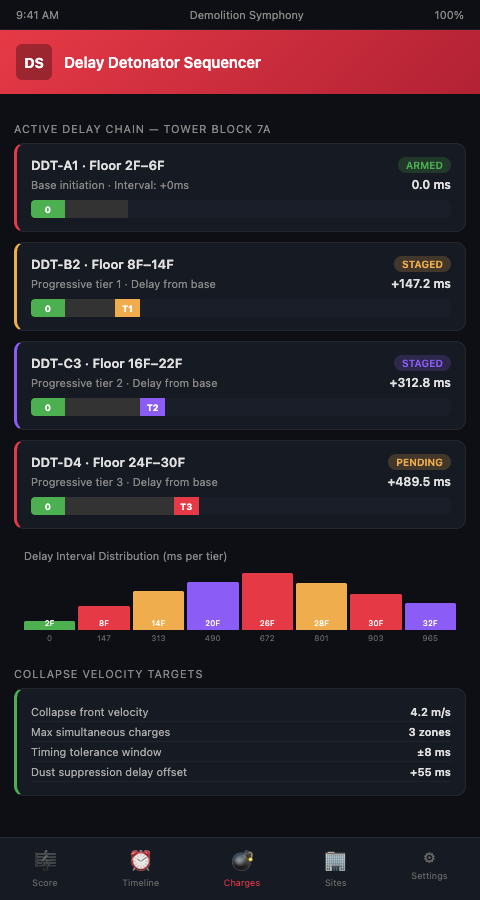
Step 4: Document the delay sequence as the visual score in Demolition Symphony Planner. The floor-by-floor implosion score is the delay interval plan made visible — each floor block shows the delay group assignment, the EDD programming value, and the ms offset from the initiation signal. When the full 40-floor score is visible simultaneously, you can verify that the inter-floor intervals are consistent, that no two adjacent floor groups are programmed with the same timing, and that the collapse mechanism produces the designed footprint. CDI case files on demolition failures demonstrate that partial-collapse failures typically involve timing anomalies that would be visible in a complete sequence review — anomalies that get missed when the plan exists only in numerical tables.
Advanced Tactics: Asymmetric Sequences, Transfer Beams, and EDD Programming Verification
Design explicit timing for transfer beams and outrigger frames. In a high-rise with transfer beams — large horizontal members that carry loads from columns above a setback — the beam must be severed in the sequence at the right moment. Too early, and the floors above lose support before the designed collapse has initiated. Too late, and the transfer beam continues to redistribute load after adjacent columns have been removed, creating an unintended cantilever condition. Transfer beams typically require dedicated charge groups with delay intervals that position their failure precisely between the floor group below and the floor group above.
Use the collapse strategy comparison between progressive and simultaneous approaches to verify your mechanism selection. Simultaneous collapse — firing all charge groups within a very tight window — is occasionally appropriate for shorter structures in open environments. For a 40-story urban high-rise, progressive collapse is almost always the correct mechanism because it limits the instantaneous ground vibration, controls debris scatter, and allows the structure to guide itself into the designed footprint rather than disintegrating without directional guidance. Confirm that your delay interval structure is consistent with progressive rather than simultaneous collapse before submitting the permit application.
Verify EDD programming before wiring. Electronic delay detonators are programmed before installation. A programming error — entering 150 ms instead of 15 ms for a specific delay group — produces a visible anomaly in the detonator memory but not in the physical wiring. All EDDs should be read back after programming to confirm that the stored delay value matches the designed interval. This verification step catches programming errors before the detonator is in the structure.
Apply delay interval principles to cantilever removal sequencing. Stadium cantilever demolition requires the same careful sequencing logic: the timing relationship between cantilever tip removal and root support removal determines whether the cantilever folds inward or rotates outward. The interval between these two events is a delay detonator design parameter, not a site judgment call.
Mechanism of EDD timing control through integrated circuit chips explains why EDD accuracy is achievable at the millisecond level. Understanding the hardware basis for timing precision — and its limits — helps you specify appropriate quality control for EDD procurement. Not all EDDs from all manufacturers achieve the same accuracy under temperature extremes or high electromagnetic field conditions. Specify EDD performance requirements in the procurement documents, not just in the design narrative.
Common mistake: designing delay intervals in the office without adjusting for actual column cross-section. Delay intervals calculated for a standard column section may be incorrect for oversized columns or heavily reinforced concrete walls that require more time to sever completely. If the column severing time is longer than the delay interval to the next charge group, the sequence runs ahead of the collapse — adjacent columns fire before the preceding column failure has propagated through the floor slab. For large structural members, extend the delay interval by 15-25% and verify through test shots on similar members during pre-demolition work.
Program Every Rest in the Score with Precision
Demolition Symphony Planner gives urban high-rise implosion coordinators the visual environment to lay out the full delay detonator sequence floor by floor, review inter-floor interval consistency, and verify that the timing architecture produces the designed collapse mechanism before a single EDD is programmed. Join the waitlist and bring your next 40-story implosion sequence onto a score where every delay interval is visible, verifiable, and documented.
The delay cap sequencing high-rise workflow described in this post applies equally to pyrotechnic and electronic systems, though with different precision tolerances. For a 40-story building with 15-25 ms target inter-floor intervals, pyrotechnic systems cannot reliably hold the designed sequence — the ±50 ms uncertainty is 2-3 times the intended interval. Electronic detonators make the four-step workflow executable at the required precision. But the workflow itself — mechanism selection, inter-floor interval assignment, frequency verification, and visual score documentation — is the same regardless of initiator type. Getting the workflow right before deciding on the initiator type ensures that the sequence logic is sound independent of the hardware executing it.