Why Cantilever Removal Order Determines Structural Stability
In January 2020, a worker was killed when a stadium roof collapsed in St. Petersburg during demolition work — a failure that Euronews attributed to inadequate structural analysis of the removal sequence. The same year, the Pontiac Silverdome had already demonstrated that stadium structures behave unpredictably under demolition conditions, with NBC reporting that the first two implosion attempts failed to bring the structure down as planned. Neither event involved cantilevered grandstands specifically, but both reflect the core principle that governs cantilever removal order structural stability: stadium structures under partial demolition carry load through paths that were never analyzed in the original design, and those paths can fail without warning if the removal sequence doesn't account for them.
Grandstand cantilever sequencing is the single most consequential schedule decision in arena and stadium teardown planning. A cantilever removed in the wrong order transfers moment forces to back-span connections that were not designed for the resulting load state — and once that transfer occurs, the remaining structure may become unsafe for continued work before anyone on the ground is aware that the load state has changed.
Why Cantilever Removal Order Is Not Intuitive
The counterintuitive aspect of grandstand cantilever sequencing is that the structurally safe removal order often appears — from ground level — to be the least efficient one. Removing the outermost cantilever sections first, working progressively toward the back span, generates more crane picks in harder access positions than removing inner sections first. But removing inner sections first eliminates the back-span contribution to the outer cantilever's stability — creating a freestanding overhang condition that may exceed the design capacity of the connection at the remaining section.
Darda's structural analysis methodology for deconstruction formalizes this through a moment distribution analysis at each removal step: before any section is removed, the redistribution of moment forces into the remaining structure is calculated for the proposed sequence and compared against the capacity of each connection. If any connection is within a defined safety margin of its limit, the sequence must be modified before removal proceeds. HSE guidance on structural stability during demolition similarly requires that each demolition phase be analyzed for stability in isolation — the assumption that a structure that was stable in the preceding phase remains stable in the next is explicitly not permitted.
Scoring Cantilever Removal Order in Demolition Symphony Planner
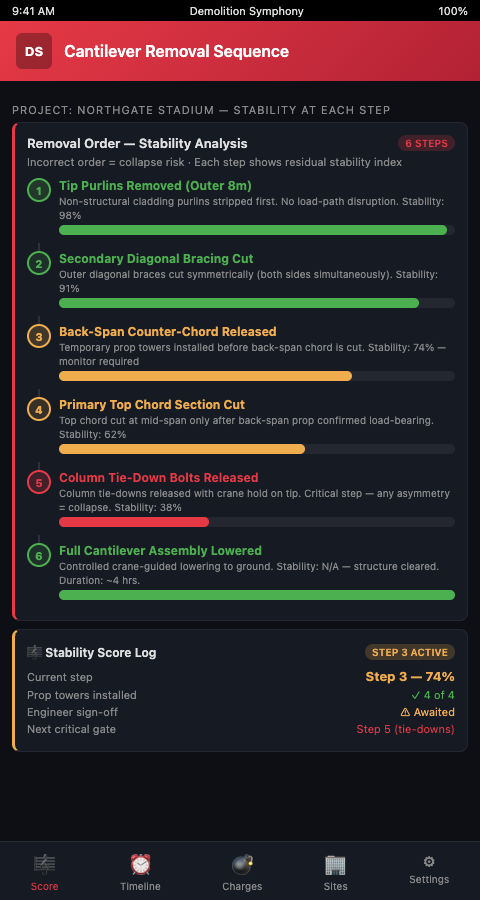
Demolition Symphony Planner translates structural stability analysis into a scored removal sequence that field crews can follow without needing to interpret engineering calculations in real time. Each removal step in the grandstand cantilever sequencing plan is notated as a measure in the demolition score, with three data elements attached: the structural state before removal, the expected load redistribution after removal, and the verification check required before the next measure begins.
The verification check — analogous to a measure line in musical notation — is the hold point that prevents field crews from advancing to the next removal step until the structural engineer has confirmed that the actual post-removal state matches the predicted state. This is not bureaucratic overhead; it is the mechanism that catches the cases where site-specific conditions — undocumented renovations, hidden corrosion, variable concrete quality — produce structural behavior that differs from the analysis model.
The curved roof load paths module integrates with the cantilever sequencing plan for roof-supported grandstand configurations, where roof structure removal and grandstand removal must be sequenced as an interdependent system rather than as separate operations.
Temporary Shoring as a Scored Element
SEPCO Engineering's redundancy and alternate load paths framework documents how temporary shoring during cantilever demolition functions as a designed structural system — not a precautionary measure, but an element that must be engineered to carry the specific loads generated at each removal stage. The Caltrans Bridge Removal Manual Chapter 3 reinforces this in the bridge context, where temporary support systems for phased span removal are designed to the same standard as permanent structural elements.
For grandstand cantilever sequencing, this means that temporary shoring must be installed, verified, and load-tested before any cantilever member is removed — and must remain in place until the structural analysis confirms that the remaining structure has achieved a stable configuration without it. Stadium overhang demolition safety depends on treating shoring as a structural phase element, not an optional safety measure that can be omitted when schedule pressure increases.
Demolition Symphony Planner scores shoring installations as rest periods in the cantilever removal sequence: heavy demolition equipment stands down, shoring crews complete installation and verification, and structural confirmation is recorded before the score advances to the next removal measure.
Advanced Tactics for Cantilever Deconstruction Phasing
Three advanced tactics improve structural safety outcomes in complex grandstand cantilever removal projects.
Pre-removal load testing at each phase. Rather than relying solely on analytical models, experienced teams load-test the temporary shoring system before the first cantilever in each phase is removed — confirming that the shoring achieves its designed capacity under actual site conditions before it is called upon to carry the redistribution load. This approach is consistent with the Hong Kong Code of Practice for Demolition's requirement for site-specific verification of assumed structural conditions.
Cross-phase stability monitoring. Structural integrity during cantilever removal is not a static condition — it changes continuously as each member is removed. Advanced teams install continuous structural monitoring (tilt sensors, strain gauges, deflection measurement) on key connections throughout the removal sequence, with threshold alerts that stop demolition work if movement exceeds the bounds predicted by the structural model. Procore construction scheduling research confirms that monitoring-triggered holds, though they appear to add delay, consistently reduce total project cost by preventing unplanned structural events that require emergency response.
Coordinated sequencing with deconstruction scoring methodology. The cantilever removal order plan is one component of a broader deconstruction score that covers all structural systems in the venue. Coordinating the cantilever plan with the full deconstruction score ensures that operations in adjacent structural systems — roof truss removal, concourse slab demolition — are not scheduled during cantilever removal phases that require structural quiet. The cross-system coordination logic draws from phased pier column removal experience, where interdependent structural systems must be sequenced as a single scored plan rather than as parallel independent operations.
Stability as the Non-Negotiable Constraint
Cantilever removal order structural stability is not a parameter to be optimized against schedule efficiency — it is the non-negotiable constraint within which schedule efficiency must be achieved. Demolition Symphony Planner's score notation system makes this constraint visible to every member of the project team: the removal sequence is what it is because the structural analysis requires it to be, and any proposed change to the sequence must be re-analyzed before it can be implemented.
For stadium and arena demolition specialists who have absorbed the lesson of St. Petersburg and Silverdome — that stadium structures under demolition conditions behave in ways that planning must anticipate — the scored removal sequence is the tool that keeps cantilever deconstruction phasing within safe bounds from the first bay to the last. Score Your Stadium Teardown with Demolition Symphony Planner and build a grandstand removal order plan that structural analysis drives, not schedule pressure. Get started with a cantilever removal sequence that maps every stability-critical bay before the first high-reach excavator is positioned.