Creating a Deconstruction Score for Cantilevered Grandstands
In January 1978, the Hartford Civic Center roof collapsed under snow load just hours after an NCAA basketball game ended — an event the SELI structural engineering case study attributes to progressive overload from accumulated design errors across interconnected structural members. No one was killed because the arena was empty, but the failure mode — load redistribution through a cantilevered system until a tipping point triggered cascading collapse — is precisely the scenario that grandstand removal planning must prevent from playing out in reverse, in controlled sequence, during demolition.
Cantilevered grandstands are the defining structural challenge of stadium and arena demolition. Their reach depends on back-span tension and moment-resisting connections that change character the moment any part of the system is removed. A cantilevered grandstand deconstruction score — a visual demolition score that notates every structural cut, shoring installation, and crew position across time — is the primary tool for keeping cantilever structural phasing within safe bounds from the first bay removal to the last.
Why Demolition Sequence Notation Fails Without Visual Structure
Verbal sequence instructions and text-based work orders fail on cantilevered grandstand removal for the same reason that a verbal description of a symphony fails as a conductor's score: they cannot represent simultaneous events, temporal dependencies, and hold points in a format that multiple trades can read and follow in parallel. A structural engineer's phase report documents the analysis. A demolition score translates that analysis into a visual timeline that a foreman can reference from a tablet at the work face.
LUSAS dynamic analysis of grandstand structures demonstrates that cantilevered systems are sensitive to vibration from adjacent demolition activity — a constraint that the deconstruction score must represent as an exclusion zone notation, not a footnote in an engineering report. The Hong Kong Code of Practice for Demolition formalizes the requirement for a documented sequential demolition plan for any structure involving cantilevers and suspended elements, and the EU Deconstruction Protocol for Steel Structures similarly requires a phase-by-phase structural stability verification.
Both regulatory frameworks assume the existence of a sequence document that is detailed enough to verify. The cantilevered grandstand deconstruction score is that document.
Building the Score: Four Notation Elements
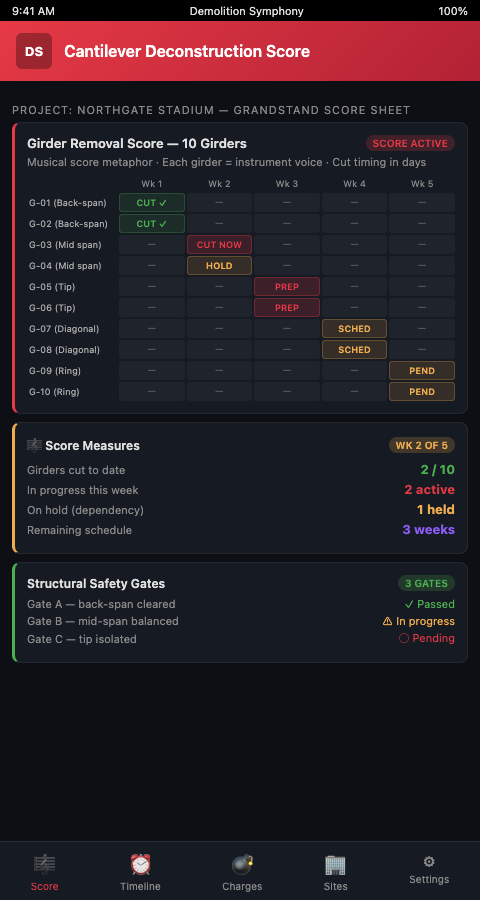
Demolition Symphony Planner organizes grandstand removal planning around four notation elements that map directly to the structural phasing decisions an engineer must make.
Structural measure lines. The score is divided into measures, each representing a discrete removal phase. Measure lines correspond to structural phase gates — points at which the remaining structure must be re-verified for stability before the next phase begins. The HSE guidance on structural stability during demolition mandates that each phase be assessed against the as-built geometry of the remaining structure, not the original; Demolition Symphony Planner's measure-line system enforces this by linking each gate to a structural check template.
Tied notes for interdependent cuts. When two structural members cannot be removed independently — because removing one before the other would create an unstable cantilever — the score marks them as tied notes: a visual indicator that both cuts must be choreographed as a single operation. Research on cantilevered roof system design for stadium stands (ResearchGate) documents the moment-redistribution behavior that makes simultaneous or tightly sequenced cuts necessary in many grandstand configurations.
Rests for shoring and inspection. Every phase that requires temporary shoring installation is marked as a rest in the score — a period during which demolition equipment stands down and structural support crews complete their work. The cantilever removal order module within Demolition Symphony Planner extends rest notation to include equipment exclusion zones, ensuring that crane operations don't induce dynamic load in sections where shoring is being installed.
Cross-references to the selective deconstruction zone map. A grandstand deconstruction score does not exist in isolation — it is one voice in the full demolition score. Cross-references between the grandstand score and the overall zone map ensure that salvage operations in adjacent areas are not scheduled during structural phases that require site-wide vibration control.
Advanced Tactics for Cantilever Structural Phasing
Once the four notation elements are in place, experienced teams apply three additional tactics that separate scored grandstand removals from unscored ones.
BIM-integrated score generation. BIM uses for deconstruction (Taylor & Francis, 2021) have matured to the point where Scan-to-BIM workflows can generate a geometric model of the as-built grandstand structure — including renovation additions that may not appear in original drawings. Demolition Symphony Planner ingests BIM geometry to auto-generate the initial measure-line boundaries based on structural bay spacing, reducing manual score-building time by eliminating the geometry translation step. Automated robotic deconstruction sequence planning research (ScienceDirect, 2025) further demonstrates that scan-derived models improve structural phase planning accuracy for complex cantilever geometries. A critical pre-score step that is often underestimated is verifying anchorage integrity: the Hong Kong demolition code explicitly requires that anchorage holding down cantilevers must never be removed before the cantilever itself is demolished — the deconstruction score enforces this by sequencing anchorage release as the final tied note in each cantilever removal measure, not the first.
Vibration monitoring integrated into rest notation. Each rest period in the grandstand score includes a vibration threshold parameter. If continuous monitoring detects ground-borne vibration from adjacent demolition equipment above the threshold, the rest period extends automatically until readings fall back within bounds. This prevents the scenario where a foreman on a tight schedule authorizes shoring installation in a vibration environment that degrades the temporary support before it can be loaded. The grandstand removal planning benefit of integrated vibration monitoring extends beyond safety: when the monitoring record is attached to each rest period in the score, it creates a timestamped compliance record demonstrating that each shoring installation was completed within the specified vibration environment — documentation that simplifies the structural engineer's phase-gate sign-off and reduces the approval lag between rest periods and the subsequent demolition measure.
Cross-score coordination with the decommissioning scoring methodology. Industrial plant decommissioning teams developed score-based sequencing for multi-system teardowns where mechanical, electrical, and structural phases must interleave without creating hazardous conditions. The same cross-system coordination logic applies to stadium grandstands where HVAC, electrical, and plumbing systems are embedded in the cantilever structure — the grandstand deconstruction score must account for these embedded systems as preparation measures that precede structural cuts.
The Score as the Safety Document
A cantilevered grandstand deconstruction score is not a planning convenience — it is a structural safety document and a demolition sequence notation system that makes the engineering logic visible to every trade on the project. It converts abstract phase-gate requirements into observable field events and creates an auditable record that demonstrates compliance with HSE, Hong Kong Code, and EU protocol requirements.
Stadium and arena demolition specialists who have experienced mid-project redesign due to an unsequenced cantilever cut understand the cost: schedule compression, emergency shoring procurement, and in some cases, complete re-sequencing of the demolition plan. The score prevents that redesign by making the structural logic and visual demolition score planning explicit before mobilization. Score Your Stadium Teardown with Demolition Symphony Planner and build a grandstand removal plan that translates engineering analysis into crew-level notation. Get started now and bring cantilevered grandstand deconstruction scoring into your next large venue project before mobilization day.