How to Plan Selective Deconstruction for Stadium Demolition
When the Castelao Soccer Stadium in Brazil required partial reconstruction ahead of the 2014 FIFA World Cup, engineers discovered what stadium teardown teams confront on nearly every large-venue project: the difference between a wrecking-ball approach and a selective deconstruction plan can mean millions in recoverable material value lost in a single unplanned cut. Research published in Waste Management estimates that selective demolition recovers 30–50% more material value than conventional demolition on equivalent structures — yet most stadium teardown planning guides still treat scope definition as an afterthought.
The US demolition and wrecking industry generates roughly $11.2 billion in annual revenue (IBISWorld), and a growing share of that work involves venues where city councils, heritage groups, and sustainability mandates require a documented selective deconstruction stadium demolition plan before a permit is issued. Getting that plan right at the outset determines whether the project runs on time, on budget, and on the right side of public scrutiny.
Why Scope Definition Fails on Stadium Projects
Stadium teardown planning fails at the scope-definition stage for three predictable reasons. First, demolition teams inherit structural drawings that were never updated after renovation cycles — grandstand extensions, luxury-box additions, and roof-system upgrades all alter load paths that the original documents don't reflect. Second, salvage inventories are conducted too late, after mobilization has already committed equipment to a sequence that conflicts with artifact windows. Third, "deconstruct what's valuable, demolish the rest" gets stated as a principle without being translated into a zone-by-zone sequencing map that crews can actually follow in the field.
Each of those failures compounds the others. A missed load-path update causes a salvage bay to be cleared by heavy demolition equipment before the salvageable component mapping team has finished its audit. The audit delay pushes the salvage window into a phase when structural instability makes manual extraction unsafe. The project absorbs cost and schedule overrun before the first structural member hits the ground.
The Demolition Symphony Framework for Selective Deconstruction
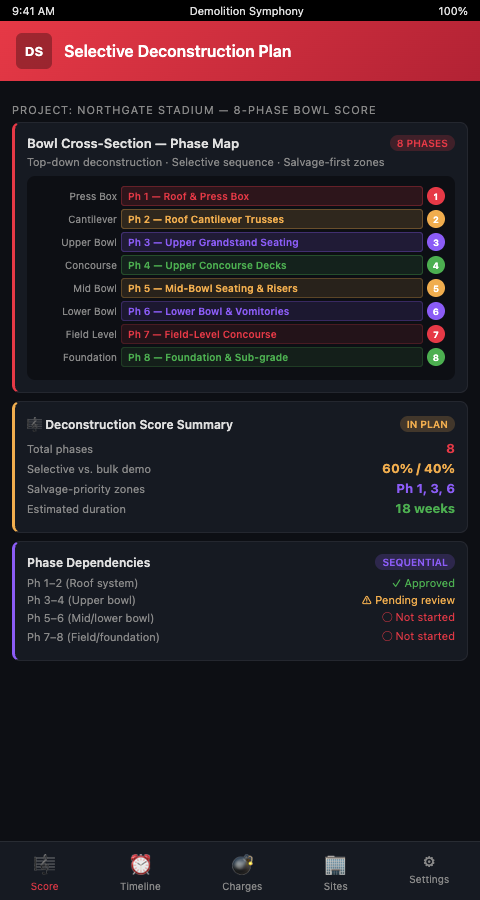
Demolition Symphony Planner treats a selective deconstruction stadium demolition project the way a conductor treats a complex score: every salvage window, recycling stream, and structural cut becomes musical notation on a visual demolition score, keeping impossible urban timelines on beat. That metaphor is operational, not decorative. A score has measures, rests, and cues. A demolition score has phases, hold points, and handoff triggers.
The framework breaks scope definition into four movements.
Movement 1 — Audit and Zone. Before any scope language is written, the site is divided into demolition zones based on material type, structural interdependency, and salvage priority. Concrete bowl sections, steel roof trusses, mechanical rooms, and field-level infrastructure each get their own zone designation. Zone boundaries are drawn on a plan set that every trade — demolition, salvage, recycling logistics — works from simultaneously.
Movement 2 — Score the Salvage Windows. Each zone receives a salvage window: the sequence interval during which manual extraction is both structurally safe and logistically feasible. These windows are plotted on the demolition score as rests — periods when heavy demolition equipment stands down and salvage crews move in. The material recycling workflow is locked to these windows, ensuring that sorted material streams leave the site before the next demolition phase begins.
Movement 3 — Define Structural Interdependencies. A cantilevered grandstand cannot be removed in the same sequence as a flat-slab parking structure. The score notation system in Demolition Symphony Planner flags structural interdependencies as tied notes — cuts that must happen in a specific order to preserve the stability of adjacent sections. ASCE case study research demonstrates that engineered demolition plans reduce unplanned collapse events by documenting load redistribution at each phase.
Movement 4 — Assign Phase Gates. Phase gates are the hold points in the score where an inspector, structural engineer, or project owner must sign off before the next movement begins. Alpine Demolition's engineered demo plan methodology formalizes this as a documented checkpoint system; Demolition Symphony Planner digitizes it so gate status is visible across the project team in real time. The demolition scope definition stadium documentation that accompanies each phase gate gives permit authorities and heritage reviewers a verifiable record that the sequence is being followed as approved — reducing the friction at each subsequent inspection cycle.
Advanced Tactics for Venue Deconstruction Sequencing
Once the four-movement framework is in place, experienced stadium teardown teams layer three additional tactics that separate on-budget projects from overrun projects.
Parallel-track salvage and demo. Rather than running salvage operations sequentially ahead of demolition, advanced teams choreograph overlapping tracks: while heavy equipment works the north grandstand bowl, salvage crews extract seating, signage, and mechanical equipment from the east concourse. Demolition Symphony Planner's score visualization makes parallel tracks visible without creating unsafe zone conflicts — each track is plotted on a separate staff, and the system flags any temporal overlap that would put crews in adjacent zones simultaneously.
Pre-bid scope lockdown. One of the most expensive scope creep patterns in stadium teardown planning is a salvage list that expands after bid submission. The venue deconstruction sequencing framework addresses this by requiring the salvage audit to be complete before the bid package is released — meaning contractors price a defined scope, not an open-ended one. Research on stakeholder perceptions of selective demolition (ScienceDirect, 2023) found that early stakeholder alignment on salvage scope reduced mid-project change orders by a statistically significant margin. The MSU approaches and costs framework further confirms that treating deconstruction as "construction in reverse" — with each removal step planned to allow material separation — is the foundation for a scope that holds through execution.
Cross-reference the implosion score basics for hybrid projects. Some stadium teardowns combine selective deconstruction of historic or salvageable sections with controlled implosion of the structural core. Teams that have internalized implosion score methodology can apply the same notation logic to hybrid projects — scoring the selective deconstruction phases on the front end and the implosion event as the final measure.
Translating the Plan Into Field Reality
The most refined selective deconstruction stadium demolition plan fails if it doesn't translate into crew-level instructions. Demolition Symphony Planner exports phase-specific work orders that reference zone designations, salvage windows, and phase gate requirements in plain language — no engineering degree required to follow the sequence on a tablet in the field.
Stadium and arena demolition projects are among the most publicly visible in any city's development calendar. A plan that demonstrates systematic salvage-first demolition workflow to permit authorities, heritage stakeholders, and sustainability reviewers doesn't just reduce waste — it reduces friction at every approval stage. The venue deconstruction sequencing discipline embedded in the score is also a contractual risk management tool: when zone boundaries, salvage windows, and phase gate requirements are documented before mobilization, mid-project disputes about scope, responsibility, and delay attribution are resolved by reference to the agreed plan rather than competing interpretations. Score your stadium teardown with a selective deconstruction plan that treats every material stream as a voice in the score, and the project runs the way a well-rehearsed orchestra plays: every section on cue, every rest observed, every movement completed before the next begins.
Ready to build your demolition score? Score Your Stadium Teardown with Demolition Symphony Planner and define your selective deconstruction scope before the first equipment mobilizes. Get started today and turn your venue teardown plan into a structured, phase-gated demolition score that every trade can follow from mobilization to final clearance.