Introduction to Material Recycling Workflows in Stadium Teardowns
When the Sacramento Kings built the Golden 1 Center, the project achieved 99% material diversion from landfill during construction — a figure that CNBC cited as a benchmark for sustainable sports venue development. The inverse challenge — achieving equivalent diversion during demolition — is structurally harder, because demolition generates mixed material streams under time pressure rather than clean procurement under controlled conditions. Yet the EPA's C&D debris data confirms that concrete constitutes approximately 70% of stadium demolition waste by weight, and PMC research on recycled aggregates demonstrates that up to 50% substitution of recycled aggregates for virgin material is structurally feasible in new concrete applications. The recovery potential is there. The gap is a systematic material recycling workflow.
Material recycling workflow stadium teardown planning is not a sustainability add-on to the demolition schedule — it is a core logistics challenge that determines where equipment is positioned, how material streams move off site, and which demolition sequences maximize the quality of recovered material. Demolition Symphony Planner integrates recycling logistics into the demolition score from the outset, treating each material stream as a voice in the score that must be choreographed alongside structural and salvage operations.
What a Venue Deconstruction Recycling Process Actually Requires
The phrase "recycling-first demolition" is easy to put in a bid document and difficult to execute in the field. A functional venue deconstruction recycling process requires four things that most demolition plans address in isolation rather than as an integrated system.
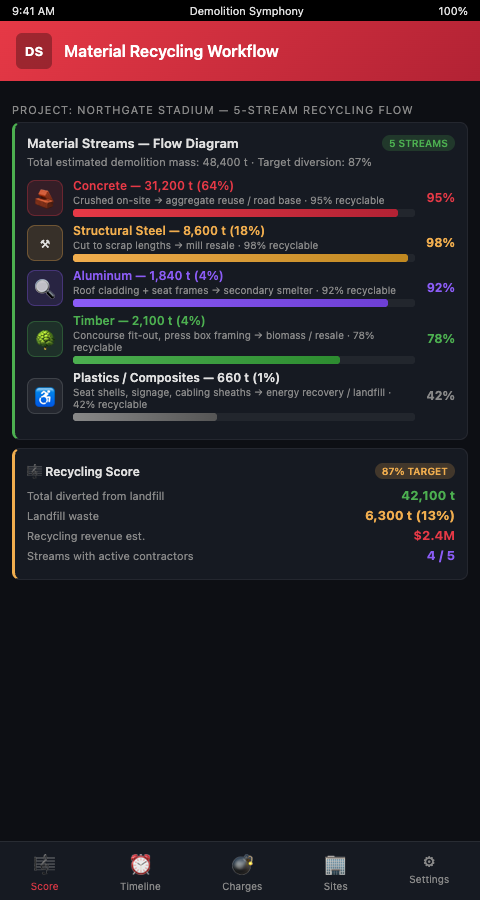
Sorted material streams from the point of generation. Recycled materials from stadium demolition achieve maximum value — and maximum acceptance by recycling facilities — when they are sorted at the point of demolition rather than at a downstream processing facility. Concrete demolished separately from embedded rebar produces clean aggregate. Concrete demolished together with steel produces a contaminated mix that requires additional processing and commands a lower market value. Demolition Symphony Planner's demolition material sorting system scores the separation sequence into the phase plan: concrete cutting precedes rebar extraction in each bay, and material streams are routed to designated accumulation zones before any mechanical demolition begins.
On-site material accumulation zones sized to the demolition rhythm. A material stream that cannot leave the site fast enough backs up demolition progress. The EPA's Sustainable Management of C&D Materials guidelines emphasize that on-site material management — temporary stockpiling, sorting, and staging for transport — must be planned to match the demolition production rate. Demolition Symphony Planner sizes accumulation zones based on the demolition phase sequence, ensuring that transport capacity is scheduled to match phase output before phase work begins.
Verified recycler capacity before demolition begins. Concrete recycling facilities have finite daily intake capacity. A stadium teardown that generates 500 tons of concrete per day cannot assume that regional recyclers can absorb that volume without pre-booking. The demolition material sorting system in Demolition Symphony Planner includes a recycler capacity verification step during pre-phase planning — the system flags any phase whose projected material output exceeds confirmed recycler intake capacity. This pre-booking discipline also benefits the recycler: confirmed delivery volumes let processors schedule crusher shifts and transport equipment in advance, which is why well-organized stadium demolition projects often secure preferential intake rates in exchange for the predictability their phase-level tonnage forecasts provide.
Documentation for waste diversion reporting. Increasingly, stadium demolition permits and sustainability commitments require documented waste diversion rates at project completion. The FIFA Qatar 2022 circular economy research (ScienceDirect) documented how inadequate diversion documentation created post-project compliance gaps even when physical recycling activity had occurred. Research on reusing stadiums for circular design confirms that circular reuse of stadium components significantly reduces lifecycle environmental impact — making diversion documentation not just a compliance requirement but a foundation for demonstrating project sustainability value. Demolition Symphony Planner generates diversion records automatically from material stream data, building the compliance documentation throughout the project rather than reconstructing it at the end.
Coordinating Recycling Workflows With the Demolition Score
The operational challenge of material recycling workflow stadium teardown planning is that recycling logistics operate on a different rhythm than structural demolition. Demolition phases are driven by structural sequencing logic; recycling phases are driven by material volume accumulation and transport scheduling. When these two rhythms are managed separately, they conflict — demolition stalls waiting for accumulation zones to clear, or recyclers receive material at uneven rates that exceed their processing capacity.
The recycling-first planning approach resolves this by treating recycling logistics as a scored parallel track rather than a downstream afterthought. Just as a musical score coordinates melody and rhythm simultaneously, Demolition Symphony Planner coordinates structural demolition phases and recycling logistics on parallel tracks — each phase's material output is matched to a confirmed recycler pickup schedule before the phase is authorized to begin.
The material recovery rates module provides the tonnage forecasts that make this coordination possible. Without a reliable estimate of how much concrete, steel, aluminum, and specialty material each phase will generate, recycler capacity booking is guesswork. With phase-level tonnage forecasts, logistics planning becomes precise.
Advanced Tactics for Stadium Demolition Waste Diversion
Three tactics move a venue deconstruction recycling process from compliant to optimized.
Material-specific demolition sequencing. PMC research on reusing stadiums through circular design principles documents how demolition sequence directly affects material quality — specifically, how mechanical demolition of concrete before embedded mechanical and electrical systems are removed reduces the recyclability of both. Advanced teams sequence material extraction by type before mechanical demolition begins: MEP systems first, architectural finishes second, structural concrete and steel third. The recycling workflow for each material type is activated in sequence rather than simultaneously.
Cross-stream value optimization. Not all recycled materials generate equal revenue. Steel commands a commodity market price; clean concrete aggregate has regional value that varies by proximity to active construction projects; aluminum and copper have high unit value but low volume. Demolition Symphony Planner's material stream tracking identifies which streams generate the highest net recovery value and sequences their extraction to maximize quality — a direct application of the waste stream segregation methodology developed for multi-material industrial demolition projects.
Phase-level diversion rate monitoring. Rather than calculating the waste diversion rate at project completion, advanced teams track diversion rate by phase — identifying underperforming material streams in real time and adjusting sorting or transport protocols before the next phase begins. Demolition Symphony Planner displays phase-level diversion rate on the project dashboard, converting an end-of-project metric into an operational feedback tool.
Making Recycling Logistics as Rigorous as Structural Engineering
The demolition industry has developed highly rigorous frameworks for structural sequencing, temporary works design, and safety management. Material recycling workflow planning deserves the same rigor — not because sustainability reporting requires it, but because material recovery generates revenue and diversion avoids disposal cost. A stadium teardown that recovers clean, sorted concrete aggregate rather than mixed demolition debris generates a measurably better financial outcome, independent of any sustainability mandate.
In practice, applying structural engineering rigor to recycling logistics means three things: specifying material output tolerances for each demolition phase as precisely as temporary works load tolerances are specified, requiring verification of recycler intake capacity before each phase begins rather than assuming it, and treating diversion rate variance as an operational signal that triggers a protocol review — not an accounting discrepancy to be corrected at project closeout. The phase gate discipline that prevents a structural cut from proceeding before temporary shoring is confirmed applies directly to material stream management: no demolition phase should begin before the recycler pickup schedule for that phase's output has been confirmed and logged in the project score. Teams that apply this level of operational discipline to recycling logistics consistently outperform those that treat material recovery as a background activity running in parallel with the "real" demolition work.
Score Your Stadium Teardown with Demolition Symphony Planner and build a material recycling workflow that runs as a scored parallel track alongside your structural demolition sequence — keeping every material stream on beat from the first cut to the final transport.