Waste Stream Segregation Workflow for Multi-Material Plant Demolition
EPA data on construction and demolition materials places the annual volume of C&D debris in the United States at 600 million tons, with 90% of that volume generated by demolition rather than construction. On industrial plant decommissioning projects, that volume includes materials that no standard C&D recycling facility can accept: PCB-contaminated concrete, lead-painted structural steel, asbestos-wrapped pipe insulation, and process equipment with residual hazardous materials. Waste stream segregation multi-material plant demolition planning must distinguish not just hazardous from non-hazardous but must categorize materials by disposal pathway—regulated landfill, licensed hazardous waste treatment facility, metal recycler, concrete crusher, or on-site treatment—before any demolition activity begins.
The failure mode is demolition-first segregation: debris is generated, then sorted on the ground, then characterized, then routed to disposal. That sequence is backwards. Once concrete from a lead-contaminated wall is mixed with concrete from an uncontaminated wall in the same debris pile, the entire pile becomes suspect and may require characterization testing before any of it can be taken to a standard concrete recycler. The mixing event—which cost nothing extra in labor—may add weeks and thousands of dollars in testing and elevated disposal costs. Industrial demolition waste sorting workflow must be designed before demolition starts, not improvised as materials accumulate.
EPA's sustainable management framework for C&D materials establishes the hierarchy for C&D waste management: reduce, reuse, recycle, and dispose. EPA's C&D debris data confirms that 90% of C&D debris volume comes from demolition, making the demolition waste segregation decision the primary driver of whether a project achieves diversion goals or sends everything to the landfill. Mixed material waste handling industrial teardown that lacks upfront segregation planning consistently underperforms against both cost and diversion targets.
The Multi-Material Segregation Problem
Think of a multi-material industrial plant as a score with a dozen instrument voices, each producing a distinct sound. The demolition process silences all those voices simultaneously—but the debris they generate must be sorted back into coherent categories before it can leave the site. The waste stream segregation workflow is the score annotation that tells every crew which debris voice gets routed to which section of the orchestra pit. Without those annotations, all the debris ends up in one pile—and the recycler, the landfill, and the hazardous waste facility each refuse to take material that doesn't belong to them.
The multi-material segregation problem at industrial plants involves seven distinct material categories, each with its own handling, characterization, and disposal requirements. Hazardous materials requiring regulated waste disposal: asbestos-containing materials, PCB-containing materials, lead paint debris, and process equipment with hazardous residuals. Potentially hazardous materials requiring characterization before pathway determination: concrete from process areas with potential contamination, structural steel from chemical storage areas, and soil-contaminated floor slabs. Non-hazardous recyclables: clean structural steel, uncontaminated concrete, copper wiring, and aluminum cladding. Non-hazardous waste: clean wood, standard drywall, and non-contaminated insulation. Universal wastes: fluorescent lamps, mercury-containing switches, and batteries. Hazardous residuals in equipment: process fluids, catalyst materials, and reactive residues requiring separate removal before equipment demolition. And salvageable equipment: items with reuse or resale value that must be extracted intact before demolition activities begin.
ScienceDirect's 2025 research on C&D recycling trends documents that material pre-sorting at the point of generation—rather than mixed-pile sorting at staging areas—achieves significantly higher diversion rates and lower contamination-related disposal costs. PMC's circular economy research on C&D waste establishes the economic case: pre-sorted clean material has substantially higher recycling value than sorted material from mixed piles, because the recycler's processing cost is lower and the contamination risk is lower.
WBDG's construction waste management guide provides a waste management plan framework that applies directly to industrial demolition waste segregation. The key requirement: waste stream identification and disposal pathway pre-designation must be completed before demolition begins, not after materials are generated.
Building the Segregation Workflow into the Demolition Score
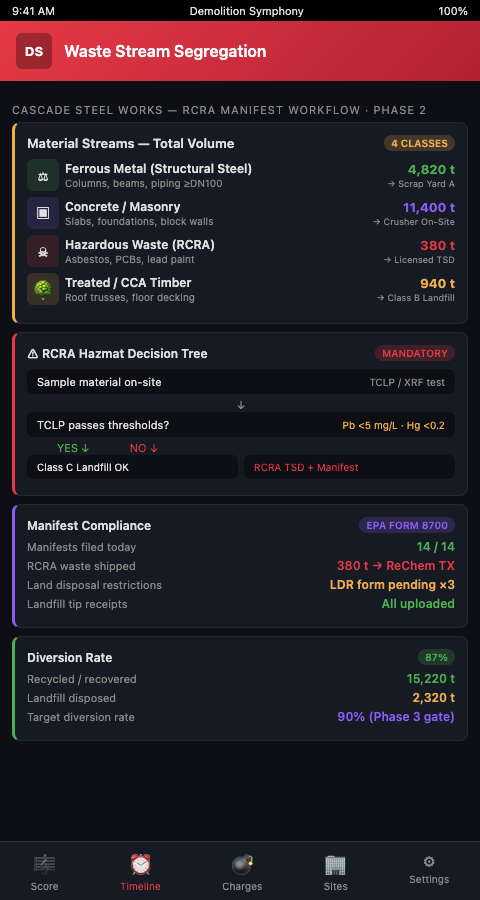
Demolition Symphony Planner treats waste stream segregation as a pre-activity voice on the decommissioning score. Before any zone can be marked ready for demolition, the segregation plan for that zone must be entered: material categories present, disposal pathway for each category, staging location for each stream, and estimated volume for each category. The system uses that information to calculate debris staging area requirements and flag any staging conflicts between zones scheduled for simultaneous demolition.
The segregation workflow integrates with demolition method selection. Some material categories are only cleanly segregable if the demolition method allows selective disassembly rather than bulk mechanical demolition. A load-bearing wall with asbestos-containing plaster coating cannot be knocked down with an excavator and then sorted—the asbestos fibers are released during demolition and contaminate the entire debris pile. The wall must be plaster-stripped first (asbestos abatement), then structurally demolished (clean concrete and steel). Demolition Symphony Planner flags that two-step requirement when the zone's material inventory includes asbestos-containing materials combined with structural demolition scope.
Hazmat disposal coordination timelines interact with waste stream segregation through the manifesting requirement: hazardous debris streams require EPA/manifest chain-of-custody documentation that begins at the point of generation in the field, not at the staging area. Each hazardous material container must be labeled at the point where it is filled, with the waste code, generator information, and accumulation start date. The segregation workflow must specify who is responsible for container labeling in each zone and must ensure that labels and containers are available at each demolition work front before debris generation begins.
TOMRA's analysis of C&D waste recycling options identifies the processing technologies available for clean C&D material streams—optical sorting, eddy current separation, air classification—and notes that each technology has minimum purity requirements for the input stream. Pre-sorting at the demolition face is the only reliable way to meet those purity requirements consistently.
Advanced Tactics for Industrial Waste Stream Management
EPA's regulation of C&D landfills distinguishes between municipal solid waste landfills (stringent liner requirements) and C&D landfills (less stringent, but accepting only non-hazardous C&D debris). Industrial demolition projects that send contaminated debris to C&D landfills are violating both the disposal facility's acceptance criteria and federal hazardous waste regulations. The project team must verify acceptance criteria for every proposed disposal facility before demolition begins—not after a load is rejected at the gate.
For industrial plant decommissioning projects with significant metal value, waste stream management facility strip-out planning should include a salvage extraction phase before mechanical demolition. Copper wiring, instrumentation equipment, and stainless steel process vessels have scrap values that can partially offset demolition costs—but only if they are extracted intact before surrounding structures collapse on them. The salvage extraction phase is a distinct voice on the score, with its own crew, its own scope, and its own completion requirement before mechanical demolition begins.
Material recovery optimization across the full teardown extends this logic to the full project: waste stream segregation planning is the prerequisite for material recovery optimization. You cannot optimize recovery from a material stream you haven't identified and pre-designated in the demolition sequence.
Cross-niche application: the waste stream segregation logic that governs multi-material industrial demolition applies at smaller scale to segmental concrete bridge disassembly, where pre-stressed concrete segments, rebar, post-tensioning cables, and expansion joint materials each require different handling and disposal pathways—and where mixing them in the debris pile destroys the recyclability of the metal streams.
Hazardous non-hazardous waste separation decommissioning success depends on a waste stream management plan that is written at the zone level, not the project level. Each zone has its own material profile, its own demolition sequence, and its own debris generation pattern. Demolition Symphony Planner generates zone-specific waste stream plans from the pre-activity material inventory, ensuring that every crew entering a zone has a specific, documented waste handling procedure—not a generic project waste plan that doesn't reflect the zone's actual material mix.
Ready to build your waste segregation workflow? Load your zone material inventories into Demolition Symphony Planner and let the system generate disposal pathway assignments, staging area allocations, and container labeling requirements for each zone before your demolition schedule is finalized.