How to Coordinate Hazmat Disposal with Structural Timelines
SCS Engineers documented that failure to sequence abatement and hazardous waste removal before renovation or demolition is responsible for both safety hazards and significant project delays—a finding that understates the problem on industrial plants where hazmat disposal isn't a single event but a rolling series of manifested shipments spanning multiple waste streams, multiple disposal facilities, and multiple regulatory timelines. Hazmat disposal coordination structural demolition timeline failures don't look like explosions; they look like a structural demo crew standing idle for three weeks while a manifest dispute holds a PCB shipment at a transfer facility.
The mechanism of failure is predictable. Hazardous waste removal structural schedule alignment breaks down because the people who write the demolition schedule and the people who manage hazmat logistics operate on different timelines. A structural superintendent schedules around weather, equipment availability, and substrate conditions. A hazmat logistics manager schedules around manifest approval windows, disposal facility capacity, and DOT transport regulations. Those two schedules are rarely in the same document, let alone the same coordination meeting.
HWH Environmental's guidance on handling hazardous waste at construction sites identifies regulatory compliance as the primary driver of hazmat disposal delays—not physical removal, but paperwork, characterization testing, and manifest chain-of-custody requirements that must be completed before a container can leave the site. The EPA's RCRA generator guidance establishes that large quantity generators must notify the EPA, obtain an EPA ID, and comply with accumulation time limits that differ by waste classification. On an industrial plant decommissioning project generating multiple waste streams simultaneously, those regulatory timelines become scheduling constraints that must appear on the project score.
The Disposal-Structure Timing Conflict
Think of industrial demolition as a two-voiced score: hazmat disposal is the first violin section, structural demolition is the cello section. Both must play through the same piece, but the cellos cannot begin their movement until the first violins have fully resolved their phrase—and the resolution of that phrase is not determined by the musicians but by the concert hall's acoustic clearance inspector. Until that inspector signs off, the cellos wait. The waiting is not wasted time; it is the mandatory rest between movements. The problem arises when the conductor did not build that rest into the original score.
The hazardous waste removal structural schedule alignment problem has three specific failure points. First, characterization lag: waste must be characterized before it can be manifested, and characterization testing can take 2-4 weeks depending on the contaminant profile. If characterization samples are collected at the same time structural demolition is scheduled to begin in that zone, the two timelines are already in conflict. Second, disposal facility capacity: PCB disposal facilities, high-temperature incinerators, and regulated landfills operate at limited capacity and require advance scheduling. A large plant decommissioning project generating hundreds of tons of multiple waste streams will strain facility capacity across the region. The 2024 RCRA manifest system update tightened e-Manifest requirements, adding another compliance step to each shipment. Third, container staging: waste containers accumulate on site during the characterization and manifesting window, occupying space that the structural demolition plan assumes will be available for equipment staging and debris handling.
BHH Demolition Services' commercial demolition planning guide notes that timeline and compliance management for demolition projects with hazmat streams requires pre-project waste stream characterization—not just pre-activity characterization—so that disposal facility bookings can be made before demolition begins rather than while structural work is waiting.
Coordinating Disposal Logistics with the Structural Score
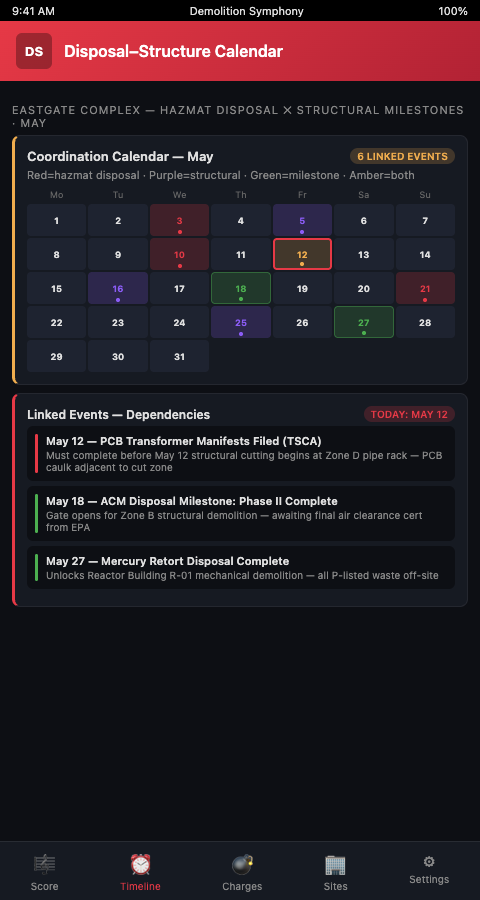
Demolition Symphony Planner treats hazmat disposal as a voice with its own tempo markings on the project score. Each waste stream—asbestos, PCBs, lead paint, petroleum hydrocarbons—has a disposal voice that includes characterization windows, manifesting lead times, transport scheduling, and disposal facility confirmation. Those voice entries are placed on the score before the structural demolition voice is scheduled, so the structural timeline is built around the disposal reality rather than assuming disposal will accommodate whatever schedule the structural team prefers.
The coordination mechanism works across three phases. Pre-mobilization: all waste streams are characterized, EPA IDs are confirmed, and disposal facility capacity is pre-booked for estimated volumes and dates. Active demolition: as waste is generated zone by zone, manifest completion drives container release from staging areas, freeing space for debris handling. The score shows each zone's current container count against available staging capacity, flagging when a zone is approaching the accumulation limit that would require a hold on structural activity. Post-phase: before a structural phase can begin in a zone, the score requires confirmation that hazmat disposal in that zone is complete and all containers have departed.
For coordinating with the full hazmat sequencing plan, the disposal voice interacts with the abatement voice: the abatement schedule determines when waste is generated, and the disposal schedule determines how long it stays on site. Misalignment between those two sub-voices creates the container staging crisis that stops structural work.
TxDOT's hazardous material procedures manual provides a useful template for waste stream identification and manifest preparation requirements that translate to industrial decommissioning projects across jurisdictions. The USGBC's waste management planning guidance adds the sustainability dimension: waste stream segregation that enables recycling versus disposal affects both the volume requiring manifested disposal and the cost of the disposal phase.
Advanced Tactics for Hazmat Logistics Alignment
Industrial demolition hazmat logistics on a large plant requires a waste logistics lead who is distinct from the hazmat abatement superintendent. The abatement superintendent's job is to remove hazardous materials from structures. The waste logistics lead's job is to ensure that the removed materials are characterized, manifested, transported, and confirmed received at a licensed facility—and to report that chain of custody back to the project score in real time.
Risk modeling for concurrent hazmat and structural work must include disposal logistics risk as a distinct category. Container overflow, manifest rejection, and disposal facility refusal are as likely to stop structural work as a contamination event—and they are far more predictable if the logistics voice is on the score from day one.
Cross-niche relevance: the same disposal-timeline-versus-construction-timeline conflict appears in bridge demolition utility conflict delays, where utility isolation schedules set by third-party owners impose external timelines that structural demolition cannot override. In both cases, the resolution is the same: the externally-constrained voice goes on the score first, and the structural voice is scheduled around it.
Waste disposal phase gates decommissioning practice should establish a "disposal clearance" requirement before each structural phase begins, equivalent to the air clearance requirement before extraction. The disposal clearance confirms that all manifested containers from the hazmat phase in that zone have departed the site and received facility confirmation — tracked against the manifest number in the project's waste tracking system, not assumed from the abatement contractor's verbal report. Without that confirmation, the structural phase in that zone is not cleared—regardless of what the abatement team's sign-off says.
Ready to align your disposal and structural timelines? Load your waste stream profiles into Demolition Symphony Planner and let the scheduling engine sequence your manifest windows, disposal facility slots, and structural phase gates onto one score before the first container is generated. Start your disposal-structure alignment today and get every manifest window and disposal facility slot on the same schedule as your structural phases before the first container leaves the site.