Advanced Risk Modeling for Concurrent Hazmat and Structural Work
Advanced Risk Modeling for Concurrent Hazmat and Structural Work
In 2019, a petrochemical plant decommissioning in the Gulf Coast region saw three abatement workers hospitalized after structural demolition in an adjacent zone dislodged legacy asbestos insulation that had not appeared in the pre-demolition survey. The hazmat clearance was current. The structural plan was approved. The risk model that should have flagged the interaction between the two did not exist — because the two plans had been written by separate contractors who never shared a single document (Chemical Engineer).
That gap is the central problem in simultaneous hazmat structural work risk assessment. Large industrial decommissioning projects routinely run hazmat abatement and structural demolition in adjacent or overlapping zones to compress the schedule, reduce mobilization costs, and free equipment for redeployment. But risk modeling has lagged the practice. Most industrial decommissioning sites still treat hazmat and structural as separate work streams with separate safety plans, separate supervision chains, and separate risk registers — producing compound exposure that neither register captures.
OSHA HAZWOPER 1910.120 requires a site-specific health and safety plan that addresses the interaction of hazardous materials work with other site operations (OSHA). The requirement exists precisely because the regulatory body recognized concurrent work as a distinct risk category. The question is how to satisfy that requirement with quantitative rigor rather than checklist compliance. Advanced risk modeling concurrent hazmat structural demolition operations requires an industrial decommissioning concurrent work risk model that quantifies interaction pathways rather than simply listing hazards from each work type independently.
The Problem With Siloed Risk Registers
A standard industrial decommissioning site carries three categories of concurrent work risk that siloed registers miss. First, airborne contamination cross-transfer: structural demolition generates dust, vibration, and pressure waves that mobilize asbestos, lead paint, silica, and residual process chemicals from surfaces that abatement teams have not yet addressed. Second, structural instability intrusion: abatement crews entering partially demolished structures face collapse risk that their HAZWOPER training does not prepare them for and that the structural subcontractor's plan does not account for. Third, resource collision: when a crane serving the structural teardown swings over an active abatement tent, the overhead load risk is invisible to both the rigging crew and the abatement supervisor.
ASME research on petrochemical decommissioning found that interaction failures between concurrent work streams account for a disproportionate share of serious incidents — not individual task hazards but the failure modes that emerge specifically at the boundary between two independently-managed workstreams (ASME). OSHA's Technical Manual Section V addresses this boundary explicitly, defining protocols for simultaneous operations that require a unified command structure rather than parallel safety supervision (OSHA Tech Manual).
The Demolition Score as a Risk Integration Layer
The Demolition Symphony Planner treats concurrent hazmat and structural work as separate voices in the same musical score. The hazmat abatement voice occupies one staff line: asbestos removal, lead abatement, chemical residue clearance, each with its own tempo and zone assignment. The structural demolition voice occupies another: mechanical knockdown, implosion prep, debris removal. Both voices are notated on the same visual sheet, and the risk modeling layer sits between them — identifying every measure where the two voices overlap in the same zone and flagging the compound risk score that the overlap produces.
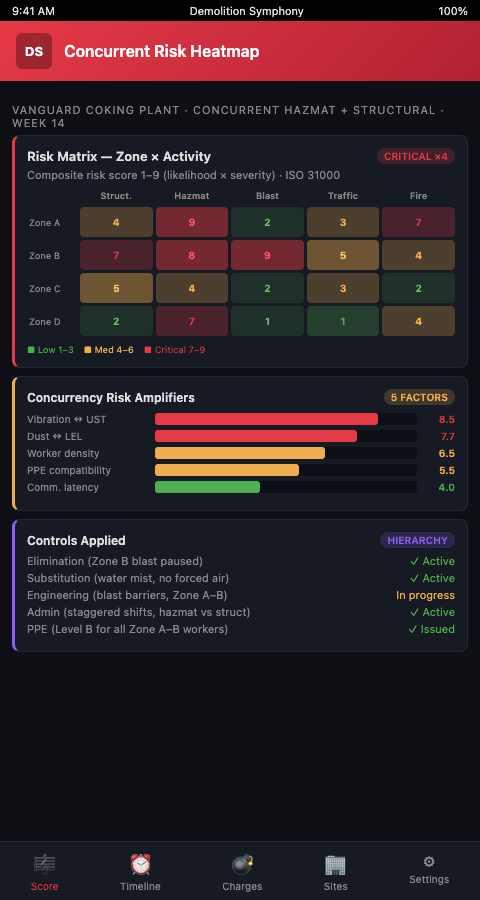
That compound score is not a simple addition of individual risk ratings. A hazmat operation rated medium-risk and a structural operation rated medium-risk in the same zone at the same time do not sum to a high-risk score — they interact. The contamination buffer tempo control in the Demolition Symphony Planner models the specific interaction pathway: does the structural activity create pathways for hazmat materials to migrate into the abatement zone, or does the abatement work alter the structural substrate in ways that affect demolition sequence safety? Those interaction pathways determine whether the overlap is manageable with additional controls or requires temporal separation.
BIM-integrated risk management platforms have demonstrated that visual, model-linked risk annotation significantly reduces the rate of field-level surprises compared to tabular risk registers (United BIM). The same principle applies to the musical-score visualization: when your hazmat abatement choreography and your structural demolition notation share the same visual plane, the conflicts are legible before the work begins.
For an analytical foundation in predictive analytics for contamination spread, the risk model should draw on dispersion modeling data for each hazardous material on site — not as a worst-case bound but as a probabilistic input to the interaction score. If contamination spread under structural vibration follows a known dispersion pattern, the model can quantify the exposure increment that concurrent structural work adds to the abatement zone.
Building a Quantitative Concurrent Work Risk Model
Define the interaction matrix first. For every combination of hazmat type and structural operation that could coexist in a zone, specify the interaction pathway: airborne, contact, structural, or resource. Not all combinations are high-risk — concrete demolition near sealed PCB transformers is very different from pneumatic hammering adjacent to a live asbestos abatement tent.
Apply zone-radius buffers rather than floor-level zones. Risk modeling at the floor or building-section level is too coarse for accurate hazmat-structural overlap risk quantification. A radius-based contamination buffer — calibrated to the specific contaminant's dispersion coefficient and the expected vibration intensity of the structural work — places the risk boundary where the physics dictate, not where the zone boundary on the site plan falls.
Score risk at each time interval, not just each task. The overlap risk changes as tasks progress. Early in an abatement sequence, the disturbed surface area is small; late in the sequence, with enclosures partially broken down and debris in transit, the contamination pathway to adjacent zones is wider. A flat risk score assigned at task planning underestimates peak exposure. Score at each shift interval and flag the intervals where the compound score crosses the threshold requiring additional controls or temporal separation.
Build the OSHA HAZWOPER documentation into the model output. The risk model is only valuable if it produces documentation that satisfies the site health and safety plan requirement. Structure the model output to generate a concurrent operations log: zone, time interval, hazmat type, structural activity, interaction pathway, control measures, and responsible supervisor. That log becomes the HAZWOPER compliance record and the field supervisor's daily authorization document simultaneously.
Research on BIM-integrated safety risk identification has shown that formalized risk annotation at the model level reduces unplanned work stoppages by surfacing interaction hazards before they manifest in the field (MDPI). Fast-track project timelines — which most large industrial decommissioning projects now face — compress the window between hazard identification and mitigation, making pre-construction risk modeling essential rather than optional (MDPI Fast-Track).
The same framework that governs hazmat disposal timelines within a single-phase plan must be extended to cover the concurrent scenario: not just when does abatement finish relative to demolition, but how do the two activities interact at every shared time interval throughout the decommissioning sequence.
For a structural stability parallel, the concurrent risk logic is conceptually identical to the challenge in bowl stability analysis during partial deconstruction: the remaining structure's risk profile changes continuously as adjacent elements are removed, and risk scoring must update with each removal step rather than being fixed at project outset.
Conclusion
Advanced risk modeling for concurrent hazmat and structural work is the analytical layer that transforms a decommissioning schedule from a liability into a defensible operations plan. The compound risk score approach — interaction matrix, radius-based buffers, interval-level scoring, and integrated HAZWOPER documentation — gives industrial plant decommissioning crews the quantitative foundation that separate-register approaches cannot provide.
Industrial plant decommissioning crews running simultaneous hazmat and structural operations need a risk model that sees both voices at once. The Demolition Symphony Planner's Hazmat-Structural Interleave Scoring layer notates every zone overlap, flags every compound risk interval, and generates the concurrent operations log your HAZWOPER plan requires. Start your concurrent work risk model today and get every compound hazmat-structural overlap scored and documented before your next permit submittal.