Advanced Stability Analysis for Partially Deconstructed Bowl Structures
Advanced Stability Analysis for Partially Deconstructed Bowl Structures
During the 2013 collapse of a partially demolished warehouse in Philadelphia, six people were killed when a wall left standing without adequate temporary support fell onto an adjacent building. That incident prompted OSHA to strengthen engineering survey requirements for active demolition sites and reminded the industry of a structural reality that stadium bowl demolition makes unavoidable: a partially deconstructed structure is not half as dangerous as a full structure — it can be far more dangerous, because the remaining elements are carrying loads they were never designed to carry alone.
Stadium bowls amplify this problem. A concrete grandstand bowl is a highly redundant ring structure. Remove a section and the remaining arc carries redistributed lateral thrust, higher bending moments at the cut sections, and new vibration modes that the original design never anticipated. Getting partial demolition bowl structure engineering right is not a refinement of standard demolition planning — it is a distinct engineering problem requiring dedicated stability analysis at every phase. This analysis must also run in parallel with cantilever deflection modeling: the bowl is structurally coupled to the cantilever roof sections above it, and each bowl sector removal can shift anchorage reactions enough to affect the cantilever's deflection envelope.
Why Bowl Geometry Creates Residual Load Path Complexity
A full concrete bowl transfers its gravity loads through a series of raker beams, precast seating units, and perimeter columns — all of which stabilize one another laterally. The ring geometry means that horizontal thrust from the curved seating tiers is balanced by equal and opposite thrust on the far side. When one sector is removed, that equilibrium breaks. The remaining arc tries to spread outward at its cut ends, creating lateral forces that the adjacent columns were never sized to resist.
HSE guidance on structural stability during demolition requires that a structural engineer assess remaining load paths before each demolition phase. For stadium bowls, that assessment cannot be a single pre-project calculation — it must be repeated as each sector comes down, because each removal changes the load distribution for every remaining element. Progressive collapse research shows that optimal initiation intervals of 300 ms or less can control collapse propagation in large concrete structures, but only when the residual structure's capacity has been correctly modeled before each phase begins (NCSU Progressive Collapse Experimental).
Stadium Bowl Demolition Phase Stability: The Three Critical Checks
For each phase of stadium bowl demolition, three stability checks govern whether the next removal can proceed:
Residual load path adequacy. After removing the planned sector, does the remaining bowl have a complete load path from every remaining seating element to a foundation? Incomplete load paths — where a raker beam's lower support has been removed but the upper seating remains — are the leading cause of unplanned partial collapses during arena bowl structural monitoring mid-demolition.
Lateral thrust equilibrium. Does the remaining arc have adequate lateral restraint at its cut ends? In most cases, temporary shoring must be installed before the adjacent sector is removed. The geometry of the shoring must match the outward thrust vector of the remaining arc, which changes as successive sectors are removed.
Dynamic amplification check. Active demolition nearby — hydraulic shears cutting rebar, high-reach excavators breaking concrete — generates vibration loads that act on the remaining structure. These dynamic loads can trigger resonance in a partially deconstructed bowl at frequencies that the intact structure would never have experienced. Each phase plan must include a dynamic amplification factor based on the current modal properties of the remaining structure, not the properties of the original design.
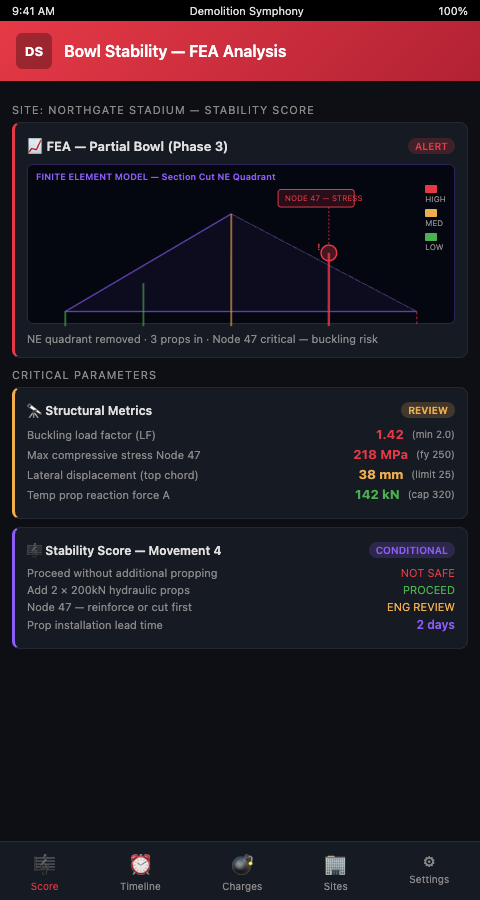
Darda's guidance on structural stability identifies pre-demolition structural assessment as the foundation for safe phasing — and notes that this assessment must be updated continuously as the structure changes. The Demolition Symphony Planner encodes each of these three checks as a mandatory gate in the phase score: no demolition note can fire in the next measure until all three checks for the current measure are marked complete.
Real-Time Structural Monitoring Integration
Arena bowl structural monitoring mid-demolition has shifted from periodic manual surveys to continuous sensor networks. IoT-enabled structural health monitoring platforms can stream strain gauge readings, tilt sensor data, and accelerometer outputs from dozens of points on the remaining structure simultaneously (Springer IoT for SHM). When readings exceed threshold values — typically 70% of the predicted response for a given phase — demolition in adjacent zones is paused and the structural model is recalibrated before work resumes.
In the Demolition Symphony Planner, sensor thresholds appear directly on the visual score as dynamic rest markers. If a sensor channel triggers during an active measure, the score pauses — just as a conductor holds a rest until the ensemble catches up — and the structural engineer reviews the live data before the next measure begins. This integration between real-time monitoring and the phase plan is what distinguishes a stability-controlled bowl demolition from one that relies on periodic manual checks.
Connecting Bowl Analysis to Cantilever and Dome Scenarios
Bowl stability analysis does not operate in isolation. The grandstand bowl is structurally coupled to the cantilevered roof sections above it: as bowl sectors are removed, the cantilever anchorage conditions change and must be updated in parallel with the bowl stability calculations. A bowl sector removal that shifts the anchorage reaction by 15% can push a long-span cantilever into deflection territory that exceeds its temporary support design.
For domed stadiums, the coupling runs in the opposite direction as well: removing dome structure changes the in-plane compression in the bowl rim, which in turn alters the residual load path in the remaining bowl arc. The domed stadium case study details how dome-bowl interaction was managed during a major large-capacity teardown by sequencing dome removal in segments coordinated with bowl sector removal below — neither progressing faster than the other's stability model could validate.
These interactions are precisely why finite element analysis methods developed for partial bridge demolition translate directly to stadium bowl work: in both cases, removing a structural element changes the stiffness matrix of the remaining system, and only a continuously updated FEA model can predict what those changes mean for adjacent elements.
Advanced Tactics: Controlling Sector Removal Sequence
The order in which bowl sectors are removed determines the magnitude of the lateral thrust imbalance at every phase. Two removal strategies dominate current practice:
Symmetric opposing removal. Sectors on opposite sides of the bowl are removed simultaneously or in rapid succession, keeping the remaining arc balanced. This minimizes the lateral thrust imbalance at any single phase but requires coordinating two demolition fronts across the bowl simultaneously.
Spiral sequential removal. Starting from one sector, each successive removal is adjacent to the previous one — like unwinding a coil. This simplifies logistics by concentrating the demolition front, but creates a progressively larger unsupported arc at the leading edge, requiring increasingly robust temporary shoring as the spiral advances.
The MDPI fundamentals research on controlled demolition confirms that sequential phasing strategies require engineering validation at each step rather than a single upfront approval, because the structural state changes with each removal (MDPI Fundamentals of Controlled Demolition). The Demolition Symphony Planner's phase score makes this validation explicit: each measure in the bowl sequence carries a structural sign-off field linked to the current FEA model output, and no subsequent measure can be marked ready-to-execute until the sign-off is recorded.
Stadium bowl demolition teams managing residual load path bowl deconstruction challenges need a planning platform built for this level of iterative validation — not a linear schedule that assumes the structure behaves the same at 80% demolition as it did at 100%. Score Your Stadium Teardown with Demolition Symphony Planner and give every phase of your bowl sequence the structural rigor it requires.