Advanced Finite Element Analysis for Partial Bridge Stability
When the Bridge Stops Behaving as Designed
In 2015, a contractor removing a prestressed concrete bridge in Ohio discovered mid-operation that the remaining spans had developed unexpected camber after the first span was cut free. The bridge had been designed as a continuous structure; the prestress tendons ran across the joint. Releasing that span unlocked stored energy in the adjacent bay, lifting the deck several inches at the next pier. No one had run a finite element analysis of the partial structure — only the as-built model existed, and it described a complete bridge, not an intermediate demolition state.
The ASCE 2025 Report Card for Bridges rates 7.5% of U.S. bridges as structurally deficient. Many of those are continuous or semi-continuous structures where partial removal creates intermediate configurations that differ fundamentally from both the original design and the final cleared state. The structural behavior in between — what engineers call the "partial structure" — is where collapse risk concentrates.
Finite element analysis partial bridge stability assessment is the discipline that maps those intermediate states computationally. The FHWA Manual for Refined Analysis establishes the modeling standards for refined structural analysis of bridges, including the mesh density requirements and material property assumptions that make intermediate-state models reliable. Without a validated FEA bridge demolition model for each phase, teams are executing a structural experiment with live equipment rather than a planned operation. A progressive demolition FEA model that is updated at each span removal gives engineers the structural simulation bridge removal phases demand — because the governing load case changes discontinuously at each phase boundary — and a computational stability check bridge demo teams can use as a gate condition before committing crews to the next structural action.
Writing the FEA Score Phase by Phase
Finite element analysis for partial bridge stability converts the structural engineer's intuition about intermediate demolition states into a computational check with a documented result. The Demolition Symphony Planner treats each FEA bridge demolition modeling checkpoint as a measure notation on the demolition score. Before the score advances to the next span removal, the FEA result for the current partial structure must register within acceptable limits — deflection, stress distribution, and support reaction thresholds are written directly into the gate symbol. This turns a computational check from a back-office calculation into a visible performance condition that every stakeholder on the score can read.
Model Initialization — The Full-Structure Baseline. The first note on the FEA score is the baseline model: the complete bridge under its original design loads. This model, built to the standards in the FHWA NHI-15-044 Structural Stability guidance, establishes the reference state against which all intermediate conditions are compared. Engineers who skip this step and jump directly to phase models lose the ability to quantify how much each removal step shifts the structural behavior away from the known baseline. Without a baseline, there is no starting point for structural simulation across bridge removal phases.
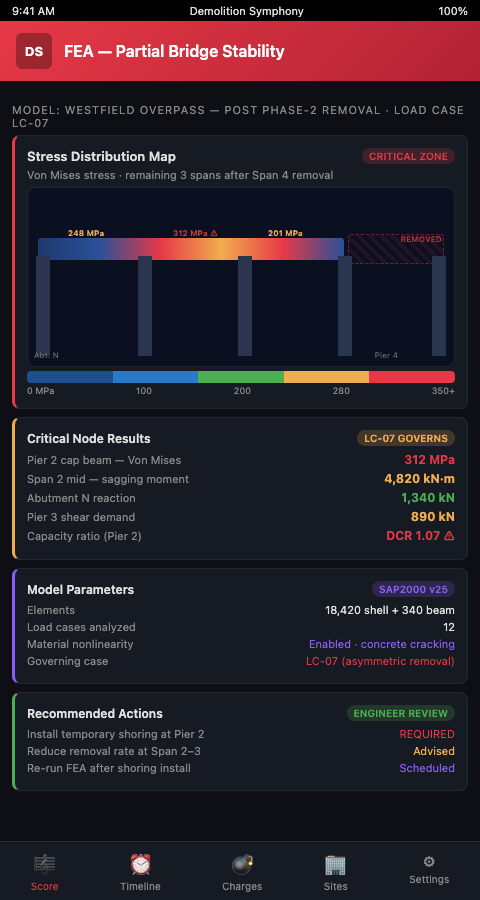
Phase Subtraction — Removing Elements Computationally. Each demolition phase is modeled by removing elements from the baseline in the same sequence the field plan dictates. The NCHRP Synthesis 536 confirms that progressive demolition FEA models must account for geometric nonlinearity — as spans are removed, the remaining structure's stiffness changes, and linear superposition no longer describes the redistribution accurately. The score notation for each phase carries the FEA result: maximum deflection at the critical pier, peak tensile stress in the deck, and revised support reactions at each temporary shore. A computational stability check for bridge demolition at each phase boundary is the mechanism that catches unsafe intermediate configurations before they become field conditions.
Instability Flags — Score Rests Until Cleared. When a FEA run identifies a partial structure configuration that exceeds allowable thresholds — say, a pier head moment that approaches yield under the post-removal load state — the Demolition Symphony Planner marks that measure with a hold rest. The sequence pauses. Field crews see the hold on the score without needing to read the underlying calculation; the engineer responsible for clearing it has the model output linked directly to the gate. This integration mirrors what a 12-span interchange case study demonstrated: staged removal of complex bridges is only safe when computational checks gate physical progress.
Sensor Correlation — The FEA Plays Against Live Data. Once field demolition begins, the FEA model is not abandoned. The structural health sensors deployed at critical points in the remaining structure report deflection and strain continuously. The Demolition Symphony Planner overlays those readings against the FEA-predicted values for the current partial structure. If the measured deflection at pier 3 tracks 12% above the modeled prediction, the score flags the divergence as a note-off condition — work halts until the discrepancy is resolved, either by updating the model or by investigating the source of the structural anomaly.
Advanced Tactics for High-Complexity Partial Structures
Nonlinear geometry for long-span continuous bridges. The Progressive Collapse Through Demolition Scenarios study from NCSU demonstrates that long-span continuous bridges enter geometric nonlinearity well before material nonlinearity. FEA models for these structures must use updated Lagrangian formulations rather than small-displacement assumptions, or the pier moment predictions will underestimate actual values by margins large enough to matter. The Demolition Symphony Planner flags model type requirements in the phase header — the assigned engineer sees immediately which solver setting is required for the current partial structure.
Staged prestress release modeling. Post-tensioned bridges present a specific FEA challenge: the prestress force in intact tendons changes when adjacent spans are removed, because the tendon profile and the eccentricity relative to the neutral axis shift. The score encodes a prestress release event as a distinct structural action note, separate from the physical cut, so the FEA phase that models the cut includes the correct updated prestress state. Skipping this two-step notation is one of the most common sources of discrepancy between predicted and measured behavior in partial bridge demolition.
Tools for computational stability verification. Software platforms like Extreme Loading for Structures from Applied Science International apply applied element method formulations that capture failure propagation in ways traditional FEA tools struggle with, particularly for structures in advanced partial states. The Demolition Symphony Planner does not replicate solver capability — it integrates the outputs from whatever platform the engineering team uses into the score's gate notation, making FEA results actionable field guidance rather than engineering-only documentation.
Cantilever deflection checks at each phase. A partial bridge often creates temporary cantilever conditions — a span is cut at one end but not yet lifted, or a portion of the deck is suspended while connections are severed. These temporary cantilevers require a separate FEA run for the cantilever configuration, because the governing load case shifts from mid-span bending to tip deflection. Teams managing staged removal of complex structures such as stadium canopies will recognize this logic from cantilever deflection modeling, where each removal step creates a new critical cantilever condition that must be checked before the sequence continues.
What Gaps in FEA Coverage Actually Cost
When engineers run a single FEA model for a bridge demolition project — typically the final cleared state, to verify that piers can be safely extracted — they leave every intermediate partial structure unmodeled. Each of those intermediate states is a structural experiment conducted without a predicted outcome. Some experiments produce acceptable results. Some produce the Ohio camber incident. A few produce progressive collapse.
The FEA bridge structure analysis published on ResearchGate shows that structural behavior changes discontinuously across demolition phases — the stress distribution in the remaining spans does not interpolate smoothly from the baseline to the cleared state. Each phase boundary is a potential inflection point where load redistribution shifts direction. Missing even one FEA checkpoint at a phase boundary is not a marginal oversight; it is the omission of the only available prediction for the structural state the field crew is about to create.
The practical implication is that FEA bridge demolition modeling must be budgeted and scheduled as a project activity, not treated as a one-time deliverable that the structural engineer produces at the project outset. On a ten-phase bridge demolition, ten FEA runs are required — one for each intermediate configuration. The Demolition Symphony Planner makes each FEA run a visible project activity by writing it as a gate in the score: the gate cannot clear until the run is complete and the results are within acceptable bounds. This visibility converts FEA from a background analytical task into a scheduled, tracked deliverable that the project manager can monitor alongside crane schedules and traffic permits.
Scoring the Partial Structure Before Cutting It
Bridge and overpass demolition teams working on continuous, semi-continuous, or post-tensioned structures have a planning obligation that differs from simply sequenced span removal: they must model every structural configuration the demolition creates, not just the beginning and end states. The Demolition Symphony Planner makes that obligation executable by embedding FEA checkpoints into the visual score as performance gates.
The result is a demolition plan where the computational stability check and the physical construction sequence are a single document read by the same team. Your structural engineer writes the model. The score displays the result. Your field supervisor advances the phase only after the gate clears. Score your bridge demolition with the Demolition Symphony Planner and give your bridge and overpass demolition team a plan where every partial structure state is computationally verified before a field crew is committed to creating it — eliminating the structural experiments that produce unexpected incidents at intermediate configurations. Start your FEA-gated demolition plan with the Demolition Symphony Planner and join the bridge and overpass demolition teams that are replacing structural experiments with computationally verified phase sequences.