Case Study: Phased Removal of a 12-Span Highway Interchange
The Problem That 12-Span Interchanges Expose
The 12-span highway interchange removal case study that defines the planning challenge for multi-span interchange deconstruction is the I-75/I-94 interchange demolition in Detroit. As documented in the Adamo Group I-75/I-94 case study, the project required continuous coordination between structural sequencing, traffic control, equipment positioning, and environmental compliance across dozens of simultaneous workfronts. A conventional Gantt chart for that scope becomes a document that no one can fully read — and a document that no one can fully read is a plan that cannot be executed faithfully.
Highway interchange bridge demolition reveals the limits of fragmented planning more clearly than any other project type. The NCHRP Synthesis 536 case examples document this pattern across phased demolition of highway bridges: structural interdependencies that require phase gates, traffic closure windows measured in hours rather than days, and regulatory checkpoints from multiple agencies that arrive unpredictably. The highway interchange bridge demolition lessons from high-complexity projects consistently show that coordination failure — not engineering error — is the primary cause of schedule deviation and incident risk. When the structural sequence lives in one document, the traffic plan in another, and the environmental compliance log in a third, the team executes three different plans simultaneously while believing they are executing one.
Scoring a 12-Span Interchange as a Single Composition
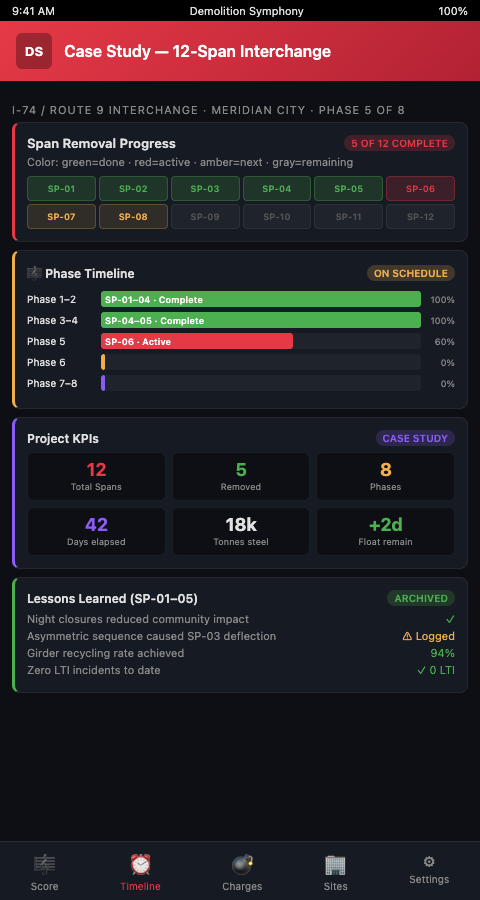
The Demolition Symphony Planner maps a 12-span interchange as a full orchestral score, where each span is an instrument section and each demolition phase is a measure. The score does not separate structural sequencing from traffic management or environmental holds — it writes them all on the same staff, so the team reading the score sees the complete performance: what comes down when, what conditions must be met first, and what cannot begin until the previous measure resolves.
Act 1 — Mapping Structural Interdependencies Across All 12 Spans. Before any demolition measure is written, the score requires a complete interdependency map. Shared pier caps, continuous deck segments, and ramp convergence points are identified and logged as structural ties — notations that indicate which spans cannot be removed independently. On a typical 12-span highway interchange deconstruction, this map reveals three to five clusters of spans that must be sequenced as units rather than individually. Isolating those clusters early prevents the field team from treating a shared-pier group as though its members are structurally independent.
Act 2 — Phase Measures with Traffic Window Rests. Each span removal is a measure in the score, written with its structural actions, equipment positions, and load gates. Between measures, traffic window rests appear — periods of fixed duration during which lanes must reopen before the next demolition phase begins. On a 12-span interchange removal, these rests are not optional pauses; they are regulatory conditions built into lane closure agreements with the DOT. The Demolition Symphony Planner encodes each rest duration directly into the measure, so the score itself enforces the traffic agreement rather than requiring a separate team to track compliance.
Act 3 — Parallel Workfronts Notated as Multiple Staves. High-complexity bridge removal projects often run parallel demolition sequences on independent span groups — while ramp A spans 1 through 4 are coming down, ramp B spans 8 through 12 may be in a separate phase sequence. The score represents these parallel sequences on separate staves within the same composition, with coordination markers indicating when the two sequences must synchronize — for example, when a shared pier becomes available for extraction only after both adjacent spans are cleared. Teams can see both sequences simultaneously and identify synchronization requirements before they become field-level surprises.
For a clear look at how the structural sequencing decisions made in Act 2 translate into visual demolition planning, the bridge incident prevention case studies detail the specific sequencing errors that have caused unplanned collapse in multi-span projects — and how a phase-gate approach catches those errors before they reach the field.
Act 4 — Computational Stability Gates Between Phases. As demonstrated in finite element analysis for partial bridge stability, each intermediate removal state creates a structural configuration that must be modeled independently. The Demolition Symphony Planner embeds FEA checkpoint gates between acts: the score does not advance from Act 2 to Act 3 until the partial structure model for the Act 2 end state has cleared its stability thresholds. This gate mechanism transforms computational analysis from a background task into a visible performance condition embedded in the plan.
Advanced Tactics from High-Complexity Removals
Accelerated bridge construction methods for final span removal. The FHWA Graves Avenue Bridge SPMT Case Study documents how self-propelled modular transporters allow entire span superstructures to be rolled out of position in a single overnight window, dramatically compressing the traffic closure duration. For 12-span interchange removal projects with strict lane closure limits, the Demolition Symphony Planner marks SPMT operations as high-tempo measures — concentrated bursts of activity that require all preceding structural preparations to be complete and verified before the tempo begins.
Digital twin integration for mid-project plan updates. Complex interchange removals rarely proceed exactly as planned. The digital twin-driven strategic demolition planning study in Scientific Reports demonstrates that real-time sensor data connected to a digital twin allows the demolition plan to update dynamically when field conditions diverge from assumptions. The Demolition Symphony Planner is built to accept mid-score revisions: when a measure needs to change because a pier condition differs from the survey prediction, the revision is documented in the score with a timestamp and an engineering authorization, preserving the full audit trail without requiring a complete plan reissue.
Rapid demolition methods for compressed time windows. The rapid demolition of arch bridges via SPMT method, documented in PMC, achieved complete span removal in under five hours — a compression that is achievable on interchange ramp spans when the structural preparation is complete before the clock starts. The score supports this by encoding preparation milestones as pre-measure checklist notations: the rapid demolition measure cannot open until every preparation note is marked complete. This prevents teams from entering a high-tempo window without having completed the structural groundwork.
Caltrans-compliant phasing documentation. For California interchange projects, the Caltrans Bridge Removal Manual Chapter 3 specifies the documentation requirements for phased removal sequences. The Demolition Symphony Planner generates phase documentation aligned with these requirements — each measure in the score produces a phase record that includes the structural rationale, the equipment configuration, and the load verification result. This documentation output is not a separate deliverable; it is generated from the score itself.
Cross-sector planning analogy. Teams who have managed the stakeholder coordination challenges of high-rise demolitions will recognize the parallel. The 40-story building implosion sequencing framework applies phase gating and multi-party coordination to vertical structures in the same way the Demolition Symphony Planner applies them horizontally across a 12-span interchange. The planning discipline transfers directly; only the geometry changes.
What Multi-Span Interchange Projects Reveal About Planning Limits
A 12-span highway interchange demolition stress-tests every planning assumption simultaneously. The structural complexity, the traffic constraints, the agency coordination requirements, and the equipment logistics all peak at the same time, because the interchange removes constraints on each dimension precisely when the others are most demanding. Standard project management tools — Gantt charts, meeting minutes, email chains — were not designed for this convergence. They fragment the plan across the people who need it to be unified.
The Demolition Symphony Planner is designed for exactly this convergence. When every structural gate, traffic window, parallel workfront, and regulatory hold is written into the same visual score, the team reads one plan and executes one plan. The complexity of a 12-span interchange does not disappear — but it becomes readable. Plan Your Next Span Removal with a score designed for the full complexity of high-span interchange deconstruction.
The diagnostic value of multi-span interchange work is that it forces every planning weakness into visibility. A planning gap that is manageable on a two-span overpass replacement becomes a project-threatening problem on a 12-span system with parallel workfronts, shared pier caps, and interleaved traffic closure windows. Teams that have built a score-based approach on smaller bridge projects find that the Demolition Symphony Planner's notation system scales to interchange complexity without changing the fundamental planning discipline — the measures are more numerous, the parallel staves are more complex, and the regulatory coordination is denser, but the format is the same one the team already knows.