Lessons from Bridge Demolition Incidents: Preventing Unplanned Collapse
Three Incidents That Define the Planning Gap
Understanding bridge demolition incidents unplanned collapse patterns requires examining the planning gaps they expose, not just the structural failures that resulted. Preventing bridge collapse during demolition means treating preparatory operations, partial removal states, and verbal-only coordination as the three highest-risk conditions in any bridge demolition sequence — conditions that a scored plan with phase gates addresses directly. Demolition failure analysis bridge incidents reveal the structural collapse risk bridge removal creates at each intermediate configuration as the primary hazard that score-based planning addresses.
In October 2024, three workers were killed when a Mississippi bridge being prepared for scheduled demolition collapsed before the controlled removal sequence began. As reported by both CNN and ENR, the collapse occurred during preparatory operations — before the engineered demolition sequence was initiated. Workers were on or near the structure when it failed. The preparatory work had altered the structural condition without triggering the monitoring or sequencing safeguards that would have governed the formal demolition phase.
In November 2006, two spans of the Grandview Triangle bridge in Missouri collapsed during demolition operations, killing one worker. The OSHA investigation of the Grandview Triangle collapse found that the collapse was directly caused by the removal of a structural element before the temporary support conditions that would have stabilized the remaining structure were in place. The workers on site at the time of collapse were executing a sequence that an engineer had not verified was safe for the current partial structure state.
In May 2015, an I-75 demolition project in Michigan experienced a girder uplift incident — an unexpected vertical movement of a bridge girder during span removal operations. The OSHA investigation of the I-75 collapse traced the cause to a verbal-only demolition plan that did not account for the prestress force release when the girder's bearing restraints were removed. The structural engineer knew that prestress existed. The field crew did not know that the prestress release would produce an uplift force. The information was available. It was not communicated in a format that reached the people who needed it.
What These Incidents Share
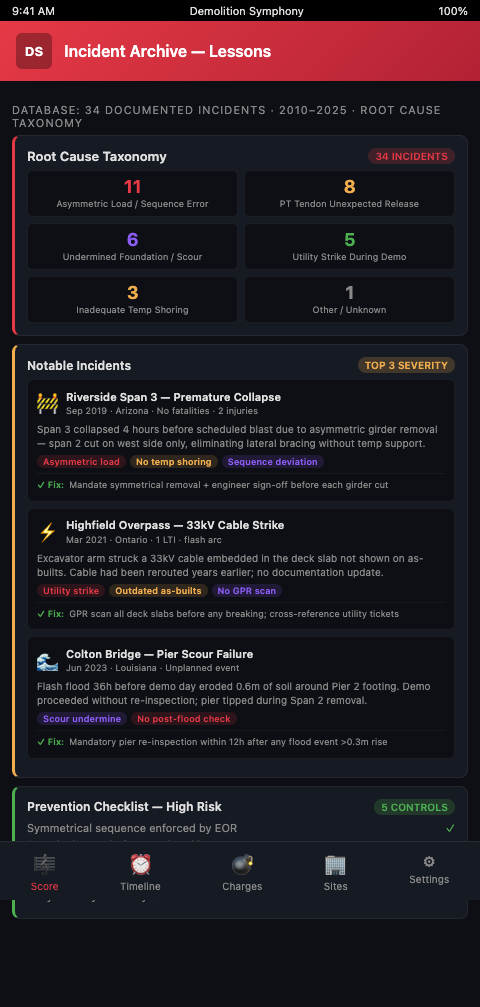
The common thread across bridge demolition incidents is not inadequate engineering. Demolition failure analysis for bridge incidents — across OSHA reports, ASCE case studies, and independent post-mortems — consistently identifies the same root cause: the structural collapse risk during bridge removal was understood by the engineering analysis but did not reach the people executing the work in a format they could act on. The gap between what the engineering analysis predicts and what the field team executes is where these incidents occur. The ASCE Manual of Practice 157 for Bridge Demolition Engineering, published in 2024 specifically in response to the documented pattern of bridge demolition incidents, establishes engineering practice standards that require explicit communication of structural conditions, phase sequencing rationale, and hazard conditions to all personnel involved in demolition operations.
ANSI/ASSP A10.6 Safety Requirements for Demolition Operations — the voluntary consensus standard adopted alongside federal regulation — requires that an engineering survey be completed before demolition work begins and that workers be informed of the structure's hazardous conditions. The ENR analysis of the Georgia Yellow River Bridge citation demonstrates that this standard is enforced as a legal obligation, not a recommendation. But survey completion and worker notification are not sufficient on their own when the hazardous conditions change at each phase of a multi-phase demolition. Static pre-demolition surveys do not describe the structural state on day 14 of a 30-day demolition sequence.
The gap that produces incidents is not the absence of an initial survey. It is the absence of a system that keeps the structural information current, communicates the current state to every team member, and prevents work from advancing when the structural conditions that make the next action safe have not been confirmed.
Writing Incident Prevention into the Score
The Demolition Symphony Planner makes incident prevention a structural element of the demolition plan, not a separate safety program running in parallel. Every measure in the score carries the structural conditions required for that measure to be executed safely. Every gate between measures requires confirmation that those conditions have been met. Every team member reading the score — from the structural engineer to the crane operator — sees the same information in the same format.
Pre-Score Hazard Survey as the Opening Notation. The Demolition Symphony Planner's first movement is the hazard survey — an assessment of the structure's current condition that goes beyond as-built documentation to capture deterioration, unexpected modifications, embedded utilities, and load conditions that affect the demolition sequence. This survey is not a checklist at the bottom of a project file. It is the first notation in the score, referenced by every subsequent measure that depends on the conditions it documents.
Phase-Specific Condition Updates. The condition of a partially demolished bridge is not described by the pre-demolition survey. After each phase of work, the structural condition of the remaining elements has changed — and those changes must be documented and communicated before the next phase begins. The Demolition Symphony Planner writes condition update gates between measures: a field inspection or sensor confirmation that the partial structure resulting from the completed measure matches the expected state before the next measure opens. The 12-span interchange case study demonstrates that condition update gates are most critical at the transitions between major phase groups, where the structural configuration changes most significantly.
Verbal Plan Prohibition — The Score as the Plan. The I-75 girder uplift incident was caused by a verbal-only plan. A verbal plan cannot be verified, audited, or confirmed to have been received by the people who needed it. The Demolition Symphony Planner treats the written score as the only valid plan format: every structural action, every hazard condition, every phase gate is in the written score. If it is not in the score, it is not part of the plan. This prohibition on verbal-only planning is not bureaucratic — it is the mechanism that closes the communication gap that verbal plans always leave.
Preparatory Work as Scored Structural Action. The Mississippi 2024 collapse occurred during preparatory work — before the formal demolition sequence began. The conventional planning assumption is that preparatory work (removing attachments, installing monitoring equipment, setting up containment) is lower-risk than structural demolition and can proceed informally. The Demolition Symphony Planner rejects this assumption: preparatory work that alters the structural condition of the bridge appears in the score as a scored structural action, with the same gate requirements as any demolition measure. Teams benefit from reviewing vibration isolation strategies during adjacent sensitive operations to understand how even non-demolition work can alter structural behavior at neighboring assets — the same vigilance applies to the demolition structure itself during preparation.
Worker Briefing as a Pre-Score Gate. The ASCE Manual of Practice 157 for Bridge Demolition Engineering requires that all personnel involved in demolition operations be explicitly informed of hazardous structural conditions before work begins. The Demolition Symphony Planner operationalizes this requirement as a pre-score gate: the demolition score does not open until all workers assigned to on-structure activities have been briefed on the hazard conditions documented in the opening movement. The briefing record — who was informed, when, and by whom — is logged in the score's gate notation, creating the documentation that OSHA enforcement reviews when incidents occur.
Advanced Tactics for Incident Prevention
Failure mode analysis before the score is written. Before drafting the demolition sequence, experienced demolition engineers perform a failure mode analysis: for each structural action in the proposed sequence, what is the most likely failure mode if that action produces an unexpected result? For a girder cut on a prestressed structure, the failure mode is uplift from prestress release. For span removal on a continuous bridge, the failure mode is load redistribution to the adjacent pier. The Demolition Symphony Planner encodes the identified failure modes as hazard annotations on the relevant measures — not to prevent the action, but to ensure that every team member executing the measure knows what to watch for and what the stop-work condition looks like.
Real-time sensor integration as an early warning system. Structural health sensors deployed on the demolition structure provide continuous readings of deflection, strain, and vibration across the partial structure as demolition progresses. When sensor readings diverge from the FEA-predicted values for the current partial state, the Demolition Symphony Planner flags the divergence before the next measure opens. This early warning function — catching anomalies in the data before they manifest as visible structural behavior — is the operational difference between a sensor deployment that documents an incident and one that prevents it.
Post-incident score review as a planning improvement cycle. When a bridge demolition project experiences an unexpected event — not necessarily a collapse, but any unplanned structural behavior — the Demolition Symphony Planner's score audit trail provides the documentation for root cause analysis. The sequence of measures, the gate confirmations, the sensor readings, and the condition updates are all timestamped in the score record. Root cause analysis for bridge demolition incidents consistently finds, as documented across OSHA investigation reports, that the gap between plan and execution is the primary failure mechanism. A score-based plan with an audit trail makes that gap visible after the fact — and preventable before it.
Cross-niche parallel — failed urban implosion lessons. Teams who have analyzed high-rise demolition failures will recognize the planning gap pattern from failed urban implosions and root cause analysis, where post-incident investigation consistently identifies communication failures between engineering analysis and field execution as the proximate cause. The Demolition Symphony Planner addresses this root cause in the same way for bridge demolition as for vertical demolition: by making engineering information part of the executable field plan, not a separate technical document that the field team may or may not receive.
What a Score Cannot Do — and What It Can
The Demolition Symphony Planner cannot prevent every bridge demolition incident. Structures in deteriorated condition may fail in ways no model predicts. Equipment can malfunction. Workers make decisions that deviate from the plan. These risks cannot be fully eliminated by planning quality alone.
What a score-based plan does is eliminate the preventable incidents — the ones caused by a communication gap, a missing gate, a verbal instruction that was misunderstood, a preparatory action that altered the structure without triggering a safety review. The three incidents documented at the opening of this post share one characteristic: they were preventable. The knowledge that would have prevented them existed. It did not reach the people who needed it at the moment they needed it.
The Demolition Symphony Planner is the instrument that closes that gap. Not through additional procedures, but through a plan format that makes engineering judgment visible, enforceable, and shared.
A demolition failure analysis for bridge incidents consistently returns to the same finding: structural collapse risk in bridge removal correlates with the distance between the engineering analysis and the field execution — not with the quality of the analysis itself. When the analysis is excellent but its conclusions exist only in a technical report that the field crew never reads, the gap is as wide as if the analysis had never been done. The score format closes that gap structurally: every conclusion that the engineering analysis produces — about structural states, critical sequence constraints, and stop-work conditions — is encoded as a notation in the plan that the field crew is executing from. The gap ceases to exist when the engineering output and the execution document are the same document.
Scoring Safety Into the Demolition Plan
Bridge and overpass demolition teams owe their workers a plan that communicates every hazard, gates every phase on confirmed conditions, and keeps structural information current through every stage of a progressive demolition. The Demolition Symphony Planner makes that standard achievable without adding administrative burden — the score is the plan, the gates are the safety system, and the audit trail is the compliance record.
The bridge demo safety incident review documented across OSHA investigation reports, ASCE guidance, and incident case studies generates a consistent recommendation: make the engineering analysis operational in the field, not archived in a project file. Every worker on a demolition site deserves to be standing on structure that an engineer has confirmed is safe for the current phase, with the confirmation documented in the same plan the crew is executing from.
Start your bridge demolition incident prevention with the Demolition Symphony Planner and build a score where every hazard, every phase gate, and every condition update is part of the executable field plan. Score your overpass removal with the Demolition Symphony Planner and give your bridge and overpass demolition team a safety system that closes the gap between engineering judgment and field execution — before anyone steps onto the bridge.