Lessons from Failed Urban Implosions: Root Cause Analysis
Lessons from Failed Urban Implosions: Root Cause Analysis
On 13 July 1997, a twelve-year-old girl was killed 500 meters from the Royal Canberra Hospital implosion site by debris that the exclusion zone was supposed to contain. The coroner's investigation found that the implosion contractor had departed from the approved workplan and that regulatory authorities had failed to scrutinize those departures (ACT Courts). The Wikipedia documentation of the incident confirms that debris traveled well beyond the planned exclusion boundary, killing one person and injuring multiple others (Wikipedia). The root cause was not a technical failure of the charges or the structure — it was a planning-execution gap that no one caught.
That gap — between an approved plan and actual execution — is one of the three primary failure categories in urban implosion incidents. Understanding all three, with specifics from documented cases, gives coordinators an audit framework for their own projects. This failed urban implosion root cause analysis draws on regulatory investigations, post-incident reporting, and controlled demolition failure lessons learned across three decades of documented cases — the demolition gone wrong case studies that the industry rarely publicizes but always learns from. Urban implosion incident analysis reveals that most failures trace to one of these three categories, not to exotic or unpredictable causes.
Failure Category 1: Planning-Execution Gap
The Royal Canberra case represents the clearest documented example of a planning-execution gap causing a fatality. The workplan specified exclusion zone dimensions and debris control measures that were not implemented as written. The gap was not discovered during pre-blast review because the authority having jurisdiction did not scrutinize the workplan departures with sufficient rigor (ACT Courts).
Planning-execution gaps occur in three forms. First, the exclusion zone is reduced on-site without formal approval, often under schedule or public-access pressure. Second, debris containment measures specified in the plan — physical barriers, water curtains, netting — are deployed incompletely. Third, deviations from the approved charge configuration — substituted charge types, modified placement, different delay values — are not reported to the authority until after the event.
The remediation for this failure category is procedural rather than technical: a pre-blast workplan departure checklist that requires sign-off from the responsible licensed blaster and, where regulatory requirements mandate it, from the authority having jurisdiction. Any field change to exclusion zone geometry, debris containment, or charge configuration that was not in the approved plan must clear this checklist before execution proceeds.
Failure Category 2: Charge System Failure
In December 2017, the Pontiac Silverdome — a 70,000-seat domed stadium — was prepared for implosion before a weekend crowd of spectators. When the charges fired, 10% failed due to a wiring problem, leaving the structure visibly intact while the crowd waited (NPR). The building did eventually come down in a subsequent attempt. The failure was embarrassing and operationally costly; in a different structural configuration or site context, an incomplete firing could have produced a partial collapse with uncontrolled debris scatter.
Charge system failures fall into three sub-categories: misfires (a charge that receives a firing signal but fails to detonate), hangfires (a charge with delayed initiation after the firing signal), and circuit failures (a detonation signal that does not reach the charge at all). OSHA misfire regulations under 1926.911 specify the mandatory wait times and re-entry procedures for each category, reflecting the distinct hazard profile of each failure mode (OSHA).
Circuit failure was the Silverdome's root cause. The transition from wired to wireless electronic detonator networks eliminates the specific failure mode that caused the Silverdome misfire — connection integrity in a wired harness — but introduces its own failure modes around signal coverage and detonator authentication. The misfire risk does not disappear; it changes character.
For network redundancy design, the Silverdome case illustrates why redundant initiation paths — two independent wiring routes, or a wireless network with confirmed detonator registration before the arm command — are a standard requirement rather than an optional upgrade.
Failure Category 3: Structural Analysis Error
Incorrect charge sizing is documented as a root cause in multiple demolition failures where structural analysis identified a structural element that was then undercharged (ASCE). The mechanism: an element that was expected to fail under the applied charge load instead transfers that load laterally or vertically into adjacent elements, which then fail in an uncontrolled pattern rather than the planned sequence.
This failure mode is most common in three situations. First, non-standard materials: a column identified as standard reinforced concrete on drawings that is actually a composite section with a steel tube core requires a substantially larger charge. Second, post-construction modifications: infill walls or structural strengthening added after the original construction but not reflected in the available drawings. Third, deterioration: corrosion, spalling, or previous damage that has changed the effective section properties — but in either direction. A deteriorated column may be easier to sever than planned, but a column with repair concrete poured around it may be significantly harder.
The Extreme Loading for Structures demolition simulation software enables pre-demolition simulation specifically to identify structural elements whose failure behavior deviates from the expected model (ELS). By testing the charge configuration against the structural model before execution, coordinators can identify elements that the simulation predicts will not fail as expected and address them with charge configuration adjustments or supplementary cutting.
Common demolition accident patterns show that structural analysis errors are more frequently found on buildings with documented renovation histories and minimal as-built records — exactly the type of mid-century commercial towers that constitute a significant portion of the current urban high-rise demolition inventory (360training).
Building the Pre-Blast Audit Framework
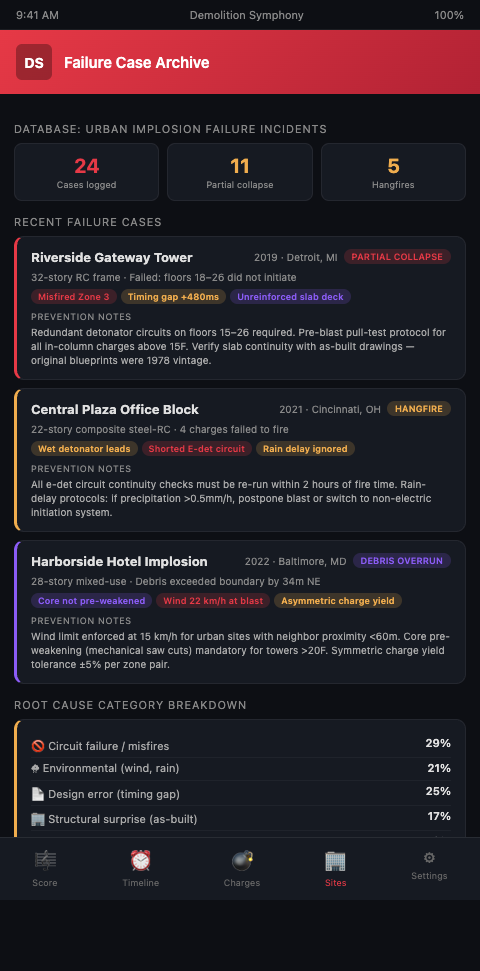
A systematic pre-blast audit addresses all three failure categories before the exclusion zone is established. The Demolition Symphony Planner's audit layer is structured as a mandatory checklist attached to the demolition score — every score must pass the audit before the delay schedule can be exported for electronic detonator programming.
The audit checklist covers: workplan departure log (are all field deviations from the approved plan documented and signed off?); charge system connectivity verification (has every detonator registered on the firing network, and have all connection points been physically inspected?); structural analysis confidence rating (has each structural element been assigned a confidence level based on material verification — measured vs assumed?); and exclusion zone confirmation (has the exclusion zone been physically marked, confirmed against the approved dimensions, and cleared by personnel accountability).
The musical score analogy applies to the audit: a conductor would not take the stage without confirming that every instrument is present and tuned. The demolition coordinator cannot execute without confirming that every charge is connected and that the structural model underlying the delay schedule has been verified against the actual building.
For super-tall building planning gaps, the audit framework becomes more critical as building height increases because the consequences of a planning-execution gap or structural analysis error scale with the building's mass and fall distance. A charge sizing error at Floor 3 of a 40-floor tower has 40 floors of potential kinetic energy consequence above it.
For cross-domain comparison, decommissioning failures from phase interleaving errors in industrial plant demolition share the same structural analysis error category: a vessel or structural element that was expected to be depressurized or load-free when a demolition phase began that was actually still loaded, producing a failure outside the planned sequence.
Applying Root Cause Analysis to Future Projects
The documented failure cases collectively support three actionable planning protocols. First, treat every field deviation from the approved plan as requiring formal re-approval, not informal acknowledgment. Second, verify detonation network connectivity at the charge level — every charge, not a sampled subset — before executing the arm command. Third, flag every structural element whose material properties are assumed rather than measured, and apply a charge weight safety factor to those elements that reflects the uncertainty.
Urban high-rise implosion coordinators with an incident in their project history — or who have worked on projects where near-miss events occurred — understand that the difference between a clean implosion and a documented failure often traces to one specific moment where a workplan deviation went unreviewed or a connectivity check was abbreviated. The Demolition Symphony Planner builds those three verification steps into the score's mandatory pre-execution audit, so the checklist cannot be skipped. Join the waitlist to run your next urban high-rise implosion with a built-in root cause prevention framework embedded in the planning workflow from day one.