Why Traditional Implosion Planning Falls Short Above 30 Floors
Why Traditional Implosion Planning Falls Short Above 30 Floors
Post-tensioned concrete releases dangerous and largely unpredictable forces when improperly dismantled (Alpine Demolition). That warning applies to a five-floor parking structure. Apply it to a 35-floor tower with post-tensioned slabs running through a hybrid RC-steel core and the risk surface multiplies. The structural systems that make modern high-rises viable — post-tensioning, high-strength concrete, curtain wall systems, outrigger frames — also make them significantly harder to demolish than the buildings that established the professional norms for implosion planning.
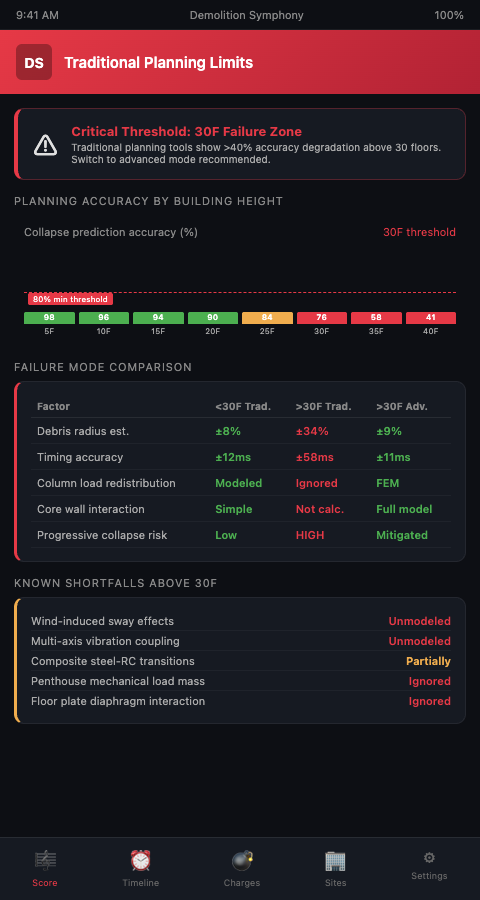
Those norms developed primarily on structures under 30 floors. The practical limit was partly regulatory, partly logistical, and partly a function of what the available simulation tools could handle. Above 30 floors, the conventional blast planning drawbacks for skyscrapers become structural rather than procedural. This post traces the traditional implosion planning limitations above 30 floors — where and why traditional methods break down — and what a coordinator needs to close those gaps. High-rise implosion complexity above 30 stories is not simply a bigger version of the same problem; it is a different engineering problem where super-tall building demolition challenges require dedicated planning infrastructure that standard methods were never designed to provide.
Where Traditional Methods Stop Working
Height-to-width ratio and fall geometry. Below 30 floors, a building's slenderness ratio stays within a range where a standard sequential floor delay produces a predictable fall line. Above 30 floors, the ratio crosses a threshold where small variations in charge timing or structural response produce significant bearing deviations. A 2-degree bearing error at Floor 15 means 3 meters of displacement at ground level; the same 2-degree error at Floor 40 means 10 meters — which may be the difference between debris landing in the designated footprint and debris landing on adjacent infrastructure.
Simulation studies using 23-story models show that delay differences between charge lines significantly affect collapse behavior even at mid-rise heights (MDPI). At 40-plus floors, those effects compound through the additional height with no simple scaling relationship that traditional tables can capture.
Innovative materials in supertall construction. Modern supertall buildings use ultra-high-performance concrete, fiber-reinforced polymer wraps, hybrid steel-concrete composite columns, and outrigger systems that tie the core to the perimeter at specific floor intervals (Springer). None of these materials appear in the empirical blast databases that underlie traditional charge weight tables. A traditional table that predicts charge weight from column cross-section and concrete grade is extrapolating outside its calibration range when applied to a composite column with a steel tube core and UHPC infill.
Floor load accumulation during collapse. A 40-story tower that collapses progressively accumulates floor mass on the collapse front as each successive floor slab is engaged. Traditional planning treats each floor charge as an independent event; the actual physics is a sequential loading problem where the debris mass at the collapse front increases with each floor. That added mass changes the velocity of collapse propagation, the timing at which lower-floor charges must fire to maintain fall-line control, and the debris scatter radius at ground impact. Traditional delay ladders are not recalculated mid-sequence; they are set before the event and executed as written.
Regulatory complexity in built-up areas. Traditional implosion within built-up areas is challenged by noise, dust, vibration, and safety constraints that intensify nonlinearly with building height (Fast Company). A 40-floor implosion in a dense urban block typically requires separate regulatory approvals for the blast itself, the debris footprint, the dust cloud propagation, and the vibration limits at each adjacent structure — approvals that depend on computational outputs that traditional planning cannot reliably produce.
What the Planning Gap Looks Like in Practice
Urban high-rise coordinators who have worked both sub-30 and above-30 floor projects describe the planning gap in concrete terms. Below 30 floors, the delay schedule fits on two sheets of paper and the simulation confirms it in a single run. Above 30 floors, the schedule runs to eight pages, the simulation requires material property inputs that take two weeks to collect, and the first simulation run almost always requires revision before it passes the fall-line and debris-footprint checks.
The decision support framework for urban renewal demolition underscores this point: the demolition method selection process for tall urban buildings requires multi-criteria analysis that simple rule-of-thumb planning cannot perform (MDPI). NYC high-rises are heavier per floor than comparable Tokyo buildings due to different construction standards (Propmodo), which means the load accumulation problem is more acute in North American urban demolition than in Asian markets.
The Demolition Score as an Answer to Scale
The Demolition Symphony Planner approaches the above-30-floor planning gap by treating the demolition score as a dynamic document rather than a static schedule. Each floor is a measure in the composition; each charge is a note with attached metadata — charge weight, delay, predicted fragment cloud, and vibration contribution at the nearest sensor. As the score is edited, the aggregate outputs update continuously.
This matters for supertall demolition because the planning process is iterative: charge positions are set, simulated, found to produce a bearing deviation, adjusted, and re-simulated. That cycle must be fast enough to complete within a project timeline that typically allocates two to four weeks for blast design. A planning tool that requires a separate software handoff for each simulation iteration cannot support the required cycle rate.
The musical score metaphor captures the key structural requirement: a conductor working with 40 musicians cannot manage each instrument independently. The score provides a unified visual representation that makes the interactions between parts visible. A demolition coordinator working with 600 charges across 40 floors has the same need — a unified visual representation that makes the timing interactions and their physical consequences visible at a glance.
For lessons learned from failed implosions, the majority of failures above 20 floors trace to one of the traditional planning limitations described here: a charge weight that didn't account for composite materials, a delay that didn't account for floor load accumulation, or a simulation that was run once and treated as definitive rather than as a first iteration.
Closing the Gap: What Coordinators Need Above 30 Floors
Material-specific charge weight models. Standard tables must be replaced or supplemented with charge weight estimates derived from material testing on the specific building's concrete, steel connections, and composite elements.
Dynamic delay recalculation. The delay schedule must be recalculable from any floor level, not fixed at T+0. This allows coordinators to adjust the upper-floor sequence if the lower-floor collapse progression deviates from the simulation.
Multi-iteration simulation as standard practice. One simulation run is not verification; it is a first estimate. Above 30 floors, the planning protocol should require at least two simulation iterations, with the second using the first iteration's deviation data to tighten the constraints.
Integrated regulatory documentation. The PPV outputs, debris boundary predictions, and dust propagation estimates must be generated from the same simulation that produces the charge schedule, not from separate conservative-estimate calculations. Regulators reviewing a 40-floor urban implosion application will examine the consistency of these outputs; inconsistencies between the blast plan and the dust/vibration analysis are a common cause of permit delays.
For the multi-phase scoring approach that handles complex structural cores, the same score-layer architecture that manages core phasing at mid-rise scale becomes the primary structural control mechanism above 30 floors, where the RC core's delayed response relative to the perimeter frame is the most critical variable in fall-line management.
For a cross-domain perspective, the phased removal of a 12-span highway interchange illustrates how span-by-span phasing manages load transfer across a multi-unit structure — the same principle that floor-by-floor supertall implosion applies vertically.
Conclusion
Traditional implosion planning was built for structures and materials that no longer define the urban demolition market above 30 floors. Composite columns, post-tensioned slabs, outrigger frames, and regulatory environments that require computational documentation have all outpaced the planning methods that experienced coordinators learned on sub-30-floor projects.
Urban high-rise implosion coordinators taking on buildings above 30 floors need a planning platform purpose-built for that complexity class — one that handles iterative simulation, material-specific charge parameters, and regulatory output generation within a single visual score. The Demolition Symphony Planner is built for exactly that scope. Join the waitlist to see how the score-based approach handles supertall demolition from structural audit through final regulatory submission.