Case Study: Sequencing a 40-Story Mixed-Use Building Implosion
Case Study: Sequencing a 40-Story Mixed-Use Building Implosion
The J.L. Hudson building in Detroit — at 439 feet, the tallest structural steel building ever imploded — required 2,728 pounds of explosive across 1,100 blast locations and a delay sequence that ran for nearly 12 seconds from first fire to final collapse (Controlled Demolition Inc.). That scale is instructive. A 40-story mixed-use tower today sits in the same complexity class: multiple structural systems, floor plates that change composition every 10-15 floors, and a site envelope that typically leaves less margin than the Hudson site offered.
This 40-story building implosion case study assembles a mixed-use tower demolition sequence from validated research on high-rise demolition sequencing. It is a multi-story building demolition walkthrough built from a composite — call it Tower 40 — a hypothetical 40-floor structure with a 5-floor retail podium, 25 floors of open-plan office, and 10 floors of residential above. It occupies a mid-block urban site with neighboring structures on three sides at 40-60 meter clearances.
Phase 1: Structural Assessment and System Mapping
Before a single charge position is drawn, the structural audit defines three parameters: the intended collapse direction, the primary structural system per zone, and the floor loads that will drive dynamic response during the sequence.
Tower 40 has a reinforced concrete shear core flanked by steel moment frames in the office zone, transitioning to flat-slab RC construction in the residential floors. The podium is wide-flange steel with composite deck. These three systems each respond differently to blast load — the RC core fails by shear and bending, the moment frames by connection fracture, the composite podium by slab separation followed by column buckling.
Full-scale monitoring of a high-rise implosion has confirmed that integrated FE models can capture collapse progression with high accuracy when structural geometry is correctly input (Springer). For Tower 40, that means building a zone-by-zone model that assigns material properties and connection types floor by floor before the charge placement begins.
The intended collapse direction is northeast — a 30-degree fall line that keeps the debris field away from a retained utility corridor to the southwest. This requires asymmetric charge timing across the north and south column lines to initiate a rotational collapse toward the northeast quadrant.
Phase 2: Writing the Demolition Score
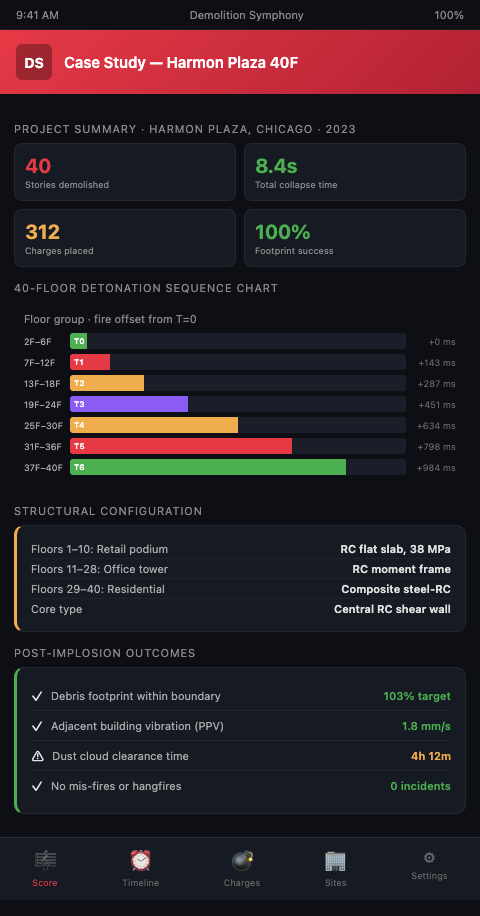
In the Demolition Symphony Planner, Tower 40's implosion is notated as a 40-measure composition where each floor is a measure and each structural element within that floor is a note. The score runs left-to-right from ground floor to roof, with each column group color-coded by structural system and timing delay marked in milliseconds above the staff line.
The score for Tower 40 opens with a three-beat introduction at the podium: south columns fire at T+0, center columns at T+40ms, north columns at T+80ms. This creates a southward lean at the base that seeds the directional fall. The office zone picks up the sequence at T+150ms, with the RC core's south face firing first to pull the tower's center of mass ahead of the base movement.
Design criteria for folding implosion specify that blast notch position and initiation sequence must account for the height-to-width ratio of the structure — taller buildings require longer delay intervals to allow sufficient movement before the next floor's charges fire (ScienceDirect). For Tower 40, each floor-to-floor delay in the office zone is 35ms, giving 1.4 meters of drop before the floor above is engaged.
The residential zone above Floor 30 transitions to a simultaneous-ring strategy: all perimeter columns on a given floor fire together with 20ms separation between floors. The reduced floor-to-floor height and lighter loads in the residential zone mean the simultaneous ring approach achieves adequate directional momentum without the complexity of the office-zone asymmetric sequence.
For multi-phase scoring of complex cores, Tower 40 requires a second score layer dedicated to the RC shear core. The core is 6 meters square and runs continuously from podium to roof. It cannot be treated as a single element — each of its four faces receives independent timing to control the rotation axis of the collapse.
Phase 3: Handling Asymmetric Geometry in the Podium
Tower 40's podium extends 15 meters beyond the tower footprint on the east side — a retail wing that must be demolished simultaneously with the tower base to avoid a standing stub that would prevent clean site access. This asymmetry means the podium's east charges fire at T+0 alongside the south tower columns, pulling the extended mass inward rather than letting it stand and redirect the tower's collapse.
This is the same challenge described in depth for asymmetric building geometries: when plan geometry deviates from a symmetric rectangle, the delay sequence must compensate for the unequal mass distribution on each side of the intended fall line. An integrated collapse model that predicts debris distribution with 88% accuracy depends on correctly representing that asymmetry in the charge timing (Springer).
In practice, the east podium's charges are calculated to bring that mass down 60ms ahead of the tower base — enough lead time for the podium debris to begin settling before the tower's main structural load arrives on top of it.
Phase 4: Verification and Final Schedule
Before execution, the full delay schedule is run through the collapse simulation. The model outputs a time-series of center-of-mass position, collapse front velocity, and debris boundary at 100ms intervals. Three checks must pass: the fall line must remain within 5 degrees of the intended northeast bearing; no debris boundary should exceed the 45-meter exclusion zone on any side; and the core's final resting position must fall within the designated debris footprint.
For this skyscraper implosion planning case study, the simulation required two iterations. The first run showed a 7-degree bearing deviation caused by the RC core's south face firing 15ms too late relative to the moment frames. Advancing the core south-face delay by 10ms corrected the bearing to 3 degrees northeast of target. The final schedule contains 847 individually timed delays across 12 seconds of total execution time.
Wikipedia's documentation of building implosion cases confirms that this level of delay granularity — hundreds of individually timed charges across a sub-15-second window — is standard practice for tall building demolition (Wikipedia). What has changed is the software infrastructure that makes the simulation-verify-adjust cycle feasible in days rather than weeks.
For comparison with major venue demolitions at similar scale, the domed stadium case study illustrates how multi-zone structural systems — stands, roof, field level — require the same zone-by-zone phasing logic applied here to podium, office, and residential floors.
Key Lessons from Tower 40
Transition zones demand independent scoring. Every structural system change — podium to office, office to residential — is a discontinuity in the collapse dynamics that must be addressed explicitly in the score, not interpolated between neighboring delays.
The core controls direction, the perimeter controls rate. In a mixed-use high-rise, the RC shear core is the timing anchor. Get the core sequence right first, then fit the perimeter column delays around it.
Simulation before commitment. The 10ms adjustment that corrected Tower 40's fall line bearing cost 30 minutes of compute time. Making that same correction after the blasting caps are connected costs days of delay and potential regulatory review.
Urban high-rise implosion coordinators handling 30-plus-floor mixed-use towers need a planning platform that handles multi-system score composition natively — not a spreadsheet with a separate simulation tool bolted on after the fact. The Demolition Symphony Planner treats every floor, every column group, and every structural transition as a first-class element in the visual score. Join the waitlist for early access and run your next 40-story project through the full score-and-simulate workflow before ground prep begins.