Predictive Analytics for Contamination Spread During Demolition
Predictive Analytics for Contamination Spread During Demolition
In 1,340 sites on the EPA's National Priorities List, asbestos contamination is a contributing factor (EPA Superfund). A significant share of those contamination events did not originate from the original industrial process — they originated from demolition and remediation activities that disturbed legacy hazmat materials without adequate dispersion modeling to predict where the released contamination would travel. Demolition accelerates contamination spread; predictive analytics is the discipline that quantifies that acceleration in advance.
For industrial decommissioning crews, the operative question is not whether contamination will spread during teardown — it will — but whether the spread will stay within the planned containment boundary or breach it. Research confirms that asbestos fiber exposure during demolition reaches levels that standard PPE and perimeter controls cannot reliably contain without specific, site-calibrated containment placement (PMC Asbestos Exposure). The contamination forecast industrial teardown requires is not a static hazmat survey — it is a dynamic model that updates as demolition activities generate new release events and atmospheric conditions change.
The EPA's contaminated land data establishes the baseline: industrial sites carry a complex inventory of heavy metals, volatile organic compounds, persistent organic pollutants, and fibrous materials — each with different dispersion coefficients, transport media, and exposure pathways (EPA Contaminated Land). A predictive analytics model for contamination spread must handle that heterogeneity rather than defaulting to a single worst-case contaminant.
How Contamination Spreads During Demolition
Three primary transport mechanisms drive contamination propagation during industrial demolition. Airborne particulate transport carries dust, asbestos fibers, lead particles, and silica from demolition activity through the site and beyond its boundary. Atmospheric dispersion modeling for demolition-generated particulate has been validated against field measurements, showing that particle concentration follows a Gaussian plume modified by wind speed, surface roughness, and source intensity — all of which change continuously during active teardown (EMST Atmospheric Dispersion).
Surface water runoff carries dissolved heavy metals, PCBs, and petroleum hydrocarbons from disturbed soil and exposed structural surfaces into drainage networks. Soil migration moves contamination through the vadose zone toward groundwater, accelerated by the compaction, excavation, and vibration associated with foundation demolition.
Each mechanism responds differently to demolition schedule decisions. Moving a foundation demolition task earlier in the sequence may accelerate soil migration of contaminants that the foundation was containing. Demolishing a building envelope before abating interior hazmat creates an airborne release event that an enclosed abatement sequence would have prevented. The contamination forecast must model how each scheduling decision changes the propagation pathway.
The Demolition Score as a Contamination Forecast Interface
The Demolition Symphony Planner's Contamination Buffer Tempo Control operates as a real-time contamination forecast layer within the musical score. Each demolition task — mechanical knockdown, floor slab removal, foundation excavation — carries a contamination release profile: which contaminants are mobilized, at what rate, under what atmospheric conditions, and toward which zones. The tempo control modulates the rate at which these tasks advance relative to the contamination containment measures that must precede them.
A task that would release high-concentration airborne particulate under current wind conditions gets a tempo hold until wind direction shifts or physical barriers are repositioned. A sequence that would expose unprotected soil to storm runoff gets flagged for drainage preemption before the structural work begins. The score notation makes these dependencies visible as timing constraints rather than buried in a separate contamination management plan that field crews rarely read.
Machine learning models trained on demolition waste and contamination data have demonstrated significantly higher accuracy than regression-based approaches for predicting contamination spread under variable conditions (PMC ML Demolition Waste Prediction). A recent SD+RF ensemble model specifically applied to environmental contamination forecasting shows that combining structural data with random forest algorithms improves prediction precision for heterogeneous contamination inventories (Nature Scientific Reports). These approaches are now computationally tractable for field use — they run on standard engineering workstation hardware without specialist infrastructure. AI contamination spread prediction demolition applications leverage these trained models to generate probabilistic plume forecasts that feed directly into data-driven hazmat containment planning, enabling decommissioning crews to position barriers and select suppression methods based on quantified risk rather than conservative engineering judgment. This is precisely the value that predictive analytics contamination spread industrial demolition adds to the planning process: replacing static worst-case buffers with dynamically updated probability distributions.
The scheduling integration required is detailed in the analysis of real-time contamination mapping for demolition plan revision: the predictive model generates the forward-looking forecast, while real-time mapping validates and calibrates that forecast against actual contamination boundaries as demolition progresses.
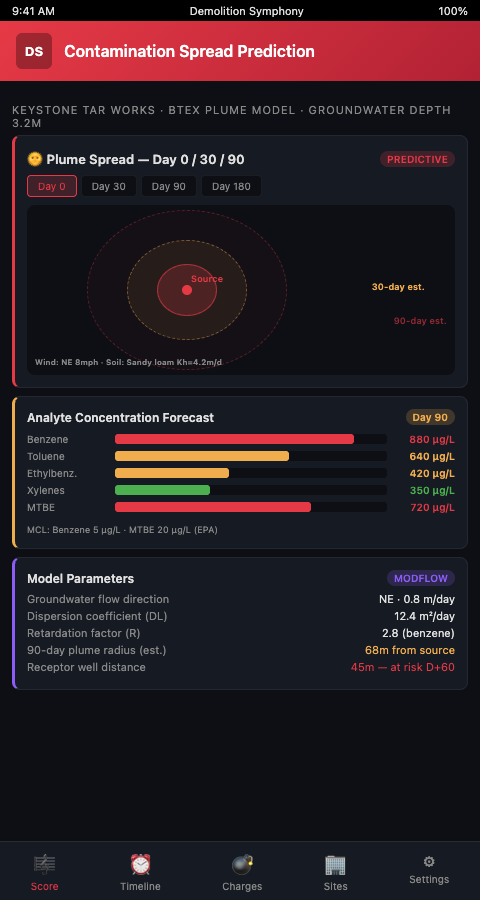
Data Inputs That Make the Model Operational
Contaminant inventory by structural element. The predictive model is only as accurate as its source data. A standard pre-demolition survey identifies materials by location; the contamination forecast model needs release rates calibrated to demolition method. Manual deconstruction of an asbestos-insulated pipe releases different fiber concentrations than hydraulic shear removal of the same pipe. The inventory must tag each item with its demolition method and the corresponding release rate.
On-site meteorological data. Gaussian plume models for airborne particulate require wind speed, wind direction, atmospheric stability class, and ambient temperature. A portable weather station at the site perimeter provides this data continuously; the contamination forecast updates its plume projections at each measurement interval. Air quality monitoring during demolition provides both the forecast input and the real-time validation data against which the model is continuously calibrated (IES AQ Monitoring).
Soil permeability and drainage mapping. Surface water and soil migration pathways require a site permeability map — typically derived from geotechnical boring logs already available from the site characterization phase. Areas of high permeability near contaminated surface zones should be flagged as migration-risk zones in the demolition score, triggering preemptive drainage controls before demolition begins in their vicinity.
Structural sequence timing from the demolition score. The contamination forecast model must be linked to the actual demolition schedule, not a generic activity sequence. When the Demolition Symphony Planner advances a task in the score, the contamination forecast layer recalculates the predicted spread for the updated sequence. This bidirectional link — schedule changes update contamination forecasts, contamination forecast alerts constrain schedule changes — is the integration that converts the model from a planning exercise into an operational tool.
The relationship between predictive analytics and concurrent work risk modeling is direct: the contamination spread forecast provides the quantitative input to the interaction pathway analysis in the concurrent risk model. Rather than estimating the contamination exposure increment from structural activity in qualitative terms, the predictive analytics layer provides probability-weighted exposure estimates at each time interval.
For a cross-sector comparison of how predictive modeling informs demolition sequencing in a different structural context, the approach shares methodology with machine learning for optimal charge placement in urban high-rise implosion: both use ML-trained models to generate forward-looking probability distributions that inform pre-execution planning rather than post-event analysis.
Regulatory Documentation from the Forecast Model
One underutilized benefit of contamination spread predictive analytics is its regulatory documentation function. When a decommissioning crew can demonstrate that their demolition sequence was designed against a validated contamination spread model — with forecast outputs showing that planned containment measures were sized to the predicted plume, not a generic standard — they have a defensible record of due diligence that standard hazmat compliance documentation cannot provide.
That documentation matters most when an unexpected contamination event occurs despite the planned controls. The difference between a regulatory enforcement action and a cooperative remediation agreement often turns on whether the project team can demonstrate that their planning was systematic and evidence-based. The contamination forecast model, with its time-stamped forecast outputs and calibration logs, provides exactly that documentation trail.
Conclusion
Predictive analytics for contamination spread during industrial demolition is a scheduling tool as much as a safety tool. When the contamination forecast is integrated into the demolition score — updating with each schedule change, generating tempo holds at high-risk release events, and producing the regulatory documentation trail — it converts hazmat management from a reactive constraint into a proactive design parameter.
Industrial plant decommissioning crews operating on contaminated sites need contamination spread forecasting that speaks directly to the demolition schedule. The Demolition Symphony Planner's Contamination Buffer Tempo Control layer links your dispersion model to your sequencing decisions, so every tempo hold in the score reflects a quantified contamination risk rather than a conservative buffer. Start your contamination forecast integration today and get dispersion-model-driven tempo holds built into every demolition measure before the first structure comes down.