Machine Learning Approaches to Optimal Charge Placement
Machine Learning Approaches to Optimal Charge Placement
A comprehensive review of ML applications in blast optimization found 23% cost reductions in charge usage when ML-optimized placement replaced manual engineering estimates — without degrading fragmentation quality or increasing vibration overage (ScienceDirect). That number represents real savings on a high-rise implosion where explosive charges alone can run into six figures. But cost reduction is the secondary benefit. The primary value is that ML models search a solution space that manual methods cannot cover.
A 40-story tower might have 600 potential charge locations across its structural frame. The interaction between any charge and every other charge — in terms of vibration superposition, fragment interference, and collapse momentum — creates a combinatorial optimization problem that exceeds human cognitive capacity. Manual methods handle this by applying rules of thumb: standard charge weights by column type, standard delays by floor height, standard exclusion zones by charge weight. ML implosion planning optimization starts from those heuristics and then searches the solution space for configurations that improve on multiple objectives simultaneously — something artificial intelligence demolition sequencing tools can evaluate in hours rather than the weeks that manual iteration would require.
What ML Models Actually Optimize
The optimization targets in AI-driven demolition charge positioning fall into three categories. The first is fragmentation uniformity — ensuring that each structural element fractures cleanly and completely, reducing the number of secondary charges needed and the volume of oversized debris. The second is vibration control — distributing charge timing so that seismic waves from sequential blasts interfere destructively rather than additively at the nearest sensor location. The third is collapse directionality — weighting charge placement to produce a center-of-mass trajectory that stays within the intended fall corridor.
Random Forest Regression applied to charge arrangement has demonstrated reliable optimization across all three objectives in a single model run (Springer). The model ingests structural geometry, material properties, and site constraints as inputs, then outputs a ranked list of charge configurations with predicted scores on each objective. The coordinator sets weights — prioritizing vibration control in a dense urban block, for instance — and the model adjusts its ranking accordingly.
Artificial neural networks with backpropagation have been validated as optimum architectures for predicting fragmentation outcomes from blast parameters (Academia.edu). In the ANN approach, the network learns the nonlinear relationship between charge geometry, rock or concrete properties, and fragment size distribution from a training corpus of historical blast events. The trained network then predicts outcomes for new configurations without requiring a full physics simulation.
Neural network and ensemble ML models for blast impact prediction have been reviewed across dozens of published studies, with ensemble methods consistently outperforming single-model approaches on out-of-sample test cases (MDPI Minerals). For production deployment, ensemble methods reduce the risk that a single model's blind spots produce a dangerous outlier prediction.
The Demolition Score as an ML Output Layer
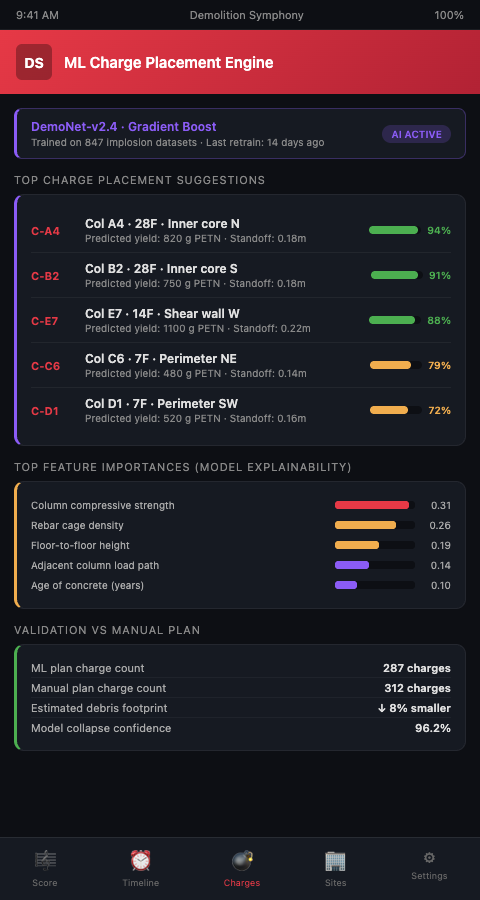
In the Demolition Symphony Planner, machine learning optimal charge placement integrates as an optimization pass over the initial score draft. The coordinator writes the structural map — each column, each slab, each shear wall — and assigns preliminary charge types and approximate positions. The ML module then runs the optimization and returns a revised score with charge weights, positions, and delays adjusted to meet the defined objectives.
The musical score metaphor applies directly here: a composer might write a first draft of an orchestral passage and then ask an arranger to optimize it for balance and resonance. The arranger doesn't replace the composer's intent — the harmonic structure and tempo remain — but adjusts the instrument voicings to eliminate muddiness and bring out the primary line. The ML module does the same for the demolition score: it preserves the intended collapse sequence while refining the individual charge parameters.
This workflow means the coordinator retains authorship of the sequence logic while delegating the parameter-level optimization to an algorithm that can evaluate thousands of candidate configurations in the time it takes to review one manually.
For digital twin integration, the ML optimization output feeds directly into the simulation layer: the optimized charge configuration becomes the input to the FE model that validates collapse behavior. If the simulation reveals a fall-line deviation, the ML module is re-run with a tightened directional constraint and the simulation repeats. This feedback loop compresses what was once a week-long design-simulate-revise cycle into hours.
Shaped Charge Optimization and Linear Cuts
ML applications extend beyond column charges to the shaped charge linear cuts used to sever floor plates and shear walls. Linear shaped-charge jet optimization using ML has been applied to the hydrodynamics of the penetrating jet, optimizing liner geometry and standoff distance to maximize cut depth and minimize secondary fragment generation (AIP). In a high-rise context, this means floor plate cuts in the implosion zone can be tuned to sever the slab cleanly without launching concrete projectiles upward into the fall path.
The state-of-the-art review of ML for blasting covers drilling pattern optimization, delay timing, and charge geometry across mining and civil demolition contexts (Springer). The transferability between mining and demolition is higher than it might appear: both involve fragmenting a brittle material using distributed explosive charges with constrained vibration budgets.
Practical Integration Tactics
Train on your building type. A model trained on mid-rise RC residential towers may not transfer reliably to a mixed-use tower with a steel moment frame above Floor 25. Supplement the public training corpus with any post-blast data from your own completed projects.
Set hard constraints before soft objectives. PPV limits at the nearest structure, fragment exclusion zones, and permitted collapse direction are non-negotiable. Enter these as hard constraints in the ML optimization, not as soft penalty terms — a model that trades off safety margin against cost reduction is not acceptable in urban demolition.
Validate ML outputs against physics simulation. ML models predict statistically likely outcomes, not physically guaranteed ones. Every ML-optimized charge configuration must pass through a dynamics simulation before execution. The combination catches cases where the model extrapolates into structural configurations outside its training distribution.
For autonomous detonation sequencing, ML charge placement is the upstream design step that makes autonomous execution viable: when the charge configuration has been validated through simulation, the electronic detonator network can execute the delay schedule with sub-millisecond precision without human intervention at the firing board.
The cross-domain application of ML to blast optimization is also advancing in industrial decommissioning contexts. The predictive analytics work in industrial plant demolition applies similar ensemble methods to predict contamination spread — demonstrating that the underlying ML architecture transfers across demolition verticals.
Limits and Honest Caveats
ML charge placement models are only as good as the structural data they consume. GPR scanning for rebar location, concrete core testing for compressive strength, and connection-detail review from structural drawings are prerequisites. A model fed assumed material properties produces confident predictions on unreliable inputs — a risk that is more dangerous than manual conservatism.
The 23% cost reduction figure applies to aggregated blast programs, not single events. On any individual implosion, the ML output may match manual estimates closely or diverge significantly depending on how well the training data represents the specific structure. Treat ML optimization as a decision-support tool, not an autonomous designer.
Urban high-rise implosion coordinators working on complex mixed-use towers need charge optimization that integrates with their structural data and simulation workflow, not a standalone calculator that outputs a charge weight and calls it done. The Demolition Symphony Planner's ML optimization layer runs within the score editor, so every charge position on every floor is validated against collapse dynamics and vibration budgets before the delay schedule is finalized. Join the waitlist to bring ML-driven charge positioning into your next high-rise implosion plan.