Future of Autonomous Detonation Sequencing in Urban Demolition
Future of Autonomous Detonation Sequencing in Urban Demolition
Rio Tinto operates the largest autonomous drilling fleet in the world at its Pilbara iron ore operations, with drill rigs selecting blast patterns, executing holes, and reporting results without human intervention at the drill head (Mining Technology). The downstream step — autonomous detonation sequencing — is following the same technology curve. The global blasting automation services market is projected to reach $3.5 billion by 2033 (Strategic Revenue Insights), and electronic detonators alone represent a $15.25 billion market in 2024 growing toward $28.93 billion by 2032 (Future Market Report).
Urban high-rise demolition sits at a different regulatory and safety tier than mining. But the underlying technology — precisely programmable electronic detonators, wireless firing networks, and real-time feedback systems — is shared infrastructure. Autonomous demolition control systems built on this foundation are advancing toward the urban environment on a predictable timeline, driven by next-generation detonation automation that compresses what once required a field crew of wiring specialists into a pre-programmed wireless network. Understanding what autonomous detonation sequencing urban demolition currently achieves and where it is heading tells coordinators which capabilities to plan around now versus which to treat as near-future preparation.
The Hardware Foundation: Wireless Electronic Detonators
The transition from cable-based to wireless electronic detonators removes the largest operational risk in complex urban implosion: the wiring harness. A 600-charge implosion requires thousands of meters of detonation wire and dozens of junction boxes. Each connection is a potential failure point. During the Pontiac Silverdome's failed implosion, a wiring problem caused 10% of charges to fail — leaving the structure standing while the firing team had to re-enter and reassess.
Wireless detonators eliminate firing cables entirely by communicating through a secure radio protocol with each detonator addressed individually (Clausius Press). Each unit stores its programmed delay in onboard memory and executes autonomously from the moment of the arm command. The firing controller transmits the start signal; the detonator network handles the rest. This self-executing implosion sequence technology represents the practical endpoint of electronic detonator development: a system where the coordinator's role concentrates entirely in the design and verification phase, and the automated blast firing systems handle execution with sub-millisecond accuracy once the arm command is given.
Delay accuracy is the critical parameter for autonomous urban demolition sequencing. Research on tunnel blasting using digital detonators has demonstrated delay accuracy within +/-0.1 milliseconds (PLOS One). At that precision level, destructive vibration interference between sequential charges — which requires delay accuracy on the order of 1-2ms — can be engineered with confidence. The old tradeoff between vibration reduction and timing reliability largely disappears.
Remote-controlled autonomous blasting systems also reduce human exposure during the most dangerous phase of implosion operations — the arm-to-fire sequence — by moving the firing controller outside the blast radius without sacrificing timing control (Engineer Live).
What Autonomous Sequencing Adds to the Demolition Score
In the Demolition Symphony Planner, the demolition score is the source document for the autonomous detonation sequence. Each note on the score — each charge, each delay — is exportable as an addressed detonator command in the firing network's protocol format. When the score is validated through simulation and approved for execution, the command file uploads directly to the wireless firing controller.
This is the musical composition analogy taken to its most direct expression: the conductor prepares the score in full, marks every tempo indication, and hands it to the orchestra's players to execute precisely. The players — in this case, the electronic detonators — follow the written score without requiring the conductor to signal each entry in real time. The performance executes from the written score, autonomously, to the millisecond.
For urban high-rise implosion, this workflow means the coordinator's role concentrates in the design and verification phase rather than the execution phase. The score must be right before the arm command is given; there is no mid-sequence intervention available. This raises the stakes on simulation accuracy and pre-blast verification but reduces the execution-phase complexity and human error risk.
For machine learning charge placement, autonomous execution is the natural endpoint: ML optimizes the charge configuration, simulation validates it, and the wireless detonator network executes it without manual delay-by-delay confirmation. The coordinator is the author and the verifier; the autonomous system is the performer.
Regulatory Path to Urban Autonomous Detonation
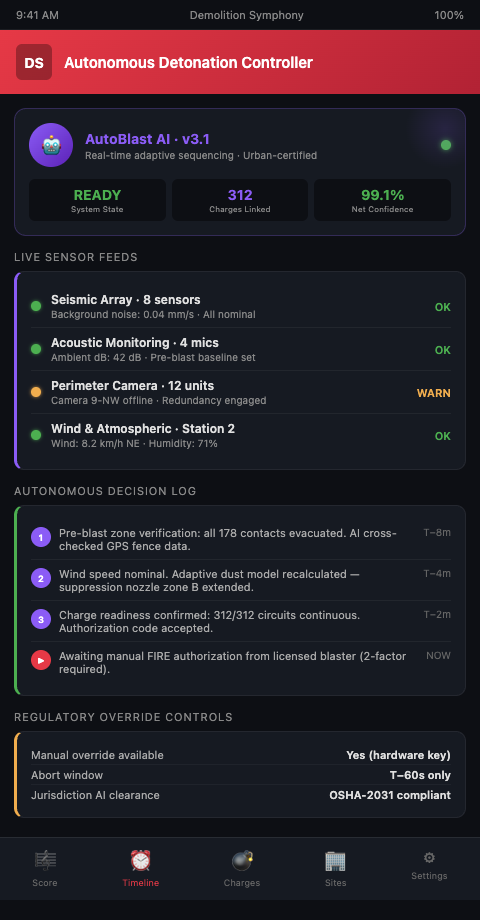
Urban high-rise implosion currently requires a licensed blaster to authorize and supervise the firing sequence. Autonomous execution does not change this requirement — the licensed blaster remains responsible for the arm command and for confirming site conditions before execution begins. What autonomous sequencing changes is what happens after the arm command: the blaster initiates the sequence but does not execute each charge individually.
This is analogous to the autopilot model in aviation: the pilot is responsible for programming, confirming, and overseeing the autopilot; the automated system handles the execution within the defined parameters. Regulatory frameworks for autonomous blasting in mining have evolved over the past decade to accommodate this model, and urban demolition regulators are beginning to engage with the same questions.
The practical near-term path for urban coordinators is to use programmable electronic detonators with the standard wired firing controller as an intermediate step — gaining familiarity with delay-programmed autonomous execution while retaining the wired network as a backup. Full wireless autonomous systems in urban demolition remain an emerging standard, not a current requirement.
Failure Modes and Safety Architecture
Autonomous systems introduce new failure modes alongside the ones they eliminate. The three primary risks are: signal interference that prevents the arm command from reaching detonators, detonator memory corruption that causes a charge to fire at the wrong delay, and network topology failure that orphans a subset of detonators from the firing sequence.
All three are addressed in current wireless detonator specifications through multi-frequency communication, onboard memory checksums, and heartbeat protocols that confirm detonator connectivity at intervals before the arm command is given. If any detonator fails its pre-fire check, the controller identifies it by address and the blaster can assess whether the compromised charge represents an acceptable risk or requires manual intervention.
The safety architecture for autonomous urban demolition must also include a hard-abort capability: the blaster must be able to interrupt the sequence between any two charges if a site condition changes after the arm command. Current wireless detonator systems support an abort window that closes approximately 50ms before each charge's programmed fire time — sufficient for most site condition responses.
For digital twin integration, the real-time structural monitoring data that feeds the digital twin during execution can serve as an early warning input for the abort system: if the measured collapse trajectory deviates beyond a defined threshold from the simulated trajectory, the abort condition triggers automatically before the next charge fires.
The precedent for autonomous multi-machine coordination in adjacent demolition domains is established in selective robotic deconstruction at complex venues, where multiple robotic platforms execute coordinated deconstruction sequences under human supervision without direct human operation at each machine.
Preparing Now for Autonomous Execution
Coordinators who want to be ready for autonomous detonation sequencing as it becomes standard in urban demolition should focus on two capabilities today. First, score-based planning: the demolition score must be complete and simulation-validated before execution begins, because there is no mid-sequence manual correction in an autonomous system. Second, detonator network design: the wireless network topology — which detonators can hear which controllers, and what the redundancy architecture looks like — must be engineered as carefully as the delay schedule itself.
Urban high-rise implosion coordinators integrating electronic detonators and autonomous firing sequences into their workflow need a planning platform that produces the delay schedule and the network topology simultaneously, from the same visual score. The Demolition Symphony Planner generates both outputs from the annotated score, so the firing network design is always in sync with the charge timing. Join the waitlist to see how autonomous sequence export works within the score-based planning environment.