Future of Selective Robotic Deconstruction for Complex Venues
Future of Selective Robotic Deconstruction for Complex Venues
When Husqvarna introduced the DXR 315 demolition robot — a 3,900-pound remote-operated platform capable of delivering 45 kN of hydraulic breaker force — the target application was not stadium demolition. It was nuclear decommissioning and industrial plant teardown, where radioactive or toxic environments made manned entry impossible (Husqvarna Demolition Robots DXR 315). But the same capabilities that make these platforms essential in hazardous industrial environments make them increasingly attractive for complex venue deconstruction: they operate in confined spaces, they can be equipped with different attachment types for cutting, breaking, and sorting, and they impose no physical risk on an operator who is managing the machine from a safe distance outside the demolition zone.
The construction and demolition robotics market is growing rapidly, with applications expanding from specialized industrial use into mainstream commercial demolition as the cost of remote-operated platforms decreases and the labor cost of manned demolition in high-risk environments continues to rise (Robotics & Automation News C&D Robots). For stadium and arena demolition teams, understanding the current state of robotic selective demolition technology — and planning for its integration into complex venue projects — is becoming a competitive necessity. That integration begins in the BIM model: the same digital model that drives structural sequencing must also supply the operational geometry data — ceiling heights, column clearances, ramp slopes, and access path dimensions — that determines where a given robot platform can actually operate.
Where Robotic Demolition Technology Is Now
Current commercial demolition robots are remote-operated rather than fully autonomous — meaning they require a skilled operator for all decision-making, with the robot executing commands through radio or tethered control systems. The platforms available today excel at three specific applications within a stadium demolition project:
Interior concourse and basement demolition. Stadium concourses are low-ceiling, column-dense environments where high-reach excavators cannot operate and manned breaker work is slow and fatiguing. Remote-operated demolition robots with hydraulic breaker or shear attachments can work continuously in these spaces at a pace that matches or exceeds manned crews, without exposing workers to the dust, noise, and falling debris risk that concourse demolition generates.
Hazardous material zone isolation. Where asbestos-containing materials or lead paint are present in confined demolition zones, robotic platforms allow bulk material removal without requiring workers in respiratory protection to spend extended periods in the hazard zone. This is not a marginal improvement — it is a fundamental risk reduction for the workers who would otherwise be doing the work.
Precision element removal around retained structures. When a stadium is being partially deconstructed while an adjacent structure remains in service — or when specific structural elements must be removed without disturbing adjacent retained elements — robotic platforms equipped with diamond wire saws or hydraulic shears can make cuts within centimeter tolerances that are difficult to achieve with conventional excavator-mounted attachments.
Research on semi-autonomous deconstruction confirms that robotic platforms achieve superior material selectivity compared to manned mechanical demolition in complex structural environments, reducing material contamination in separated streams by 15-25% in documented trials (Springer Towards Controlled Semi-Autonomous Deconstruction).
The C&D Waste Market Context
The construction and demolition waste management market is projected to reach $308.5 billion by 2030, driven by increasing landfill diversion requirements and the rising commercial value of recovered materials (Grand View Research C&D Waste Market). For stadium demolition, the material recovery economics are compelling: a 70,000-seat stadium contains enough recoverable steel, copper, aluminum, and sorted concrete aggregate to generate millions of dollars in salvage revenue — but only if the materials are separated cleanly rather than intermixed during demolition.
Robotic selective demolition technology improves material recovery rates because it allows element-by-element removal rather than zone-by-zone bulk demolition. A robotic platform equipped with a shear can cut the steel secondary framing from a precast concrete section — separating two materials that have significant separate salvage value — in a way that a hydraulic excavator operating at height cannot match in precision. The Prism sustainability analysis of robotics in deconstruction identifies material stream purity as the primary economic driver for robotic adoption in selective deconstruction, ahead of safety improvements and schedule compression (Prism Robotics Deconstruction Safety).
Autonomous Machinery Arena Deconstruction: The Near-Term Trajectory
Fully autonomous robotic demolition — where the machine makes removal decisions based on sensor data without human operator input — is still in research and pilot deployment phases. Current semi-autonomous systems can handle simple repetitive tasks — advancing along a defined path, breaking material to a specified size — but cannot yet navigate the complex structural state changes of a partially deconstructed stadium without human oversight.
The near-term trajectory (3-5 years) is toward supervised autonomy: robots that execute defined demolition sequences autonomously, with human operators monitoring sensor outputs and approving each phase transition before autonomous execution continues. This is the same model that the Demolition Symphony Planner uses for its phase gate system — each measure in the score executes autonomously within defined parameters, with human review required before the next measure begins.
In the Demolition Symphony Planner, robotic demolition platforms are notated in the visual score as independent instrument tracks alongside the high-reach excavator and implosion tracks. Each robot's operational zone, attachment type, and removal sequence are specified in its track, with handoff points to manned excavator operations explicitly marked at the boundaries of what robotic platforms can currently handle. This coordination — between what the robots do and what the manned equipment does — is the planning challenge that robotic demolition creates, not the technology itself.
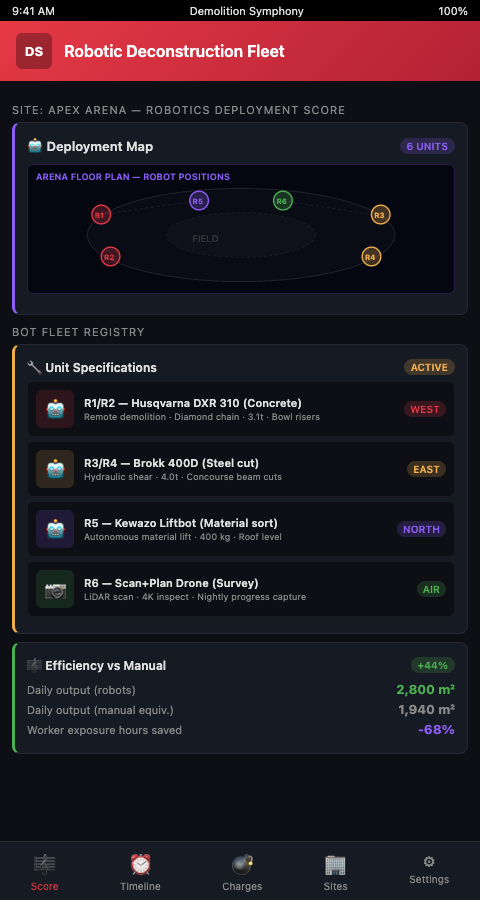
Advanced Tactics: Integrating Robotic and BIM Planning
The most productive current application of autonomous machinery in arena deconstruction planning is not on the demolition site itself but in the digital planning environment. BIM-integrated robotic path planning — where the robot's operational zone and removal sequence are simulated in the BIM model before any physical work begins — allows teams to identify interference points between the robot's path and the retained structure, optimize the removal sequence for material stream separation, and verify that the robot's physical dimensions are compatible with the confined spaces it will be operating in.
For BIM model integration to support robotic demolition planning effectively, the model must include not just structural geometry but operational geometry: ceiling heights in concourses, column clearances, ramp slope data, and access path dimensions that determine where a given robot platform can actually operate. A BIM model built for design review will typically be missing half of this operational data.
The Darda documentation of demolition robots in practice identifies this operational geometry data as the primary gap between theoretical robotic capability and practical deployment — platforms that are technically capable of accessing a space cannot do so because the path from the access point to the work zone is too narrow or too sloped for the robot's ground clearance and turning radius (Darda Demolition Robots).
The wrecking ball limitations post establishes why legacy impact methods fail for modern complex venues. Robotic selective deconstruction is the operational counterpoint: the same structural complexity that defeats a wrecking ball — dense reinforcement, confined working spaces, retained adjacent structures — is precisely the environment where remote-operated demolition platforms perform best. For autonomous detonation in high-rise contexts, the same supervised-autonomy principle applies: human approval gates separate autonomous execution phases, maintaining human control over the critical decisions while capturing the speed and precision advantages of automated operation.
Remote-operated demolition equipment large venue teams can score their stadium teardown with Demolition Symphony Planner — the only planning platform that integrates robotic operational zones, BIM geometry verification, and phase-gate supervision into a single coordinated visual score. Score Your Stadium Teardown and plan your next complex venue project with the tools that match the complexity of what you are tearing down.