Integrating BIM Models into Stadium Deconstruction Planning
A 2021 Taylor & Francis study on BIM uses for deconstruction found that project teams integrating building information modeling into their demolition workflow reduced pre-demolition RFIs by an average of 34% compared to teams working from 2D drawings alone — a finding that understates the benefit on stadium projects, where the gap between original structural drawings and as-built conditions after 40–60 years of renovations can be extraordinary. A stadium that opened in 1985 and received luxury-box additions in 1997, concourse expansions in 2004, and a partial roof replacement in 2016 may have structural documentation across four different drawing standards, three different engineering firms, and two different unit systems — none of which is internally consistent.
BIM models stadium deconstruction planning solves the documentation inconsistency problem by creating a single federated model that represents the structure as it actually exists, not as it was originally designed. That model becomes the foundation for demolition sequence development, clash detection, material quantity estimation, and crew-level work order generation — a workflow that treats 3D model stadium teardown sequencing as the operational center of the project, not an optional analytical layer on top of a 2D plan.
Why 2D Drawing-Based Demolition Planning Fails
Building information modeling demolition workflow adoption on stadium teardowns lags behind its adoption on new construction because the perceived upfront cost of creating a BIM model of an existing structure discourages project teams that are already under schedule and budget pressure. The result is demolition planning conducted from incomplete 2D documentation — and the field surprises that follow.
Three failure modes are specific to 2D-based stadium demolition planning. The BIM model also serves a critical role in structural deterioration assessment: field assessments of corroded rebar and spalling concrete are most useful when captured in the BIM model at element level, enabling automated sequence adjustment without manual cross-reference. First, hidden MEP conflicts: in a stadium with 60 years of infrastructure additions, mechanical, electrical, and plumbing systems often run through structural members in ways that renovation drawings never captured. A demolition sequence that calls for cutting a concrete shear wall without knowing that a 14-inch chilled water main runs through it produces a field stop, emergency plumbing work, and a days-long schedule impact. BIM clash detection pre-demolition catches this conflict before it becomes a field event.
Second, material quantity errors: steel tonnage, concrete volume, and recyclable material estimates derived from 2D drawings carry significant inaccuracy on buildings with complex renovation histories. The ScienceDirect BIM for deconstruction review documents that BIM-derived quantity takeoffs achieve 85–92% accuracy on existing structures with comprehensive scan-to-model preparation — compared to 65–75% for 2D-derived estimates on equivalent structures. On a stadium where steel recovery revenue is a significant project budget component, a 15% quantity error translates directly to a budget variance.
Third, sequence validation: a 2D demolition plan cannot visualize the intermediate structural states of a partially demolished stadium — the configuration after the east grandstand is removed but before the west grandstand deconstruction begins. BIM-based sequencing allows the structural engineer to validate each intermediate state for stability before the sequence is finalized, catching instability conditions that are invisible in plan and section views.
The Demolition Symphony Score with BIM Integration
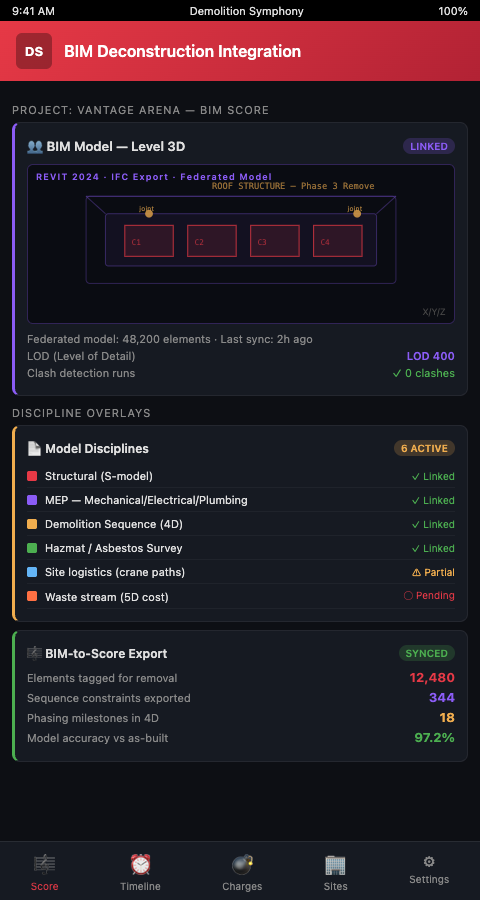
Demolition Symphony Planner integrates BIM models as the geometric foundation of the visual demolition score: every salvage window, recycling stream, and structural cut becomes musical notation on a visual demolition score, and every measure in the score is linked to the BIM elements it affects — the specific structural members, floor sections, or MEP systems that are modified in that demolition phase. When a measure is executed, the linked BIM elements are marked as demolished in the model, and the software automatically recalculates the structural state for the next measure.
The framework structures BIM integration across four operational movements.
Movement 1 — Scan-to-BIM Model Creation. For stadiums without comprehensive BIM documentation, a pre-demolition scan-to-BIM survey creates the baseline model. Clovetech's strip-out modeling methodology establishes that a terrestrial laser scan of a large venue, combined with georeferenced point cloud processing, can produce a BIM model accurate to within 10mm in 4–6 weeks — a timeline that fits within the pre-mobilization phase of most stadium demolition projects. The model captures actual as-built geometry, not design intent, making it immediately useful for demolition sequence planning.
Movement 2 — Clash Detection Against the Demolition Sequence. The federated BIM model — combining structural, MEP, architectural, and hazmat abatement models — is run against the proposed demolition sequence to identify clashes: MEP systems that must be abated before structural members can be demolished, structural elements whose removal would destabilize adjacent elements not yet scheduled for demolition, and temporary access routes that conflict with planned debris pathways. The ResearchGate building deconstruction BIM research identifies clash detection as the highest-value single BIM application in demolition planning, generating an average return of 6x the model creation cost in avoided field change orders.
Movement 3 — Material Quantity Integration. BIM-derived quantities for each demolition measure are pushed into the project's material recovery tracking system. Steel tonnage, concrete volume by type, hazmat quantity by zone, and salvageable element counts are all extracted from the model, not estimated from drawings. The Springer BIM in C&D waste management research documents that BIM-integrated waste tracking on deconstruction projects improves diversion rate accuracy by 18–22% compared to estimate-based tracking.
Movement 4 — Work Order Generation from Model State. As each measure in the visual demolition score is completed and the BIM model is updated to reflect the current field state, Demolition Symphony Planner generates the work orders for the subsequent measures based on the model state — not the original sequence plan. This means that when field conditions deviate from the plan (an unexpected structural member, a hidden utility, a material in a different condition than anticipated), the sequence automatically adjusts and regenerates the affected work orders rather than running on a plan that no longer reflects reality.
Advanced Tactics for Digital Twin Demolition Planning
Three advanced tactics extend the value of BIM integration beyond clash detection and quantity takeoff.
Use the BIM model to validate condition survey findings at element level. A BIM-integrated condition survey captures corroded rebar, spalling concrete, and degraded connections at the element level — allowing the demolition sequence to be automatically adjusted based on where deterioration is severe enough to modify the removal protocol, without requiring a manual cross-reference between the survey spreadsheet and the drawing set.
Apply the digital twin modeling discipline from implosion planning. Urban highrise implosion teams use digital twin models to simulate blast propagation and structural response before a single charge is placed. The same simulation discipline — structural analysis of the BIM model in partially demolished configurations — validates the demolition sequence at each intermediate state, identifying instability conditions before they reach the field. Demolition Symphony Planner supports finite element analysis model export from the BIM environment, enabling the structural engineer to run stability analyses on intermediate-state configurations within the project's BIM workflow.
Maintain the BIM model as a live project record, not a planning artifact. The Springer deconstruction waste management 3D BIM research notes that BIM models are most commonly used in demolition planning for pre-project analysis and then abandoned as the project progresses. Projects that maintain the model as a live record — updating it as-demolished rather than as-designed — generate a project closeout document that is directly usable for site development planning, redevelopment permitting, and subsurface infrastructure mapping on the cleared site. Demolition Symphony Planner's BIM integration is designed for continuous update throughout the project, making the as-demolished model a deliverable rather than a planning byproduct. The BIM-derived intermediate state views complement the visual score planning approach: while the visual score presents the demolition sequence as a readable musical notation, the BIM model provides the three-dimensional validation of what each score measure means structurally.
Delivering the BIM-Powered Demolition Score
Digital twin arena demolition planning is rapidly transitioning from an optional value-add to a regulatory and contractual expectation on large public venue projects. Municipal permit authorities, sustainability certification bodies, and insurance underwriters for large demolition projects all increasingly require the level of pre-demolition analysis that BIM makes possible: clash-free sequences, BIM-validated material quantities, and intermediate-state structural stability confirmation.
Demolition Symphony Planner's BIM integration delivers that analysis as a natural output of the scoring workflow — the visual demolition score is built from the BIM model, the BIM model is updated by the score execution, and every measure in the score is backed by model-derived data. Score Your Stadium Teardown with Demolition Symphony Planner and bring the precision of BIM-powered planning to every phase of the demolition sequence. Get started with a BIM-integrated demolition score that validates every intermediate structural state before the next measure begins.