How to Handle Structural Deterioration in Aging Arenas
The Science Advances research on corrosion-induced size effects in reinforced concrete documents a striking finding: the tensile strength reduction in corroded rebar begins at 20–30 years of service exposure in aggressive environments — precisely the age range of many stadiums currently entering the demolition pipeline. A concrete arena built in 1995 may have reinforcing steel that carries 60–70% of its original design capacity, yet the structural drawings — and the demolition plan derived from them — assume 100%. That assumption is not conservative. It is a source of unplanned load redistribution during demolition that field engineers discover the hard way.
Structural deterioration aging arena handling requires a pre-demolition structural assessment that goes beyond reviewing drawings and conducting a visual survey from the concourse level. It requires element-level condition mapping, material sampling, and engineering analysis of how actual-condition structural capacity changes the load path at each phase of the demolition sequence. Getting that analysis wrong produces field stops, emergency shoring, and the kind of partial structural collapse that generates injury reports and regulatory investigations. Deterioration findings must be continuously cross-referenced with the bowl stability analysis framework as demolition progresses: previously hidden structural conditions exposed during work can change the stability analysis for subsequent phases, making the stability model a living document rather than a static pre-project calculation.
How Deterioration Alters the Demolition Sequence
Aged concrete stadium demolition risk manifests differently from the structural risk in a healthy building. In a healthy building, removing a structural member transfers its load to adjacent members that are designed to carry that additional demand. In a deteriorated building, the adjacent members may already be carrying more than their design load due to load redistribution from previously compromised elements — meaning the removal of the scheduled member tips a system that was already at its limit.
Three deterioration mechanisms are most significant for arena deconstruction sequencing. First, corroded rebar arena deconstruction risk: ScienceDirect rebar corrosion research documents that corrosion products expand to 6–7 times the original steel volume, cracking the concrete cover and reducing the bond between steel and concrete. A concrete section whose rebar is significantly corroded no longer behaves as a composite section — it behaves as two weakly connected materials, each carrying load independently at reduced capacity.
Second, spalling concrete venue teardown risk: Rimkus Concrete documents that spalling — the loss of concrete cover over reinforcing steel — is a direct indicator of advanced corrosion and often accompanies delamination of the concrete section. A spalled beam or column may have lost significant cross-section to concrete loss, reducing its compressive capacity below what the undamaged section drawing suggests.
Third, FEMA P-2018 seismic evaluation guidelines for older concrete structures identify non-ductile reinforcement detailing — characteristic of concrete buildings constructed before the 1971 San Fernando earthquake and its aftermath — as a particular concern for structures in seismic zones. Many arenas built in the 1950s–1970s use non-ductile detailing that performs acceptably under service gravity loading but fails catastrophically under the lateral and dynamic loads introduced by demolition operations.
The Demolition Symphony Score for Deteriorated Arenas
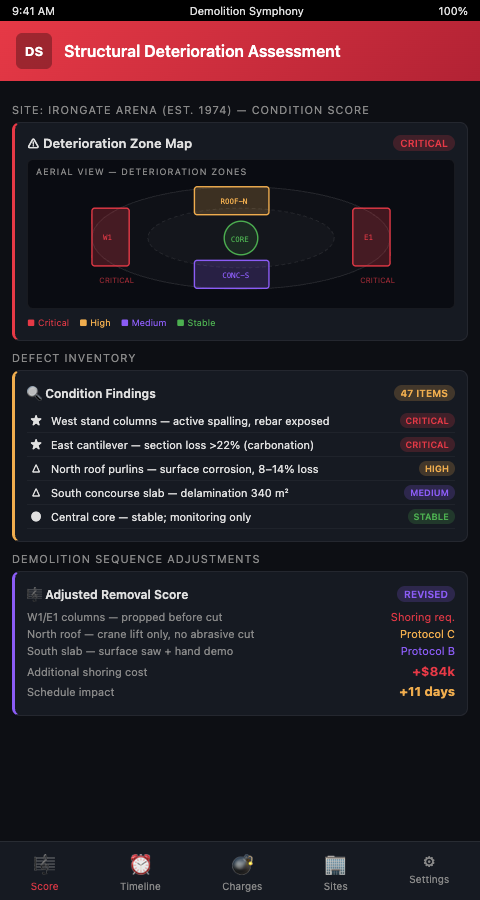
Demolition Symphony Planner treats structural deterioration assessment as a mandatory preliminary movement that the visual demolition score cannot begin without: every salvage window, recycling stream, and structural cut becomes musical notation on a visual demolition score, but the condition of each element in the score is informed by the actual deterioration survey, not the design drawings. Elements flagged as severely deteriorated receive modified demolition measures — alternative sequencing, reduced equipment weight limits, or temporary shoring requirements — before the structural sequence proceeds.
The framework structures deterioration handling across four movements.
Movement 1 — Element-Level Condition Survey. The structural assessment deteriorated arena pre-demolition process begins with an element-level condition survey conducted by a structural engineer with demolition experience. Each primary structural element — columns, beams, shear walls, foundation connections — receives a condition rating based on visual inspection, cover depth measurement, chloride penetration testing, and carbonation depth measurement. Demolition Symphony Planner logs the condition ratings as element-level annotations on the structural model, creating a deterioration map that the demolition sequence engine can query.
Movement 2 — Capacity Reduction Factors. Based on the condition survey, the structural engineer applies capacity reduction factors to deteriorated elements. A column rated severely corroded receives a reduced axial and shear capacity factor that the demolition sequence must respect when calculating load redistribution at each phase. OSHA 1926.850 requires that demolition operations be conducted under the supervision of a competent person with knowledge of the structural conditions present — the capacity reduction factor assignment operationalizes that requirement at the element level.
Movement 3 — Sequence Modification for Deteriorated Elements. Elements with significant capacity reduction require modified demolition sequencing. A shear wall with 40% section loss cannot be removed in the same sequence as a healthy wall — it must be temporarily propped before adjacent elements are removed, or removed in a sequence that avoids placing it in a configuration where it carries redistributed load from removed neighbors. The MDPI durability deterioration mitigation research identifies temporary shoring insertion as the primary modification for accommodating capacity-reduced elements in the demolition sequence, at a typical cost of 3–5% of the element's removal cost.
Movement 4 — Material Recovery Rate Adjustment. Deteriorated concrete and corroded steel have different material recovery profiles than healthy material. Severely corroded rebar loses section area that reduces its scrap weight below what the original drawing quantity suggests. Spalled concrete sections may contain significant delaminated debris that must be sorted separately from clean crushed aggregate. Demolition Symphony Planner adjusts the material recovery rate projections for each zone based on the deterioration survey findings, producing budget estimates that reflect what will actually be recovered rather than what the design documents suggest.
Advanced Tactics for Aging Venue Deconstruction
Three advanced tactics address the complexity of demolition planning in heavily deteriorated structures.
Update the stability analysis whenever significant deterioration discoveries occur. A pre-demolition stability analysis is based on the deterioration survey conducted before work begins. As demolition proceeds and previously hidden structural elements are exposed, new deterioration may be discovered that changes the stability analysis for subsequent phases. Demolition Symphony Planner treats the stability analysis as a living document that is updated when significant deterioration discoveries occur, triggering re-evaluation of the remaining sequence before the next phase is dispatched.
Adjust material recovery rates projections early and communicate them to project stakeholders. The gap between design-document material quantities and actual recovered quantities is larger on deteriorated structures than on any other project type. Project owners who are counting on steel or concrete recovery revenue to offset demolition costs need accurate projections before the project begins, not after the first weigh ticket reveals the shortfall. The Procore construction sequencing documentation identifies early stakeholder communication about material recovery uncertainty as a risk mitigation practice that reduces project owner disputes on demolition projects with significant recovery revenue assumptions.
Apply the pre-blast structural assessment methodology to arena structural evaluation. Urban highrise implosion teams conduct exhaustive pre-blast structural assessments that document every element's condition before explosive charges are designed. The same assessment depth — including non-destructive testing, chloride profiling, and connection integrity evaluation — provides the confidence level that a complex stadium demolition sequence requires. The assessment cost is a fraction of the cost of a mid-project emergency shoring intervention triggered by an undiscovered deteriorated element.
Delivering Safe Demolition on a Deteriorated Structure
Aged concrete stadium demolition risk cannot be managed by adding contingency to the budget and hoping the structure performs as designed. The PMC monitoring of corrosion in steel bars documents that corrosion-induced capacity reduction is non-linear — a bar that appears 80% intact on a visual inspection may carry 50% of its original load capacity due to pitting and section loss at the critical cross-section that no surface survey captures. Only physical testing — core sampling, half-cell potential mapping, rebar extraction and tensile testing — provides the data that a credible capacity reduction factor requires.
Demolition Symphony Planner exports the deterioration-adjusted demolition score with element condition ratings, capacity reduction factors, modified sequence annotations, and adjusted material recovery projections as an integrated package that the structural engineer, demolition superintendent, and project owner all work from. No element is demolished on a plan that assumes its design capacity when the condition survey says otherwise. Score Your Stadium Teardown with Demolition Symphony Planner and build the structural assessment findings into the demolition score before the first equipment mobilizes. Get started with a deterioration-adjusted demolition sequence that replaces design-capacity assumptions with field-verified condition data at every phase gate.