Best Practices for Pre-Blast Structural Assessment in High-Rises
What OSHA Requires vs. What Implosion Demands
OSHA 29 CFR 1926.850 mandates an engineering survey of framing, floors, and walls before demolition begins. For a standard mechanical demolition — excavators, shears, and pulverizers — this survey provides adequate pre-work documentation. For a controlled explosive implosion, it is the minimum, not the standard.
An implosion-grade pre-blast structural assessment high-rise workflow must determine: the structural system type and original design loads at every floor level; the current condition of load-bearing columns, including corrosion, spall, and pre-existing deformation; the presence and routing of post-tensioned tendons in slabs and beams; the location and condition of moment-frame connections at column-beam joints; and the presence of hazardous materials — particularly asbestos — that affect the pre-blast removal sequence. This building evaluation before implosion is not a once-per-project event — it must be updated whenever structural conditions discovered during charge installation differ from what the drawings and initial inspection documented.
Stott Demolition's failure case analysis lists inadequate pre-blast surveys as a leading root cause of unexpected collapses and costly remediation. Unexpected structural conditions discovered after the detonation network is installed — a post-tensioned slab that wasn't on the structural drawings, a corroded column section that fails at a lower charge weight than specified — require last-minute charge modifications that compromise the timing sequence and may require the blast to be aborted. A rigorous pre-demolition structural survey and structural integrity check before blast also provides the documented baseline that protects the project team against liability claims when neighboring structure damage is alleged post-blast.
The Pre-Blast Assessment Workflow
The assessment workflow for high-rise implosion begins with document review: original structural drawings, any subsequent modification permits, and any available structural inspection reports. Document review establishes the intended structural system. Field verification confirms what was actually built and how the building has changed over its operational life.
Banner Environmental's pre-demolition survey guide outlines all components of a complete pre-demolition survey: structural condition, hazmat, utility mapping, and neighbor impact. Each component generates data that feeds directly into a different layer of the Demolition Symphony Planner's score — structural condition data into the charge placement layer, hazmat data into the pre-weakening and pre-blast removal sequence layer, utility mapping into the timing score's pre-detonation event layer, neighbor impact into the vibration monitoring zone calculation.
The progressive collapse robustness study from ScienceDirect establishes the pre-assessment framework for high-rise RC buildings: the robustness assessment identifies which structural elements are the load-path keystones — the columns that, when removed, trigger progressive collapse across the widest structural area. These keystone elements are the primary targets for the charge placement sequence. Pre-blast robustness assessment tells the implosion coordinator which columns drive the collapse and which are secondary. This prioritization directly determines the floor-by-floor detonation sequence.
The hazmat component of the assessment has its own regulatory requirements. The EPA NESHAP asbestos inspection mandate requires asbestos inspection and a 10-day pre-notification before demolition of any commercial structure. A3E Environmental's survey scope documentation covers the destructive sampling required for ACM behind walls and inside columns — sampling that must be completed before the charge placement map is finalized, because hazmat removal in column cavities can alter the column's effective structural section.
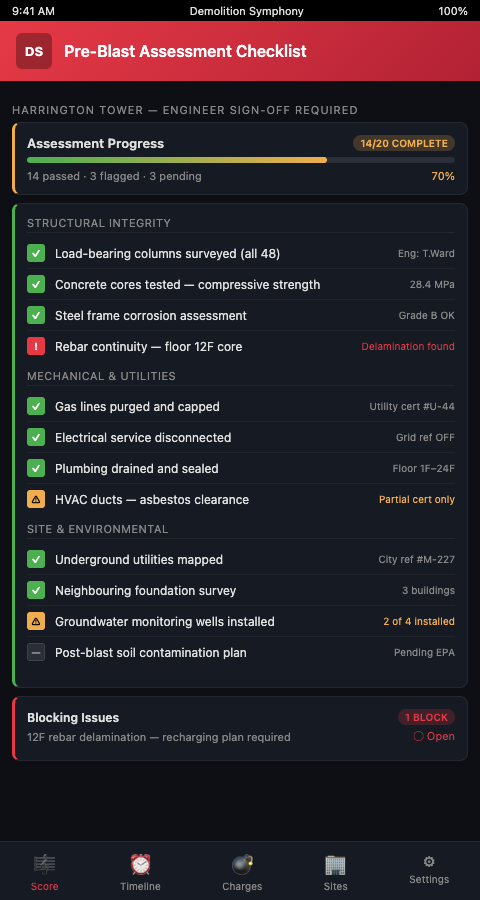
The structural condition assessment feeds directly into the charge specification layer of the implosion score. A column with 15% rebar corrosion requires a different charge weight than the same column type in original condition. A floor slab with post-tensioned tendons requires a tendon pre-severance event in the score before the column charge fires. The Demolition Symphony Planner links assessment findings to score layers explicitly: when the assessment documents a condition that affects charge specification, that condition appears as an annotation on the relevant note position in the score.
The utility mapping component of the assessment deserves specific attention on urban high-rise projects. Active utility services — electrical, water, gas, telecommunications — entering the building from below grade must be confirmed disconnected and sealed before the blast. But the assessment must also verify utility runs within the building that serve neighboring structures. Shared utility corridors that pass through the target building's basement are a documented source of post-blast service disruption when they're not identified in the pre-blast assessment and protected or rerouted before demolition begins. In some urban sites, a shared telecommunications conduit in the basement may serve three neighboring buildings — cutting it during the blast creates service outages that are entirely separate from any structural damage, but equally costly in liability terms.
Pre-blast robustness assessment for the building's current structural condition — not just its original design condition — is the final component that separates an implosion-grade assessment from a standard demolition survey. The progressive collapse robustness framework identifies which elements are load-path keystones in the building's current state, accounting for any post-construction modifications, deterioration, or structural repairs. A building whose lower three floors were retrofitted with additional shear walls in 2005 has a different progressive collapse robustness profile than the original design, and the charge sequence must address the retrofitted load path, not the original one.
For the drone-based structural inspection methods that are replacing or supplementing traditional access-based surveys on high-rises, the drone surveillance post covers how aerial inspection data integrates with the pre-blast assessment workflow and what it can and cannot replace in the field verification process.
Advanced Assessment Practices for Complex High-Rise Conditions
FEM validation of assessment findings. Springer's full-scale FEM study validates FEM simulation against sensor data from an actual controlled demolition, confirming that numerical pre-blast assessment predicts the structure's response to progressive column removal with high fidelity. For complex high-rise geometries — asymmetric towers, setback buildings, buildings with significant structural modifications from original design — FEM simulation of the pre-blast condition provides a more reliable charge specification baseline than analytical methods alone. The Extreme Loading for Structures software builds 3D structural models to evaluate controlled collapse plans, specifically for validating pre-blast assessment inputs against predicted demolition behavior.
Load path continuity verification. The pre-blast assessment must verify that the load path in the current building matches the load path in the original structural drawings. Tenant modifications — added mezzanine structures, infilled floor bays, column-to-beam connection modifications — create load paths that don't exist on the drawings and can redirect the progressive collapse if the charge sequence doesn't account for them. A field verification sweep specifically for load path modifications should be part of the standard high-rise implosion pre-assessment protocol.
Neighbor structure resonance testing. The vibration wave propagation calculations that determine the inner exclusion zone and the vibration monitoring zone boundaries depend on the resonant frequency of neighboring structures. For buildings within 150 meters of the blast perimeter, pre-blast ambient vibration testing establishes the natural frequency so the timing sequence delay intervals can be designed to avoid resonance excitation. This testing is most efficiently scheduled as part of the structural assessment phase, so its results are available when the delay timing layer of the implosion score is being designed.
Documenting the assessment-to-score translation. Every structural condition finding that changes a charge specification or a sequence timing decision should be documented with a traceable link from the field observation to the score annotation. This documentation trail is the primary defense against liability claims when neighboring structure damage is alleged: the record shows that the charge specification at column X was based on the field assessment finding at column X, reviewed by structural engineer Y on date Z, and that the exclusion zone calculation was based on those specifications. Without this documentation, the implosion team must reconstruct the decision rationale from memory — which is both unreliable and legally weak.
Timing of the assessment relative to permit milestones. On projects where the demolition permit requires a structural assessment report as part of the application, the assessment must be completed and the report written before the permit is filed. This sounds obvious but frequently creates a schedule conflict: the contractor wants to start planning the blast sequence, but the assessment won't be complete for three more weeks. The Demolition Symphony Planner allows coordinators to build a preliminary score structure — floor tracks, column positions, placeholder charge specifications — before the assessment is complete, so that when assessment findings arrive, they slot into an existing score framework rather than starting a blank document. This parallel workflow reduces the gap between assessment completion and permit-ready blast plan.
For the safety zone calculations that depend on pre-blast assessment data, the safety zone planning post covers how assessment findings translate into Zone 1 and Zone 3 boundary parameters — and why assessment completion must precede zone finalization.
For bridge demolition teams applying structural assessment methods to high-rise implosion projects, the load transfer analysis post covers how load path continuity analysis works in a different structural geometry — the assessment logic transfers directly even when the structure type differs.
Complete the Assessment Before the First Charge Is Specified
Urban high-rise implosion coordinators who finalize the pre-blast structural assessment before beginning the charge placement map avoid last-minute field modifications to the detonation network — the kind of modifications that compress the blast planning timeline and increase the probability of sequencing errors. The Demolition Symphony Planner links pre-blast assessment findings directly to the charge placement and delay sequencing layers, so conditions discovered in the assessment automatically generate specification flags in the score rather than existing as a separate document that may not get reconciled with the blast plan.
A complete high-rise condition assessment demolition workflow produces four outputs that feed directly into the charge placement score: a column-by-column structural condition register, a hazmat survey with pre-blast removal sequencing requirements, a utility mapping report with disconnection lead times, and a neighbor structure resonance frequency survey. When all four outputs are available before the score's first note is placed, the charge specification at each column position reflects the actual building condition rather than a design assumption. When any one of them is missing, the charge design contains an assumption that the field will correct — under time pressure, without formal review, and without a documented basis for the decision.
Join the waitlist for urban high-rise implosion coordinators and get priority access to the assessment-to-score integration workflow when it launches.