How Visual Score Planning Improves Stadium Demolition Efficiency
How Visual Score Planning Improves Stadium Demolition Efficiency
When the Wembley Stadium reconstruction project ran into coordination failures, the root cause identified in the post-project analysis was not engineering complexity or budget — it was the absence of a shared visual plan that all parties could read consistently (Wembley Stadium Case Study, Parallel Project). Different contractors were working from different versions of the program, with no single document that encoded every team's phase dependencies in a format they could all interpret in real time. For demolition projects — where the structural state changes with every removal event and the consequences of a coordination error are immediate and physical — this planning gap is not an inconvenience. It is a structural risk.
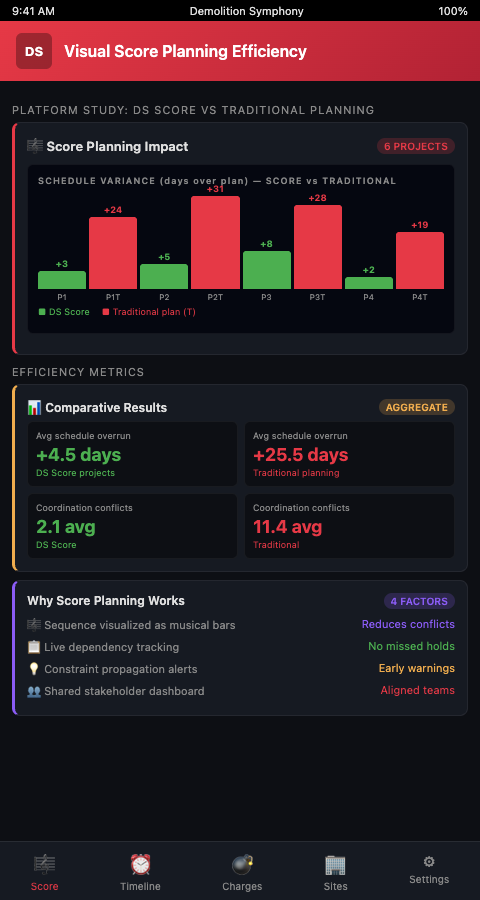
Visual score planning stadium demolition efficiency addresses this gap directly. The Demolition Symphony Planner encodes every element of the demolition sequence — structural removal events, material stream windows, equipment deployment zones, monitoring gates, regulatory approval holds, and salvage recovery periods — onto a single visual score where time runs horizontally, structural zones run vertically, and every action is a note in a coordinated demolition composition. The visual score's time dimension also functions as the 4D layer of BIM model integration — converting a static 3D structural model into a dynamic sequencing tool where every zone's state at every phase is explicit.
What Makes a Demolition Score Different from a Gantt Chart
The Gantt chart is the default project planning tool for stadium demolition — and it is the wrong tool for the job. Gantt charts are good at showing when tasks start and end. They are poor at showing the structural and spatial dependencies between tasks that happen simultaneously in different zones. When a structural engineer looks at a demolition Gantt chart, they see a list of activities. When they look at a demolition score, they see relationships: how the bowl sector removal in Zone A relates to the cantilever load redistribution in Zone B, which in turn gates the material recovery window in Zone C.
The construction management literature on BIM's potential for demolition identifies this visualization gap as one of the primary reasons that demolition projects underperform relative to plan — not because the plan is wrong, but because the plan is encoded in a format that prevents teams from seeing interdependencies until they are already causing delays (Construction Management BIM Demolition). A visual score format, where every zone's activity is visible simultaneously and phase gates between zones are explicitly marked, converts the demolition plan from a schedule document into a coordination instrument.
Musical Notation as a Demolition Planning Framework
The Demolition Symphony Planner's musical notation demolition planning tool is not a metaphorical decoration — it is a functional encoding system that maps directly onto the structural logic of stadium demolition.
In a musical score, each instrument carries a staff showing its part across time. The conductor can see all instruments simultaneously and verify that each transition — a handoff from strings to brass, a moment where all instruments pause — is planned and coordinated. In a demolition score, each structural zone carries a lane showing its removal phases across time. The project manager can see all zones simultaneously and verify that each structural gate — a point where one zone's removal must be complete before the adjacent zone's removal begins — is planned and encoded in the sequence.
The time signature in a demolition score is not beats per measure but structural phase gates per zone. A measure in the demolition score represents a complete phase: structural removal events that share the same monitoring requirements and can proceed in parallel. The barlines between measures represent the gates — stability checks, regulatory approvals, material recovery completions — that must close before the next measure begins. Reading the score tells any team member exactly where they are in the sequence, what phase gates are currently open, and what the next measure requires from their zone.
ScienceDirect research on BIM-based visual demolition waste planning confirms that visual phase representation of demolition sequences reduces material contamination rates and improves recovery diversion by enabling real-time coordination between demolition and material handling teams — a benefit that is not achievable with text-based Gantt schedules (ScienceDirect BIM Visual Demolition Waste Planning).
Phase Visualization Arena Teardown: What Each Section of the Score Contains
A complete demolition score for a large stadium teardown in the Demolition Symphony Planner contains five instrument sections running in parallel:
Structural removal section. The sequence of removal events — sector by sector, element by element — with structural phase gates marked at every boundary where stability must be verified before work continues. This section is authored by the structural engineer and updated after each monitoring cycle.
Material stream section. The windows during which each material stream — steel, sorted concrete, copper, seating, mechanical equipment — can be recovered. Material stream windows are aligned with structural removal events to ensure that recovery operations do not interfere with active demolition in adjacent zones.
Equipment deployment section. The schedule of which equipment type operates in which zone during each measure. High-reach excavators, robotic platforms, implosion events, and manual salvage teams are each represented as distinct instrument tracks within this section.
Monitoring and regulatory section. The gates that must close before each structural phase can proceed — sensor threshold checks, engineering sign-offs, permit confirmations, and community notification completions. These appear as rest markers in the score that convert to proceed markers when the required condition is confirmed.
Artifact salvage section. The Artifact Salvage Windows specific to this project — the periods during which historically significant or high-value elements must be removed before bulk demolition of the surrounding structure begins.
The 4D BIM research confirms that integrating time-phased visual planning with structural sequencing reduces rework events and phase-gate failures by making interdependencies visible to all parties simultaneously — not just to the project manager who maintains the master schedule (ScienceDirect 4D BIM Benefits Review).
Advanced Tactics: Using the Score to Accelerate Phase Approvals
The demolition score's visual format creates a secondary benefit that teams often discover partway through a project: it dramatically accelerates regulatory and stakeholder approvals. When an engineer or inspector can look at a single visual document and immediately understand where the project is in its sequence, what phase gates have been completed, and what the next structural phase entails, the review process that typically requires multiple meetings and document exchanges can often be completed in a single session.
The NFDC's deconstruction of structures guidance notes that clear phase documentation is among the most effective tools for managing approval timelines, because it allows reviewers to verify that their specific requirements are encoded in the sequence rather than relying on verbal assurances that they will be addressed (NFDC Deconstruction of Structures). A demolition score makes this verification visual and immediate.
The combination of BIM geometry and a demolition score timeline gives project teams and reviewers a complete picture of the project in a way that neither tool provides alone — the geometry shows what, and the score shows when and in what order.
The robotic deconstruction integration in the visual score is particularly important for scheduling equipment handoffs — the point where a robotic platform completes its zone and a high-reach excavator takes over. These handoffs are coordination failures waiting to happen in a text-based schedule; in the visual score, they are explicit transition events marked with equipment-specific gate conditions.
For industrial projects where linear plans fail at scale, the demolition score provides the same solution it provides for stadium work: a format that encodes parallel activity, interdependency, and real-time gate management in a way that sequential linear plans cannot.
Demolition orchestration software for stadiums must match the structural complexity of the project it is managing. As a demolition sequence visualization tool, Demolition Symphony Planner converts every phase dependency, gate condition, and equipment handoff into a single readable score. Score Your Stadium Teardown with Demolition Symphony Planner and give every member of your project team — from structural engineer to equipment operator to regulatory reviewer — a single visual plan they can read at a glance, in real time, throughout the full demolition sequence.