Why Linear Decommissioning Plans Fail at Scale
Why Linear Decommissioning Plans Fail at Scale
A well-documented pattern in industrial facility decommissioning is the project that completes on schedule for its first two phases and then runs 40% over budget and six months late on phases three through five. The first two phases ran on schedule because they were simple, sequential, and could be managed with a standard Gantt chart. The later phases failed because they required concurrent operations across multiple zones, shared resources, and interdependent hazmat and structural activities — conditions that the linear plan could not represent, let alone manage (Melching).
Linear decommissioning plans fail large industrial sites for a reason that is structural, not operational. Understanding why linear schedules break large plant teardowns requires examining the decommissioning plan limitations industrial scale creates: sequential-only demolition plan failures are not aberrations but predictable outcomes when a planning methodology built for simple sites is applied to complex interdependent systems. Scaling industrial decommissioning to non-linear planning is the practical remedy — and understanding the failure modes is the prerequisite for designing the alternative.
When a large plant teardown is sequenced as a chain of phases — hazmat first, then equipment extraction, then structural demolition — the plan implicitly assumes that each phase can be completed without generating new work in previous phases. That assumption is false for industrial sites above a certain complexity threshold. Structural demolition consistently exposes new hazmat. Equipment extraction reveals buried tanks. Foundation removal uncovers contaminated soil that requires abatement before the structural phase in the adjacent zone can begin.
The European Demolition Association's framework for scheduled industrial decommissioning identifies phase interdependency as the defining characteristic that separates manageable projects from overrunning ones (EDA). The IChemE has documented the same pattern specifically in process industry decommissioning: linear schedules create artificial sequential constraints that force idle time on subcontractors waiting for predecessor phases to clear, and that idle time is the primary budget driver in overrunning projects (IChemE).
What Linear Planning Looks Like in Practice
A typical linear decommissioning plan for a large industrial site looks something like this: Phase 1, hazmat abatement across the entire site; Phase 2, equipment deinstallation and extraction; Phase 3, structural demolition; Phase 4, foundation removal and site clearance. Each phase has a defined start and completion milestone. No phase begins until the previous one achieves substantial completion.
The problems emerge immediately. Hazmat abatement across an entire large site cannot be completed before structural demolition reveals new hazmat in concealed locations — so Phase 1 can never be fully closed before Phase 3 reveals new scope. Equipment extraction in Phase 2 requires structural demolition to clear access routes to some equipment locations — so Phase 3 must partially begin before Phase 2 is complete. Foundation removal in Phase 4 disturbs soil that requires hazmat remediation — so Phase 1 is reopened during Phase 4. The linear plan generates circular dependencies that it has no mechanism to resolve.
BCG's analysis of large oil and gas decommissioning projects found that the projects achieving best-in-class execution times were those with the most deliberate concurrent phase management — not those with the most aggressive resourcing within a linear sequence (BCG). Fast-track industrial construction research confirms that fast-track schedules that compress timelines by running phases concurrently succeed when they have explicit interface management at phase boundaries, and fail when they apply linear-plan logic to concurrent execution (MDPI Fast-Track).
The Demolition Score as a Non-Linear Planning Structure
The Demolition Symphony Planner treats the large plant teardown as a musical score rather than a sequential task list. In a musical score, multiple instruments play simultaneously — their parts are composed in relation to each other, with explicit notation for where one voice must pause while another resolves its phrase, and where two voices can advance in parallel without interference.
Applied to industrial decommissioning, this means that hazmat abatement, equipment extraction, and structural demolition are not phases that follow each other — they are voices that run concurrently, with Zone Isolation Barrier Sequencing notation specifying the exact conditions under which one voice can advance in a given zone relative to the others. A zone might have structural demolition beginning in measure 6 while hazmat abatement is still active in measure 4 — provided the Zone Isolation Barrier Sequencing has established a physical and procedural barrier that protects the abatement crew from the structural demolition debris field.
The key difference from a linear plan is that the score notation represents dependency relationships, not phase sequences. A dependency relationship says: structural demolition in Zone B can begin when hazmat abatement in Zone B has reached Stage 3 clearance and when Zone A structural demolition has progressed far enough to establish the debris exclusion boundary. That is a specific, testable condition — not a phase milestone that triggers a blanket authorization for all Zone B activities.
AEI Consultants' guidance on effective decommissioning planning specifies that the transition from planning to bidding requires a work breakdown structure that captures these zone-specific dependencies, not a master phase schedule that averages across zones (AEI). The Demolition Symphony Planner's score structure generates that work breakdown structure directly from the dependency notation.
The simultaneous vs sequential strategy comparison provides the quantitative tradeoff analysis for specific site configurations — the failure analysis here provides the diagnostic for why the linear plan fails before the strategy comparison becomes relevant.
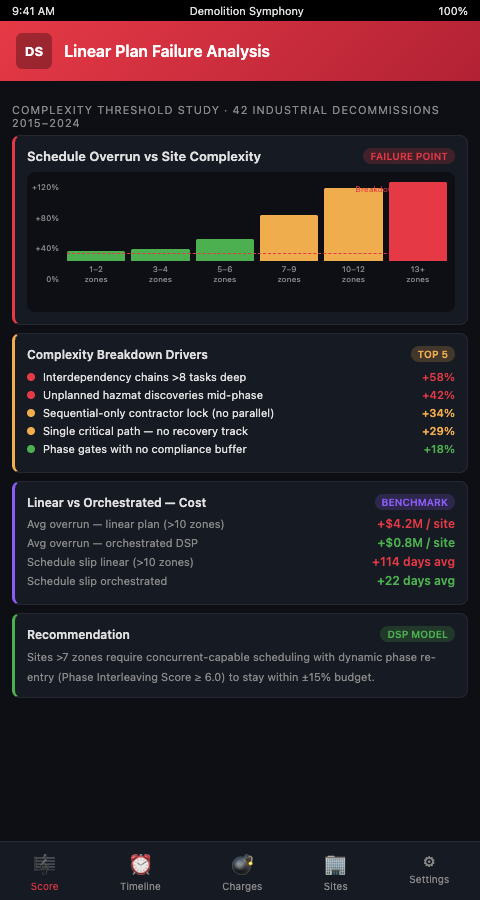
The Specific Failure Modes at Scale
Idle time from phase gates. When a linear plan gates Phase 2 on Phase 1 completion, any Phase 1 overrun idles all Phase 2 resources. On a large site where Phase 1 is hazmat abatement across dozens of zones, partial completion in most zones does not unlock Phase 2 anywhere — because the phase gate requires complete completion. Equipment that could be mobilized and productive stands idle waiting for a gate condition that the site's complexity makes almost impossible to achieve on schedule.
Cascade delays from re-opened phases. When Phase 3 structural demolition reveals new hazmat scope, the linear plan has no mechanism for handling it other than pausing Phase 3, re-opening Phase 1, completing the new abatement scope, and resuming Phase 3. Each pause-and-resume cycle carries mobilization cost and schedule impact. On large sites, these cycles occur dozens of times — each one individually manageable but cumulatively devastating to the schedule.
Resource bottlenecks from serial demand. A linear plan generates peak resource demand at phase transitions — when Phase 1 is winding down and Phase 2 is ramping up simultaneously. Large-site linear plans produce these transition peaks at regular intervals, each requiring surge resourcing that the project budget planned for sequentially rather than concurrently. Non-linear plans smooth resource demand by running multiple zones at different points in their local sequences simultaneously, spreading the transition peaks across time.
Regulatory documentation gaps. Linear plans generate hazmat clearance documentation at the phase level. When structural demolition reveals new hazmat scope, the phase-level clearance is voided for that zone but the documentation structure has no mechanism to record the partial clearance state. Non-linear plans with zone-specific clearance records maintain accurate hazmat documentation regardless of the sequence in which zones are cleared.
As the 200-acre petrochemical case study demonstrates, the projects that execute large-scale teardowns on schedule use dependency-mapped parallel sequencing from the outset — not linear plans that get revised into parallel plans under schedule pressure.
For a cross-sector application of the same principle, the failure of linear planning in large plant teardowns mirrors the failure of linear sequencing in phased removal of a 12-span highway interchange: both involve interdependent structural elements where the removal sequence must be derived from the dependency graph, not from a left-to-right progression across the site.
Designing Out the Linear Plan's Failure Modes
The alternative to a linear plan is not an unstructured parallel plan. It is a dependency-mapped concurrent plan that retains explicit sequencing constraints where they are genuinely required by safety, regulatory, or structural considerations, and allows concurrent execution everywhere else.
The design process starts with an interdependency audit: for each zone, list the specific conditions under which each work type can begin, not the phase that precedes it. Those conditions become the dependency notation in the Demolition Symphony Planner score. Where two work types genuinely cannot overlap — because a specific hazmat type requires full clearance before any structural work in the zone — that constraint remains as a hard sequential gate. Where they can overlap with controls — because a barrier system separates abatement from structural work — the score notation specifies those controls and permits both voices to advance.
Conclusion
Linear decommissioning plans fail at scale because they cannot represent the dependency structure of large industrial sites. The sequential phase model generates idle time, cascade delays, resource bottlenecks, and documentation gaps that grow exponentially with site complexity. The alternative is a dependency-mapped concurrent plan — a musical score rather than a checklist — that specifies exactly where each voice can advance relative to the others.
Industrial plant decommissioning crews managing large plant teardowns need a planning structure that captures real dependencies without defaulting to artificial sequential phases. The Demolition Symphony Planner's score notation converts your site's dependency map into a concurrent sequencing plan that keeps all voices advancing rather than waiting on phase gates that large-site complexity makes impossible to achieve cleanly. Map Your Decommissioning Sequence and replace the linear plan's failure modes with a score built for the site's actual structure.