Advanced Material Recovery Optimization in Industrial Teardowns
Advanced Material Recovery Optimization in Industrial Teardowns
The EPA estimates that construction and demolition activities in the United States generate approximately 600 million tons of material annually — more than twice the volume of municipal solid waste (EPA Sustainable Management). Industrial teardowns contribute disproportionately to that volume, and the materials they generate are disproportionately valuable: structural steel, process piping, heat exchanger bundles, and large-format concrete aggregate all command significant market prices when recovered in recoverable condition.
The gap between potential recovery value and actual recovery value on industrial teardowns is primarily a sequencing problem. When decommissioning crews demolish structures before extracting the salvageable equipment inside them, or apply general demolition methods to materials that would be worth three times as much in intact form, or sequence hazmat abatement in a way that forces structural steel to be cut rather than extracted whole, they are leaving recovery value on the site rather than in the salvage yard.
Material recovery optimization industrial teardowns requires advance planning of the advanced material salvage decommissioning workflow — a process that integrates industrial teardown material reclamation planning directly into the demolition sequence. Scrap metal recovery plant decommissioning depends on salvage value maximization industrial demolition decisions made before the first structure is touched, not at the salvage yard after the damage is done. Okon Recycling's analysis of decommissioned power plant scrap values found that strategic recovery planning can offset 25% of total decommissioning costs — a significant margin on projects that routinely overrun budget (Okon Scrap Value Power Plant).
The used industrial machinery market underscores the value at stake: equipment in resale condition commands 15-25% of original purchase price, while the same equipment demolished as structural steel commands the scrap rate — a difference of ten to one or more on high-value process equipment (Calcix). The decommissioning crew's sequencing decisions determine which category each asset falls into.
Where Recovery Value Gets Lost
The three primary mechanisms by which industrial teardowns destroy recovery value are structural demolition sequencing, hazmat abatement timing, and material stream contamination.
Structural demolition sequencing. When the structural demolition sequence does not account for equipment extraction access, high-value equipment gets trapped: a compressor surrounded by demolished structural steel cannot be extracted intact; a reactor vessel with its nozzles sheared by mechanical demolition cannot be resold as process equipment. JJ Liquidations' analysis of industrial demolition scrap trends documents that equipment accessibility at the point of extraction is the dominant determinant of whether an asset achieves resale value or scrap value (JJ Liquidations).
Hazmat abatement timing. Structural steel encased in asbestos insulation cannot be extracted for scrap until the insulation is abated. If the abatement schedule does not prioritize the steel structures with the highest scrap value — treating all zones equally rather than sequencing abatement to unlock high-value assets first — the extraction team may arrive at a high-value structure after structural demolition has already compromised it, or may wait through unnecessary idle time while abatement completes in lower-value zones.
Material stream contamination. Industrial demolition scrap metal markets pay premium prices for clean, segregated steel — the same steel mixed with concrete, non-ferrous metals, and contaminated debris may command 30-40% less per ton. Okon's demolition scrap processing data shows that 95% of metals in demolition waste are recoverable when properly segregated — but that segregation must be designed into the demolition sequence, not attempted as a post-demolition sorting exercise (Okon Demolition Scrap).
The Demolition Score as a Material Recovery Choreography Tool
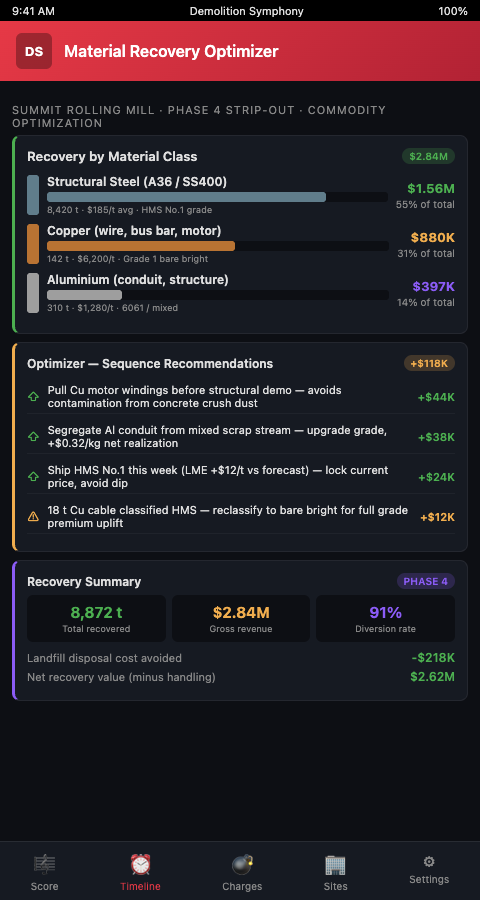
The Demolition Symphony Planner's Equipment Extraction Choreography feature is the sequencing mechanism for material recovery optimization. In the musical score framework, each piece of high-value equipment or structural material is notated as an extraction event: a specific measure in the score when the extraction must occur, with dependency notations specifying the hazmat clearance conditions that must precede it and the structural access conditions that must be maintained until extraction is complete.
This is where the musical sheet notation metaphor has concrete operational value. In a score, every note has a defined position in time relative to every other note — the bass line cannot rush ahead of the melody without destroying the composition. In a material recovery workflow, every extraction event has a defined position in the demolition sequence relative to every other event. A compressor extraction that should occur in measure 8 — after Zone B hazmat clearance and before Zone B structural demolition — cannot slip to measure 12 without risking that structural demolition in measure 10 will compromise the extraction access.
Invrecovery's equipment liquidation research documents that strategic recovery planning can improve industrial asset recovery rates from the 28-35% typical of unplanned recovery to 40-50% when extraction sequence is optimized relative to the demolition plan (Invrecovery). That 10-15 percentage point improvement represents significant absolute revenue on a site with tens of millions of dollars in process equipment and structural steel.
The detailed material classification and segregation protocols that make this sequencing executable are developed in the waste stream segregation methodology, which provides the material identification framework that the extraction choreography tool uses to assign each material to its recovery category and corresponding extraction sequence position.
Advanced Salvage Sequencing Tactics
Classify assets by recovery value tier before the demolition sequence is finalized. A Tier 1 asset — process equipment with resale value as a functional unit — requires an extraction window protected by hard predecessor constraints in the score. No structural demolition in its zone until extraction is confirmed complete. A Tier 2 asset — intact structural steel with scrap value in segregated form — requires hazmat clearance and segregated removal before general demolition. A Tier 3 asset — contaminated or structurally compromised material with low recovery value — can be handled within the general demolition sequence. This tiering determines how the extraction choreography tool positions each asset's notation in the score.
Coordinate equipment extraction with crane availability from the equipment extraction choreography layer. High-value equipment extraction typically requires crane or rigging access that competes with structural demolition equipment for the same lift capacity. When equipment extraction events are notated in the score alongside structural demolition events, crane scheduling conflicts become visible before they occur — the project manager can resolve them by sequencing events to avoid conflicts rather than discovering the competition during execution.
Build abatement sequencing to unlock high-value assets first. If the hazmat abatement contractor is given material recovery optimization as an explicit scheduling objective — not just hazmat clearance as a safety objective — they can sequence their zone work to clear Tier 1 and Tier 2 assets first, enabling extraction to begin before abatement completes in lower-value zones. This requires sharing the material recovery tier classification with the abatement contractor and integrating it into the abatement sequencing plan.
Document recovery decisions for owner reporting. Industrial decommissioning clients — asset owners and their insurers — increasingly require documentation of material recovery decisions as part of project closeout. The EPA's aggregate recycling data shows that 85% of concrete demolition aggregate is technically recyclable (EPA C&D Debris Data), but actual recovery rates on industrial teardowns fall well short of that figure. An owner who sees that their project achieved a documented 80% recovery rate across material streams has a sustainability and financial performance record that has regulatory and reporting value.
Okon's asset recovery service for industrial machinery demonstrates that professional extraction sequencing combined with targeted scrap processing produces significantly higher per-ton recovery rates than standard demolition processing (Okon Asset Recovery). The methodology applies at any scale — what changes with scale is the value of the optimization, not the optimization logic itself.
The recovery sequencing challenge for industrial teardowns shares structural logic with fragmentation analysis for reinforced concrete towers: in both cases, the demolition method applied to a structural element — and the sequence in which it is addressed — determines what value or hazard the resulting material represents. The sequencing decision made at the planning stage cannot be reversed once the element is demolished.
The related analysis of heavy machinery extraction from confined spaces addresses the physical execution challenge for the Tier 1 equipment that the recovery optimization framework has identified as highest-priority for extraction before structural demolition proceeds.
Conclusion
Material recovery optimization in industrial teardowns is a sequencing problem that must be solved at the planning stage, not at the salvage yard. The equipment and materials on an industrial site have their maximum recovery value at the moment before demolition begins; every demolition decision after that point either preserves or destroys that value. The Demolition Symphony Planner's Equipment Extraction Choreography notation integrates recovery sequencing directly into the demolition score, ensuring that high-value assets reach the extraction team in extractable condition.
Industrial plant decommissioning crews managing large teardowns need material recovery optimization built into the demolition sequence from the outset, not appended as a salvage afterthought. The Demolition Symphony Planner's extraction choreography layer positions every high-value asset's removal event in the score relative to the hazmat clearances and structural access windows it requires. Start your material recovery sequence today and get every high-value asset's extraction event positioned in the score before the first structural element comes down.