Best Practices for Heavy Machinery Extraction from Confined Spaces
Between 2011 and 2019, confined spaces were the site of 1,030 fatal occupational injuries in the United States, according to Bureau of Labor Statistics data. That figure spans all industries, but process industries—chemical plants, refineries, pulp and paper mills—account for a disproportionate share because their equipment is large, heavy, permanently installed, and surrounded by confined or restricted geometry. Plant machinery removal safety confined areas intersects the confined space fatality record with the separate risk profile of heavy rigging operations. PMC research on confined space contributory factors identified mechanical and structural failure as responsible for 20% of confined space incidents—a category that includes equipment shifting during extraction, lifting failures, and structural collapse of access openings under equipment weight.
Confined space equipment removal plant decommissioning projects fail in predictable ways. The extraction plan is written assuming that equipment can be removed through the access route that was used during installation—an assumption that ignores the fact that most industrial equipment was installed during initial plant construction, before walls and adjacent structures were completed. The reactor vessel that entered through an open-roofed building in 1978 cannot exit through the building's current 3.5-meter doorway. The motor-generator set that was skidded into the basement through an adjacent equipment hatch is now surrounded by 45 years of additional infrastructure. Industrial machine extraction tight spaces requires an engineering study of the extraction path, not an assumption that the path exists.
OSHA's confined space standard (1910.146) establishes the permit-required confined space entry protocols that govern equipment removal operations: atmospheric testing, continuous monitoring, retrieval equipment, attendant requirements, and rescue procedures. Those requirements apply to every entry into a permit-required space during the extraction process—including the entries made by rigging engineers assessing attachment points, which are often treated as informal site visits rather than confined space entries requiring full OSHA compliance.
The Confined Extraction Sequencing Problem
Think of heavy machinery extraction from a confined industrial space as a musical passage where multiple instruments must play in a precise order before the primary melody can be heard. The melody is the moment the equipment clears the opening. But before that moment, the score requires atmosphere testing (the woodwind introduction), rigging attachment (the brass entry), structural reinforcement of the extraction route (the percussion foundation), and coordinated lifting sequence (the string harmony). Each voice must complete its phrase before the next enters. Executing them out of order—starting the lift before the structural reinforcement is confirmed—produces the equipment failure version of a harmonic collision.
The confined extraction sequencing problem has four specific dimensions. First, extraction path engineering: before any rigging plan is written, the extraction path from the equipment's current location to its exit point must be fully engineered. That includes vertical clearances at every doorway and corridor, floor load capacity along the entire route, utility crossings that must be relocated, and any structural modifications required to create a viable path. NIOSH/CDC data on confined space fatalities estimates that 85% of confined space fatalities are preventable with proper planning—a finding that applies directly to extraction planning, where engineering the path in advance eliminates the improvised problem-solving that creates fatalities.
Second, atmospheric management during extraction: confined spaces in process facilities contain residual contaminants—process chemicals, oxygen-depleted atmospheres, explosive vapors—that persist even after equipment decommissioning and purging. Extraction activities that breach vessel walls, cut through piping, or disturb settled sludge release those contaminants. Continuous atmospheric monitoring throughout the extraction operation is mandatory, with atmospheric thresholds that trigger work stoppage programmed into the monitoring equipment rather than left to worker judgment.
Third, structural loading during extraction: equipment removal imposes dynamic loads on floors, walls, and structural framing that static design loads do not anticipate. A 30-ton reactor vessel being skidded on rollers generates point loads and lateral forces that the floor may not be rated for. Structural engineering review of the extraction route under dynamic loading conditions—not just static weight—is a pre-activity requirement, not a post-incident investigation.
Fourth, access modification and restoration: creating an extraction path often requires temporary structural modifications—cutting through walls, removing structural members, widening doorways. Those modifications must be engineered, permitted, and restored. The restoration scope must appear on the project schedule as a distinct work element, not an assumed inclusion in the extraction activity.
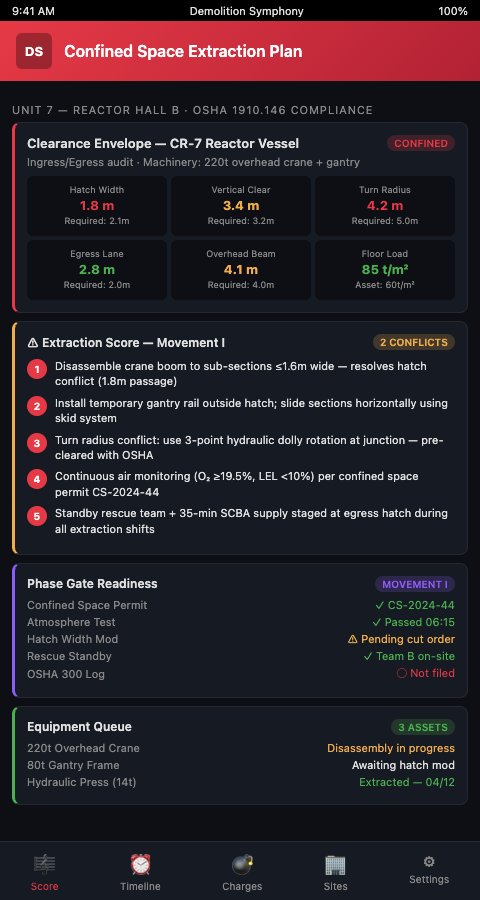
Planning Confined Extraction in Demolition Symphony Planner
Demolition Symphony Planner treats confined space heavy extraction as a composite activity—a set of prerequisite voices that must all resolve before the extraction event can be scheduled. When a project manager adds a heavy extraction activity in a confined space zone, the system expands it into its component requirements: extraction path survey, structural assessment, atmospheric baseline, rigging plan, permit-required space entry program, and rescue plan. Each requirement must be completed and entered into the system before the extraction activity is authorized to proceed.
The composite activity structure prevents the most common extraction failure mode: beginning rigging operations while extraction path engineering is still in progress. On the score, the rigging voice cannot start until the path engineering voice has fully resolved—a mandatory sequential dependency that is easy to overlook when both are labeled as "pre-extraction" in a flat task list.
For equipment inventory before strip-out, the extraction complexity assessment is a required field for each piece of equipment: accessible (standard extraction), restricted access (engineered path required), or confined space (permit-required confined space extraction). Equipment classified as confined space triggers the expanded activity template automatically in Demolition Symphony Planner.
Mammoet's reactor pressure vessel extraction case study and their nuclear reactor segmentation work demonstrate that the largest-scale confined space extractions require not just rigging engineering but structural modification planning and multi-week preparation schedules. For most industrial decommissioning projects, the equipment is smaller but the principle holds: complex confined space extraction is a project within the project, with its own schedule, its own engineering deliverables, and its own safety management plan. ANSI/ASSP Z117.1 on confined space safety extends confined space requirements to the industrial demolition and decommissioning context, covering the scenarios where equipment removal operations in permit-required spaces require a unified safety management plan that integrates atmospheric monitoring, rescue readiness, and rigging operations under a single permit framework.
Advanced Tactics for Confined Space Extraction Safety
Large equipment removal confined facility operations require a formal extraction team structure: a rigging engineer (responsible for lift plan and equipment attachment), a confined space program manager (responsible for atmospheric monitoring, entry permits, and rescue readiness), a structural engineer (responsible for floor and access loading assessments), and a field superintendent (responsible for executing the plan and calling holds when field conditions deviate from plan assumptions). All four roles must be active simultaneously during the extraction event.
Rescue plan readiness is a pre-activity requirement, not a documentation exercise. Before any confined space extraction begins, the rescue team must have practiced the specific rescue scenario for that space—including the same atmospheric conditions, equipment configuration, and access geometry that the extraction crew will encounter. Tabletop scenarios do not satisfy this requirement.
For waste stream segregation during the strip-out phase, equipment extracted from confined spaces often contains hazardous residuals—process fluids, scale, and residue—that require characterization before disposal. The extraction plan must include a residual management step: the extracted equipment is staged in a designated containment area, drained and cleaned, and characterized before it is released for scrap or disposal. That step appears on the project score as a post-extraction voice that must complete before the equipment can be removed from site.
Cross-niche relevance: the structural engineering and sequencing discipline required for confined space heavy extraction parallels the charge placement in steel-frame implosion, where the order of structural interventions determines whether the building falls as designed or collapses in an uncontrolled direction. In both contexts, sequence is not a scheduling preference—it is a structural engineering requirement.
Plant machinery removal safety confined areas success depends on treating extraction path engineering as a design deliverable, not a field activity. The crews that walk into a confined space without a completed extraction engineering package are the ones who improvise under load. Demolition Symphony Planner prevents that improvisation by requiring all pre-activity voices to complete before the extraction event is unlocked on the schedule.
Ready to plan your confined space extraction sequence? Load your equipment inventory and confined space classifications into Demolition Symphony Planner and let the system build the composite pre-activity checklist for each extraction before rigging crews mobilize.