How to Inventory Heavy Equipment Before Plant Strip-Out
When Invrecovery analyzed industrial asset recovery outcomes across decommissioning projects, they found that facilities with systematic pre-demolition equipment cataloguing recovered 40–50% of asset value through resale and reuse—compared to just 28–35% for facilities that liquidated assets without a structured inventory process. The difference is not the equipment itself. It is knowing what you have before the extraction schedule is locked.
A thorough heavy equipment inventory plant strip-out process gives the project team the data layer that drives extraction sequencing, crane selection, and hazmat flagging before any contractor mobilizes. Strip-out equipment tracking through a structured industrial plant asset inventory decommissioning system ensures that every asset's disposition, weight, and access requirements are captured in one place and connected to the schedule.
A facility equipment survey before teardown is not just a financial exercise. It is the foundational data layer for the entire strip-out schedule. Without a complete equipment catalogue, you cannot determine extraction sequence, crane requirements, floor load impacts, building access requirements, or the disposition status that governs debris classification. Strip-out scheduling built on an incomplete inventory creates collision points between extraction crews, structural demolition teams, and hazmat abatement crews that cannot be resolved without schedule changes in the field.
The EPA's construction and demolition debris data indicates that the United States generates approximately 600 million tons of C&D debris annually, with 98% of structural steel ultimately recycled. But steel recovery rates for major process equipment—reactors, heat exchangers, compressors—are substantially lower when extraction is not planned in advance, because equipment that could be removed intact for resale is instead demolished in place.
What a Complete Equipment Inventory Contains
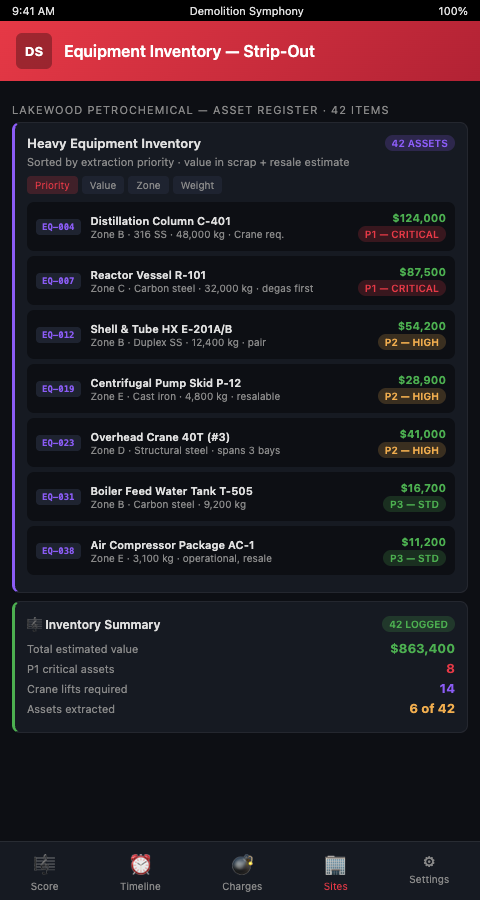
The pre-demolition equipment cataloguing process for a strip-out schedule requires six data fields per asset:
Identity and location. Equipment tag number, description, manufacturer and model where known, exact building and floor location including bay reference. For large facilities, GPS or coordinate reference. Demolition Symphony Planner imports these from existing CMMS systems or from field survey entries directly into the asset catalogue.
Physical dimensions and weight. Length, width, height, and dry weight. For process vessels, operating weight if residual contents may be present. These dimensions determine crane capacity requirements, route widths, and floor load ratings along the extraction path.
Access requirements. Does extraction require wall openings, roof penetrations, or stair removal? Which structural members must remain intact to support the rigging setup? Access requirements determine which structural members are locked during equipment extraction and must be flagged in the phase schedule before structural demolition begins in that building.
Hazmat content. Does the equipment contain residual hazardous materials—PCBs in transformers, asbestos in insulation on process vessels, lead in paint on structural steel supports? Equipment with hazmat content must be flagged for pre-extraction abatement before riggers can work on it. This field connects the equipment catalogue to the hazmat sequencing schedule.
Disposition decision. Resale, reuse on another site, scrap, or in-place demolition. Disposition determines whether full extraction is required or whether the asset can be demolished with structural equipment once the building is open. Equipment marked for resale requires a delivery date and buyer coordination timeline that appears on the strip-out schedule as a deadline constraint.
Extraction priority. When must this piece be extracted relative to other equipment and relative to structural demolition? Equipment that blocks crane paths to higher-priority assets must be extracted first even if its own disposition priority is lower.
Sequencing the Inventory Survey Itself
Alltracon's industrial plant decommissioning steps guide recommends completing the equipment inventory before any engineering assessment of the demolition sequence, because the equipment data changes the structural analysis. A structural engineer assessing which members can be demolished first needs to know which members are required for crane paths and rigging loads. Without the equipment catalogue, that analysis is incomplete.
The survey sequence should follow the proposed extraction sequence in reverse: survey the equipment that will be extracted last first, so that early extraction plans do not have to be revised as the survey progresses. In practice, survey teams often survey building by building, which works if building-level extraction sequence has been determined before the survey begins.
For large industrial sites, the facility equipment survey before teardown takes 2–6 weeks depending on facility size and equipment density. That survey window must appear on the Demolition Symphony Planner project schedule as a predecessor to extraction planning, not an activity that runs in parallel with early extraction work.
Okon Recycling's specialty equipment decommissioning guide adds a practical point: equipment that has been idle for years may have developed structural deterioration, corrosion, or secondary hazmat content (bird nests, rodent contamination, water infiltration into electrical systems) that is not reflected in operating records. The field survey must include a condition assessment that updates the original equipment data with current physical status.
For teams who need to manage the downstream extraction workflow after the inventory is complete, heavy machinery extraction from confined spaces covers the specific rigging and access challenges for assets that cannot be extracted through standard building openings—a challenge that the inventory phase must identify and flag before extraction planning begins.
Connecting the Inventory to the Strip-Out Schedule
OSHA 1926.850 requires that structural demolition work be preceded by a survey to identify hazards, load conditions, and the condition of framing, floors, and walls. The equipment catalogue extends that survey requirement to include the load and access impacts of in-place equipment on the demolition sequence.
Demolition Symphony Planner uses the equipment catalogue as the primary input for the strip-out voice on the decommissioning score. Each catalogued asset becomes a scheduled task with duration, crane requirements, access dependencies, and disposition-linked constraints. When the project manager views the full score, the strip-out voice shows exactly which assets are scheduled for extraction in each building and week, and which structural members are locked to support that extraction work.
The cross-asset dependency logic prevents two common errors: scheduling extraction of Asset B before Asset A when A blocks B's crane path, and releasing a structural member for demolition before all assets that require that member for rigging support have been extracted.
For the cross-niche parallel, salvageable component mapping in stadium demolition applies the same inventory-before-schedule discipline to a different asset category—architectural elements, seating systems, and scoreboard equipment—where disposition decisions (resale vs. demolition) directly control which structural members can be removed early.
MacAllister's decommissioning services asset recovery framework notes that buyer timelines for resalable equipment frequently compress the extraction schedule: a buyer who commits to a purchase date creates a deadline that must appear in the project schedule as a hard constraint, not a preference. Demolition Symphony Planner tracks these buyer deadline constraints and flags conflicts before they require field rescheduling.
How the Equipment Inventory Feeds Building Demolition Order
The equipment catalogue directly influences building teardown priority across the campus. Buildings with the largest number of crane-dependent extraction assets—and therefore the longest extraction windows—must be scheduled for extraction earlier in the project, because they consume crane and rigging resources that block other buildings from beginning structural demolition. A building with ten major process vessels requiring sequential crane extraction may tie up the primary crawler crane for six weeks. That constraint must appear in the building priority matrix before teardown order is finalized.
Building-by-building teardown priority order requires the equipment catalogue as a primary input. Without knowing which buildings have the highest extraction complexity—and therefore the longest crane-locked windows—the priority matrix cannot correctly sequence buildings to optimize shared resource utilization across the campus.
Demolition Symphony Planner connects the equipment catalogue to the building priority scoring system. When an asset in Building G is catalogued as requiring a 100-ton crane with a 12-week extraction window, Building G's structural complexity score in the priority matrix increases accordingly—and the buildings that share crane access with Building G are sequenced to avoid overlapping that window.
The connection is bidirectional: if Building G's teardown priority later changes (for example, because the owner accelerates a redevelopment timeline for that parcel), Demolition Symphony Planner flags the equipment catalogue entries for Building G and surfaces the extraction schedule changes required to support the new priority. Project managers see the full downstream impact of a building priority change before approving it.
The equipment catalogue is not a static document created at project inception and filed away. It is a living record that updates as field conditions reveal new information—equipment that appeared to be in good condition in the pre-demolition survey may have developed additional hazmat content, or equipment marked for resale may lose its buyer and need to be reclassified as scrap. Demolition Symphony Planner tracks catalogue updates and flags any change that affects the extraction sequence, crane requirements, or abatement predecessors—so project managers always work from current data, not survey data that may be months old.
Equipment Inventory Checklist Before Strip-Out Planning Begins
Before scheduling any extraction activities, confirm the following are complete in Demolition Symphony Planner:
- All equipment assets catalogued with tag, location, dimensions, weight, and condition notes
- Hazmat content flags applied to all assets with residual contamination or hazmat-insulated components
- Disposition decision recorded for every catalogued asset
- Buyer deadline constraints entered for all resale-designated equipment
- Access requirement analysis complete—wall openings, roof penetrations, and structural locks identified
- Extraction priority ranking assigned based on crane path dependencies and disposition deadlines
- Hazmat pre-abatement requirements connected to abatement schedule as predecessors to extraction tasks
- Building priority scores updated to reflect crane-locked extraction windows for high-complexity buildings
Start your extraction sequence. Load your equipment catalogue into Demolition Symphony Planner and generate the disposition-linked strip-out schedule before your first rigging contractor mobilization meeting.