How to Map Salvageable Components Before Stadium Demolition
Research from the New York State Department of Environmental Conservation confirms that building material reuse and deconstruction consistently outperforms recycling from a resource-conservation standpoint — reused structural steel requires a fraction of the energy that recycling demands. Yet ScienceDirect research on estimating the recoverable value of building components documents a persistent gap: most pre-demolition salvage audits are conducted at a level of detail insufficient to inform actual deconstruction sequencing decisions. Components are listed but not located. Conditions are estimated but not verified. Structural constraints on extraction are noted but not incorporated into the salvage plan.
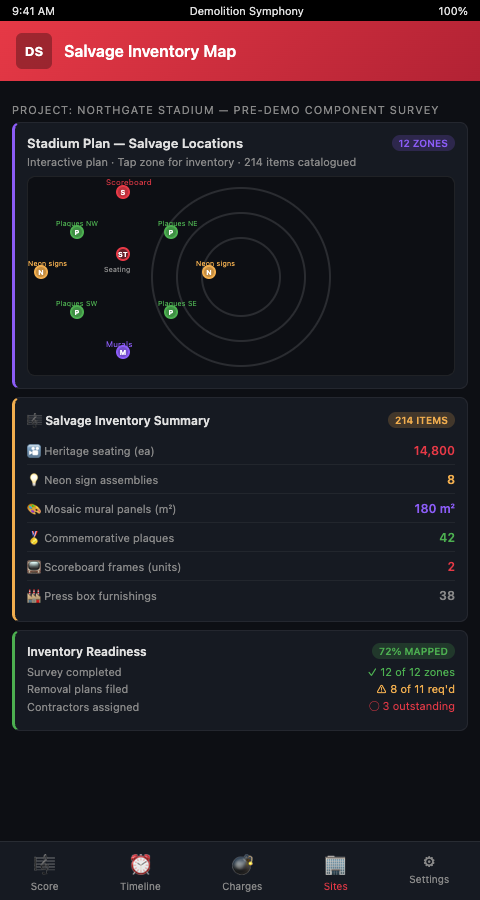
For stadium and arena demolition specialists, pre-demolition salvage audit quality directly determines how much of a venue's material value is recovered rather than demolished and recycled at lower value. A salvageable component mapping stadium process that identifies location, condition, structural accessibility, and extraction sequence for every reusable element creates the foundation for a salvage-first demolition plan. Demolition Symphony Planner integrates this mapping as the first scored movement of every stadium teardown — no structural demolition phase begins until the salvage map for its zone is complete and verified.
What a Pre-Demolition Salvage Audit Must Capture for Stadiums
The EU Commission Pre-Demolition Audit Guidelines establish a minimum scope for large-structure audits: hazardous material inventory, reusable component identification, recyclable material quantification, and disposal stream documentation. For stadiums, each of those categories is more complex than for conventional buildings.
Reusable components in a typical office building are primarily architectural: doors, windows, flooring, fixtures. Reusable materials in a stadium teardown include long-span structural steel members, precast concrete seating risers, specialized mechanical systems, sports-grade flooring, and large-format glazing systems — each requiring a different extraction method, a different handling protocol, and a different receiving market. The Pell Frischmann pre-demolition audit methodology formalizes this by categorizing components not just by material type but by extractability — the combination of access, condition, and structural configuration that determines whether a component can be removed intact or must be demolished in place.
Demolition Symphony Planner's salvageable component mapping module organizes the audit output by zone, by material category, and by extractability rating, creating a three-dimensional inventory that informs both salvage scheduling and structural demolition sequencing.
Mapping Structural Accessibility for Each Component
The most common failure in stadium structural element inventory work is treating structural accessibility as a binary: the component is either accessible or it isn't. In practice, structural accessibility is a phased condition — a section of precast seating that is structurally inaccessible before the upper grandstand is removed becomes accessible after Phase 2 demolition completes. A pre-demolition salvage audit that captures accessibility as a static condition at the time of survey misses the phase-dependent opportunities that develop as demolition progresses.
Demolition Symphony Planner maps each inventoried component with a phase-availability indicator: the demolition phase at which the component becomes safely extractable. This transforms the salvage audit from a snapshot inventory into a dynamic schedule resource — as each demolition phase completes, the system surfaces the components that have just become accessible and prompts the salvage coordinator to schedule extraction before the next structural phase advances into the zone.
The artifact preservation module cross-references this phase-availability data with heritage item extraction windows, ensuring that high-value artifacts are flagged for early extraction before structural phases close off access.
Quantifying Recoverable Value Before Demolition
ScienceDirect research on building component reuse value demonstrates that the financial case for reuse over recycling is strongest when components are extracted intact at full dimensions — and that the value premium diminishes rapidly as component size decreases or condition degrades during extraction. A pre-demolition salvage audit that quantifies recoverable value by component and extraction method gives project owners the data to make informed decisions about salvage investment: which components justify the cost of careful manual extraction, which can be removed by conventional equipment without significant value loss, and which are more economically recycled than reused.
The EPA's Deconstruction Rapid Assessment Tool provides a methodology for estimating material quantities and reuse potential at the building level. Demolition Symphony Planner extends this to the component level for stadium structures, generating an estimated recovery value for each inventoried item based on condition, market comparables, and extraction cost estimates. This value mapping informs salvage crew scheduling: high-value components are assigned dedicated extraction windows with specialized crews, while lower-value reusable materials are incorporated into the standard demolition workflow.
Springer's research on recovery and reuse of salvaged building products further documents that market-matching — connecting specific salvaged components to identified buyers before extraction — increases net recovery value by reducing holding cost and speculative storage. Demolition Symphony Planner's component inventory supports pre-demolition market matching by providing detailed component specifications that receiving organizations can evaluate against their procurement needs.
Scheduling Salvage Crews Against the Demolition Sequence
A complete salvageable component mapping stadium process produces three documents: a component inventory with location, condition, and extractability data; a phase-availability schedule that identifies when each component becomes accessible; and a recovery value estimate that prioritizes salvage crew allocation. Those three documents feed directly into the salvage crew scheduling module, which assigns crew capacity to extraction windows based on component priority and structural phase timing. The stadium structural element inventory that underlies all three documents also serves a risk management function: when the pre-demolition audit identifies reusable materials stadium teardown components that require specialized handling — long-span steel members that must be lifted in specific orientations, precast concrete risers with embedded post-tensioning — the structural engineer can incorporate those handling constraints into the phase plan before mobilization rather than improvising in the field.
The cross-niche application of pre-demolition audit discipline comes from utility line mapping methodology developed for overpass demolition — where the constraint is not just what to remove but in what order, given embedded utility conflicts. Stadium structural element inventories face the same embedded-system challenge: seating riser extraction conflicts with embedded conduit, roofing material removal conflicts with attached mechanical systems, and concourse flooring removal conflicts with utility runs below. The mapping process must document these conflicts so that salvage sequencing accounts for embedded system removal as a prerequisite, not a surprise.
The Audit as the Foundation of the Demolition Score
Demolition Symphony Planner treats the pre-demolition salvage audit as the first movement of the demolition score — the measure that establishes the key signature for everything that follows. A complete, phase-aware, value-quantified salvage map makes every subsequent planning decision more precise: structural sequencing, recycling logistics, crew scheduling, and contract scope definition all benefit from a foundation that is documented at the component level rather than estimated at the building level. Projects that invest in detailed pre-demolition audit work consistently recover more material value and run fewer mid-sequence surprises than projects that begin demolition from a high-level material estimate — because every surprise that surfaces during demolition represents time already committed to a structural phase that the salvage plan did not account for.
Score Your Stadium Teardown with Demolition Symphony Planner and build a salvageable component mapping process that turns a pre-demolition audit into an operational score — one that guides salvage, structural, and recycling operations from the first extraction to the last structural cut. Get started before mobilization and ensure every reusable component is inventoried, prioritized, and scheduled for extraction before the first structural phase begins.