Best Practices for Segmental Concrete Bridge Disassembly
The Structural Complexity Hidden in Uniform Segments
A 2025 multilevel evaluation study published in Taylor & Francis — analyzing the Kalix Bridge in Sweden — documented how the prestressed segmental concrete structure required a phased deconstruction analysis that treated each segment not as an independent block but as a load-transfer element connected to adjacent segments by post-tensioning. Removing segments without accounting for that load-transfer role produced unexpected deflection patterns that the original construction sequence had never exhibited. The failure mode was structural, not mechanical: the bridge behaved differently in demolition than it did in service.
The American Segmental Bridge Institute defines segmental bridge construction as structures with spans of 100 to 800 feet, built from precast or cast-in-place segments assembled using epoxy joints and post-tensioning. Over 800 such structures exist in the United States. As the oldest of these bridges approach the end of their service lives, segmental bridge deconstruction sequence planning has become a practical problem for which most demolition frameworks were not designed.
The NCHRP Synthesis 536 specifically addresses this gap: complete structural analysis is required for segmental deconstruction, yet the tools used by most teams — linear Gantt charts, generic phase narratives — cannot represent the dependency relationships between segment removal order, post-tension state, and intermediate stability. The result is field improvisation on structures where improvisation can trigger progressive collapse.
Writing the Reverse Construction Score
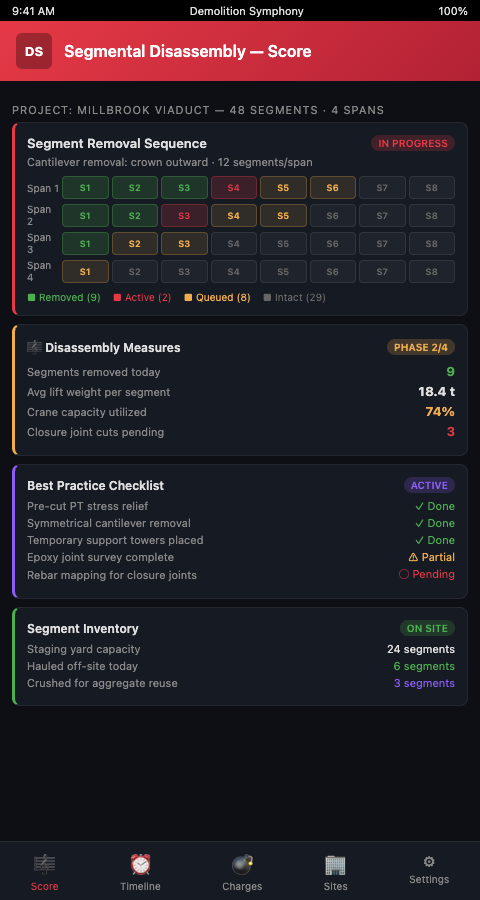
The Demolition Symphony Planner approaches segmental concrete bridge disassembly by treating each segment as a note in a score that reads the construction sequence in reverse. Just as a musical composition played backward has a new structure with its own internal logic, the demolition score is not simply the construction timeline flipped — it is a new composition written with the constraints of the original as its governing key signature.
Segment inventory as the score's key signature. Before any removal measure is written, the Demolition Symphony Planner requires a segment inventory: each segment's identity, its position in the span, its post-tension connections (how many tendons cross its joints, whether those tendons are grouted or ungrouted), and its structural role at the current state of the bridge. This inventory is the key signature of the demolition score — it defines the starting conditions that every subsequent measure must respect.
Tendon mapping per segment joint. The critical notation element in segmental concrete bridge disassembly is the tendon map: which tendons pass through which joints, what their current stress state is, and whether they are accessible from within the box girder interior. Post-tensioning controls segmental bridge deformation — and that same design constrains how deformations develop during deconstruction. The Demolition Symphony Planner writes each tendon connection as a notation at the joint between segment measures: the tendon must be released in a specific step before the adjacent segment may be moved, and the release method — controlled hydraulic destress, saw cut, or abrasive disc — is specified by the tendon's access geometry and stress state.
Temporary support notation as prerequisite measures. For segmental box girder bridge removal, the standard approach involves introducing temporary supports at specific span points before any segments are detached. These supports transfer the load path away from the post-tension system before the system is disrupted. The Demolition Symphony Planner writes temporary support installation as prerequisite measures — bars in the score that must be played before the segment removal movement begins. The Caltrans Bridge Removal Manual requires contractor work plans for segmental removals to be reviewed by the engineer of record, and the Demolition Symphony Planner's score format produces the documentation basis for that review.
Hydraulic wedge splitter notation for segment separation. Where explosive methods are impractical or prohibited, hydraulic wedge splitting equipment provides controlled concrete segment separation at joint lines. The Demolition Symphony Planner writes the splitter placement positions as spatial notations on each measure: the tool position, the joint being targeted, and the expected fragment size that will result from the split. Fragment size governs the handling method — a splitter that produces 500 kg fragments requires different crane rigging than one producing 150 kg fragments — and the score ensures both notations are consistent before the measure begins.
Connection to post-tensioned girder sequencing. Match-cast segment demolition is closely related to but distinct from post-tensioned girder cut sequencing, which covers the broader class of prestressed concrete bridge demolition. For segmental structures, the additional complexity is the number of tendon systems per span and the match-cast joint geometry that constrains how fragments can be separated once tendons are released. The Demolition Symphony Planner's notation for both contexts shares the same underlying structure but adds segment-specific joint mapping for segmental box girder bridge removal.
Advanced Tactics for Segmental Deconstruction
Interior access planning for tendon inspection. Segmental box girder bridges have hollow interiors accessible from abutments or inspection hatches. Pre-demolition internal inspection confirms the tendon condition — grouted tendons are less hazardous to cut than ungrouted ones, which retain full elastic energy. The Demolition Symphony Planner writes the internal inspection as a pre-project phase-measure: entry method, inspection scope, and finding documentation required before the tendon map is finalized. An interior that reveals ungrouted tendons or corroded anchors triggers a revised tendon release plan before the score's first removal measure is written.
Fragment size management for crane capacity matching. Precast segments in a segmental concrete bridge disassembly range from 4 to 20 feet in length depending on span type and construction method. Heavier segments require larger crane capacity and longer rigging preparation time. The Demolition Symphony Planner's per-segment notation includes the estimated lifted weight and the required crane setup configuration — so the crane operator knows exactly what is coming and has the correct rigging prepared before each segment's measure begins.
Top-down vs. cantilever removal paths. Segmental bridges built by the balanced cantilever method have a structural logic that governs which segments should be removed first. Removing the crown segment before the cantilever arms are supported reintroduces the stresses that were relieved when the bridge was completed. The top-down vs. bottom-up arch bridge removal addresses a related set of structural precedence questions — and the Demolition Symphony Planner applies the same scoring logic to segmental balanced-cantilever removals by writing the cantilever arm support as a prerequisite measure before any crown or haunch segments are removed.
Steel recycling coordination for segment reinforcing. Each segment in a segmental concrete bridge disassembly contains a specific reinforcing configuration. As segments are cut and processed, the steel fraction can be extracted for recycling. Coordinating steel recycling logistics for arena demolition with the segment removal sequence requires knowing the reinforcing density of each segment in advance — information the Demolition Symphony Planner logs in the segment inventory, giving the material processing crew a predictive schedule for steel volume by day rather than a surprise discovery at the crusher.
Verification against the original construction drawings. The Taylor & Francis study of the Kalix Bridge used finite element modeling based on original construction records to verify the demolition sequence before any work began. The Demolition Symphony Planner's segment inventory notation references the original construction drawing set — tendon schedules, segment geometry, pour sequence records — as the baseline for every demolition measure. Discrepancies between the as-built record and the field condition are logged as gate failures that require engineering review before the affected measures proceed.
The Cost of Treating Segments as Interchangeable Blocks
Demolition teams that approach segmental concrete bridge disassembly as a simple "cut and lift" operation — treating each segment as an independent block without structural relationship to its neighbors — typically discover the failure mode of that assumption at the worst possible moment: when a segment section that appeared stable begins to move unexpectedly as the tendon that was providing its stability is cut without a replacement load path in place.
The NCHRP Synthesis 536 requirement for complete structural analysis exists precisely because this failure mode is predictable and preventable. The Demolition Symphony Planner gives teams the instrument to capture that structural analysis as an executable score rather than a static report that the field team reads once and then sets aside.
The financial cost of this failure mode — beyond the safety consequences — includes unplanned crane time, emergency shoring installation, structural engineering consultations under time pressure, and the schedule extension that follows. On a project with a traffic closure agreement, an unplanned structural event during segmental removal can void the closure window and require a full closure renegotiation before work can resume. The cost of a complete structural analysis for every segment — recorded in the Demolition Symphony Planner's score and verified at each measure gate — is small compared to the cost of one unplanned movement during a segmental bridge deconstruction sequence.
Plan Your Next Span Removal
Bridge and overpass demolition teams working on segmental concrete structures need a planning instrument that reflects the actual complexity of match-cast joint geometry, post-tension state, and segment removal order — not a generic demolition timeline that treats the structure as a pile of uniform blocks. The Demolition Symphony Planner writes the reverse construction sequence as a visual, phase-gated score that every engineer and operator on the project can read and execute.
The segmental concrete bridge disassembly score created by the Demolition Symphony Planner also generates the documentation that owners, regulatory agencies, and insurance underwriters require for complex segmental removal operations. When each segment's structural state, removal authorization, and post-removal verification is logged in the score, the project record demonstrates engineering rigor at every phase — not just at the pre-demolition plan stage.
The reverse construction score also reveals scheduling conflicts that a conventional phase plan cannot see: when the correct arch rib deconstruction sequence from a top-down vs. bottom-up structural analysis determines that segments must be removed in a specific order that conflicts with the crane access sequence, those conflicts appear in the Demolition Symphony Planner score at the planning stage rather than in the field after the crane is positioned. Score your segmental bridge removal with the Demolition Symphony Planner and give your bridge and overpass demolition team a reverse construction sequence that is built on the structure's actual post-tension state, confirmed at every segment, and documented throughout the disassembly from first segment to final span clearance.