Top-Down vs Bottom-Up Strategies for Arch Bridge Demolition
Why Arch Bridges Break the Standard Demolition Logic
In standard beam bridge demolition, removing a span segment reduces the load on the adjacent structure. The logic is additive removal: take away material, reduce structural demand, proceed to the next span. Arch bridges invert this logic at critical points in the sequence. The arch rib is a thrust line structure — it is in compression throughout its entire geometry, and the stones, segments, or ribs maintain their position because the compression force is continuous. Remove a section at the crown without first relieving the thrust at the abutments, and the arch does not simply lose a piece. It loses the structural mechanism that was holding all the other pieces in position.
The arch bridge removal strategy comparison between top-down and bottom-up approaches is not a matter of contractor preference — it is a structural determination that must be made before any phase is planned. Bridge arch demolition method selection governs the entire removal sequence: once an approach is chosen and the arch is partially stripped of its spandrel elements, reversing course is technically complex and potentially dangerous.
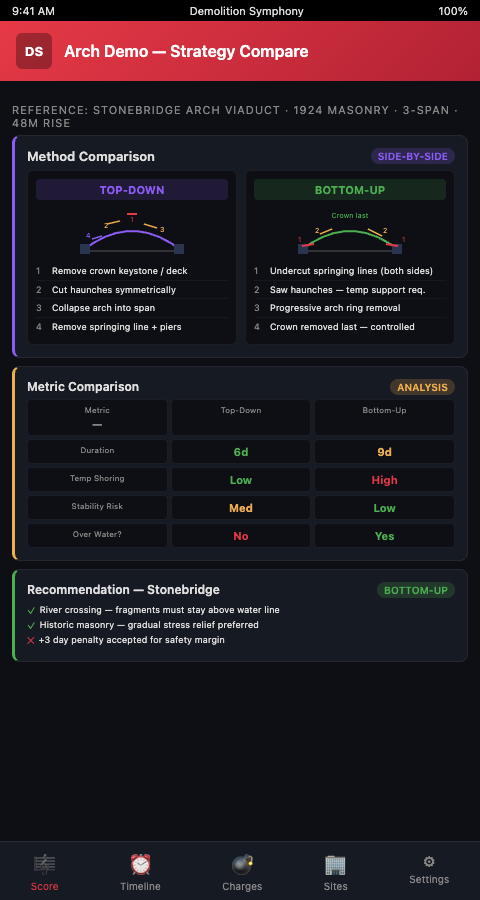
The NFDC DRG102 Top Down Demolition Guidance explicitly prohibits bottom-up demolition approaches for arch structures in the general case, noting that unauthorized methods are disallowed in favor of top-down techniques that progressively relieve arch thrust from the crown downward. The prohibition is not stylistic. It reflects the structural reality that bottom-up removal — starting at the abutments and working toward the crown — can destabilize the full arch at any point before the thrust is fully resolved.
The Rapid Demolition of Crossline Arch Bridge study published in Scientific Reports documents a three-phase weight reduction strategy for arch demolition: progressive removal of spandrel fill and non-structural elements — spandrel demolition for the arch bridge — first, followed by symmetric superstructure removal, then controlled arch rib deconstruction sequence working from crown toward the abutments. This sequence respects the arch's thrust mechanism at each stage and is documented to perform as predicted when implemented with engineering authorization at each phase gate.
The U.S. demolition and wrecking market reached $9.8 billion in 2024, reflecting the continued pressure on demolition teams to handle increasingly complex legacy structures at pace. Arch bridges — stone masonry arch viaducts, concrete-filled spandrel arches, and tied-arch steel structures — are among the most technically demanding, because the structural behavior at each demolition phase differs fundamentally from the behavior of the same structure at the previous phase.
Scoring the Arch: Phase Strategy Before the First Note
The Demolition Symphony Planner requires the arch removal strategy — top-down or the specific variant applicable to the structure — to be declared at the score's opening movement, before any structural action measures are written. This declaration is not just a method selection. It is the structural rationale that governs the logic of every subsequent measure in the score.
Top-Down Strategy — Crown-First Sequencing. Top-down arch demolition writes the score from the crown outward toward the abutments. The first structural action measures remove spandrel walls, deck elements, and fill above the arch ring, reducing the arch's total load progressively. Each measure is checked against the arch's thrust line at that load state: as material is removed, the thrust line shortens, and the arch rib experiences changing compression distribution. The research on arch rib assembly supports removal published by Springer demonstrates that optimized bracket and temporary support removal sequencing is critical at this stage — the support removal sequence must mirror the load reduction sequence to avoid creating temporary eccentricities that exceed the arch's buckling capacity.
The Demolition Symphony Planner writes each top-down measure with an arch thrust state notation: the current compression load in the arch rib at the critical section, derived from the structural model for that partial removal state. The measure cannot advance until the thrust state is confirmed within the arch's capacity for the current geometry.
Balanced Symmetric Removal — Managing Abutment Thrust. The practice of demolishing truss-combined arch bridges published in ASCE documents symmetric balanced removal as the primary method for managing abutment thrust during arch rib deconstruction. Simultaneous symmetric removal from both sides of the crown maintains equal thrust on the abutments as the arch is progressively shortened. Asymmetric removal — taking material from one side faster than the other — creates unbalanced horizontal thrust at the abutments, potentially destabilizing the remaining arch half before it can be supported.
The Demolition Symphony Planner marks symmetric removal measures as paired actions: the measure cannot close until both symmetric operations are marked complete. An asymmetric condition — one side advanced and the other delayed — triggers a hold notation that pauses the sequence until the symmetry is restored or a structural authorization is issued for the specific asymmetric condition.
SPMT-Assisted Rapid Arch Removal. The PMC documentation of SPMT-assisted rapid bridge demolition records complete span removal in under five hours compared to multi-day conventional demolition for the same structure. On tied arch bridges where the arch rib and deck can be treated as a single rigid unit, SPMT transverse rolling allows the entire superstructure to be moved off the abutments as a monolithic element, eliminating the phase-by-phase arch rib deconstruction that carries the highest structural complexity. The Demolition Symphony Planner marks SPMT-eligible arch configurations at the score baseline, enabling the project team to evaluate the option before committing to a phase-by-phase approach.
For teams who have managed segmental concrete bridge disassembly, the phase-gate logic applied to segment-by-segment arch rib removal is the same: each segment removal creates a new partial structure state that must be checked before the next segment is released. The difference is that arch removal operates against a compression mechanism rather than a prestress mechanism, requiring different analytical tools but the same planning discipline.
For teams selecting between arch removal approaches on post-tensioned arch structures, the post-tensioned girder cut sequencing methodology provides the framework for managing stored energy release during cutting operations — a concern that applies to tied-arch systems with post-tensioned tie rods just as it applies to conventional prestressed girders.
Advanced Tactics for Arch Bridge Strategy Selection
Three-phase weight reduction before arch rib engagement. The Scientific Reports arch bridge demolition study demonstrates that reducing the dead load on the arch ring before beginning arch rib removal significantly reduces the required temporary support capacity during the rib deconstruction phase. Removing spandrel fill, parapet walls, and non-structural deck elements in Phase 1 reduces the arch ring's compression load by 20 to 40%, depending on the original fill-to-rib load ratio. This reduction is worth encoding as a distinct preliminary movement in the Demolition Symphony Planner score: Phase 1 measures reduce load, Phase 2 measures remove structure, and the boundary between them is a structural gate confirming the new thrust state before arch rib engagement begins.
Abutment monitoring during arch removal. Arch abutments are among the most heavily loaded structural elements in bridge infrastructure — they carry the horizontal thrust of the full arch ring under maximum dead load. As the arch is removed progressively, the abutment loading changes. Monitoring abutment displacement during demolition provides real-time confirmation that the thrust reduction matches the model prediction. The Demolition Symphony Planner links abutment sensor readings to the arch thrust state notation in the score, so deviations from predicted behavior are flagged at the measure level rather than discovered in a post-event analysis.
Temporary falsework design as a score prerequisite. Some top-down arch removal strategies require temporary falsework to support arch segments while adjacent sections are removed. The falsework design must be load-rated for the specific partial removal states it will encounter — not just the original dead load. The Demolition Symphony Planner marks temporary falsework installation and verification as pre-measure prerequisites for the arch rib deconstruction measures, ensuring that the falsework is confirmed in place and rated before the structural action that depends on it begins.
Cross-niche parallel — progressive vs. simultaneous collapse strategies. Teams managing high-rise implosion projects will recognize the strategic comparison from progressive versus simultaneous collapse strategies for skyscrapers, where the choice between sequential progressive collapse and simultaneous initiation follows the same structural logic as top-down versus bottom-up arch demolition: the structure's load-carrying mechanism determines which removal strategy is safe, and that determination must be made before any action is planned. The Demolition Symphony Planner encodes both structural strategy types in the same score framework, adapting the notation to the specific mechanism — arch thrust for bridge arches, column load transfer for high-rise implosion.
The Structural Decision That Cannot Be Undone
An arch bridge demolition team that begins bottom-up removal and discovers mid-sequence that the arch is destabilizing has no clean recovery path. Reversing a bottom-up sequence requires re-installing structural support in areas already partially demolished — a technically complex, time-consuming, and expensive intervention that assumes the partially demolished arch is stable enough to be re-supported. It frequently is not.
The top-down strategy, documented across multiple case studies and enforced by the NFDC guidance, succeeds because it respects the arch's structural mechanism throughout the entire removal sequence. The score written before demolition begins does not guarantee that every measure will execute without complication — but it does guarantee that every measure was designed with the arch's thrust mechanism in its current state as the governing constraint.
The arch bridge removal strategy comparison must also account for site constraints that limit which approaches are physically executable. An arch spanning a navigable waterway may not allow SPMT rolling because there is no continuous road surface for transporter movement. A stone masonry arch in an urban corridor may require top-down hand demolition rather than any mechanized approach because equipment access is restricted to the deck level. The Demolition Symphony Planner's opening strategy declaration is not just a structural decision — it is the intersection of structural requirements, site geometry, access constraints, and regulatory conditions. Writing all four categories into the strategy declaration at the score's first movement prevents a strategy selection that is structurally sound but operationally infeasible from consuming the project.
Playing the Arch Score from Crown to Abutment
Bridge and overpass demolition teams working on arch structures face a strategy selection that commits the entire project. The Demolition Symphony Planner makes that selection explicit at the score's first movement, ensuring that every downstream measure is written against the correct structural logic for the chosen approach.
Top-down, symmetric, or SPMT-assisted — each approach produces a distinct score with distinct phase gates and distinct structural checks. The spandrel demolition sequence for an arch bridge, the arch rib deconstruction sequence for a tied-arch, and the symmetric removal pairing for a segmental ring arch each require different gate structures and different structural authorization triggers. The goal in every case is the same: remove the arch in a sequence that the structure can accommodate at each intermediate state, confirmed by analysis and monitored by sensors, until the last arch rib note resolves and the structure is cleared.
Plan your next span removal with the Demolition Symphony Planner and declare the arch removal strategy before the first measure is written. Start your arch bridge demolition score with the Demolition Symphony Planner — the structural logic of your chosen approach is encoded in the gate structure, ensuring your bridge and overpass demolition team executes from crown to abutment without a sequence reversal.