How to Sequence Post-Tensioned Girder Cuts Safely
What Happens When the Energy Releases Without a Plan
In January 2013, during the demolition of a post-tensioned rail bridge on the M62 motorway corridor in Castleton, UK, the project team encountered a tendon configuration that was partially ungrouted — a condition not apparent from the external inspection. The Andun case study of the M62 Castleton post-tensioned rail bridge demolition documents how a coordinated sequence was developed specifically because the ungrouted tendon condition created an explosive release risk that an unsequenced approach could not safely manage. Post-tension cut sequencing for safe prestressed concrete bridge demolition begins with identifying which tendons carry the highest energy risk and writing the release order around that analysis.
Not all such projects resolve that well. The Andun analysis of hazards in post-tensioned structure demolition identifies explosive energy release as the primary hazard in post-tensioned demolition — a mechanism where a tendon cut without controlled destress sends the strand recoiling at high velocity through the duct or anchored element. The tendon release order for bridge removal must be established by a structural engineer who has reviewed the grout condition, the prestress level, and the structural contribution of each tendon before any cutting begins. In stressed girder demolition planning, that review is not a background step — it is the governing input to the demolition sequence. Without it, the crew cannot know which cuts are safe and which ones will produce a structural event.
The FHWA Post-Tensioning Manual identifies ungrouted tendons as the highest risk category in post-tensioned demolition — because a grouted tendon's energy release is distributed through the grout, while an ungrouted tendon's energy releases through the free length of the strand. Age and corrosion complicate the picture: a bridge originally specified with fully grouted tendons may have ungrouted sections at mid-span where the grout never fully penetrated the duct.
Scoring the Tendon Release Sequence
The Demolition Symphony Planner treats post-tensioned girder cut sequencing as a composition where the tendons are the primary instruments and the structural response to each release is the music that results. A score without notation is noise. A score with complete notation — tendon identity, stress state, release method, structural response threshold — is a controlled performance.
Tendon state survey as the score's key signature. The Demolition Symphony Planner's first required entry for any post-tensioned demolition score is the tendon state survey: a systematic assessment of which tendons are grouted, which are ungrouted, which show corrosion or anchor damage, and which have tendon force that can be verified through lift-off testing. The FHWA impact echo technology for post-tension grout void detection provides a non-destructive method to identify ungrouted duct segments before cutting begins. The survey results populate the key signature of the score — every subsequent measure is written against this baseline.
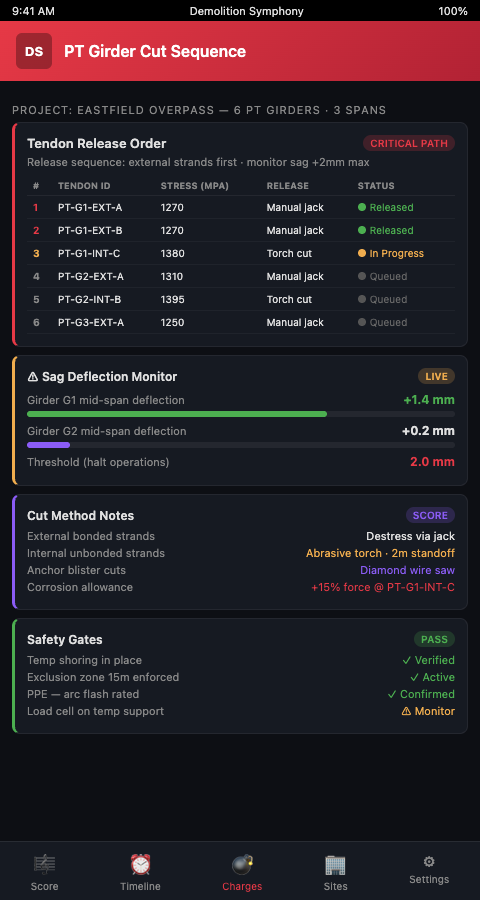
Tendon release order as the core sequence. The Andun analysis of pre-tensioned versus post-tensioned structural demolition documents that shear capacity loss is the governing structural concern when post-tension cut sequencing proceeds without account for the shear contribution of each tendon. Removing longitudinal post-tension in a girder before the shear capacity from the remaining tendons has been verified leaves the structure vulnerable to diagonal shear failure under its own self-weight. The Demolition Symphony Planner writes the tendon release order as the core sequence of the demolition score: each tendon release measure specifies the tendon's contribution to shear capacity at the current state of the bridge, and the shear check is a gate condition before the next tendon may be released.
Controlled destress vs. direct cut notation. For grouted tendons in acceptable condition, a direct saw or torch cut is typically the release method. For ungrouted tendons or those with uncertain grout condition, a controlled destress — using a hydraulic jack to incrementally reduce the tendon force before cutting — is the safer approach. The weld-torch strand cutting method documented in ScienceDirect research on alternative demolition techniques for post-tensioned box girders provides a controlled-heat alternative for specific tendon configurations. The Demolition Symphony Planner writes the release method as a notation in each tendon measure: destress protocol, tool specification, exclusion zone radius during the release, and structural monitoring requirement during and after the cut.
Structural monitoring gates between tendon measures. After each tendon release, the girder's structural state changes — deflection increases, stress redistributes, and the load on remaining tendons adjusts. The Taylor & Francis FEM reverse-engineering approach to bridge demolition analysis demonstrated that finite element models can predict the structural response at each stage of a tendon release sequence, providing thresholds against which field measurements can be compared. The Demolition Symphony Planner writes those thresholds as gate conditions between tendon measures: a deflection reading or strain gauge output must fall within the predicted range before the next tendon release may proceed.
Connection to segmental disassembly planning. Post-tensioned girder cut sequencing for single-web or multi-web girder bridges is closely related to the broader segmental concrete bridge disassembly framework. In both contexts, the prestress force is a stored energy system that must be released in a controlled sequence. The Demolition Symphony Planner's tendon notation architecture applies to both structural typologies, with segmental structures adding the complexity of match-cast joint geometry to the tendon release sequence.
Advanced Tactics for Prestressed Demolition Sequencing
Exclusion zone radius calibration per tendon. The exclusion zone during a tendon release is not uniform across all tendons — it is proportional to the tendon's free length and prestress force. A short draped tendon in a cast-in-place box girder has a different energy release profile than a long, straight external tendon in a post-tensioned segmental bridge. The Demolition Symphony Planner calculates and records the exclusion zone radius for each tendon as part of the tendon state survey entry. Workers outside the exclusion zone may continue parallel tasks; workers inside it must clear before the measure begins.
Anchor block inspection sequence. Anchor blocks at girder ends are the structural connection between the tendon system and the concrete section. Corroded or damaged anchor blocks can fail during a controlled destress, releasing tendon force prematurely. The Demolition Symphony Planner writes an anchor block inspection as a prerequisite measure for each girder: visual and where possible tactile assessment of anchor block condition, with a findings log that governs whether controlled destress or direct cut is the appropriate method for each associated tendon.
Coupling and deviation saddle notation for external tendons. Post-tensioned girders with external tendons — those routed outside the concrete section through deviation saddles — have a different release behavior than internal duct tendons. External tendons can be depressurized hydraulically before cutting, eliminating the explosive release risk. The Demolition Symphony Planner writes the hydraulic depressurization as a prerequisite measure before any external tendon cutting, with confirmation of pressure gauge reading at zero as the gate condition.
Connecting tendon sequencing to charge placement principles. Teams with explosive demolition experience will recognize that charge placement map development for steel frame buildings follows the same logic as tendon release sequencing: each structural element that is cut or fractured changes the load distribution in the remaining structure, and the cutting or fracturing order must account for those changes. The Demolition Symphony Planner uses the same gate notation architecture for both contexts — tendon release gates in prestressed demolition and charge sequence gates in explosive demolition are structurally equivalent planning events.
Span removal order integration. The tendon release sequence for a single girder is one movement in the larger composition of the full span removal order. The span removal order framework for bridge demolition establishes which span comes down first, and the post-tension cut sequencing score for each span is a nested composition within that larger sequence. The Demolition Symphony Planner writes both levels — span order and tendon order — in the same score hierarchy, so the engineer reading the span-level plan can drill into any span's tendon-level detail without switching documents.
The Consequence of an Unscored Tendon Release
A demolition crew operating on a post-tensioned bridge without a tendon release sequence is managing a stored energy system with an unknown state. The bridge appears solid. The tendons are invisible inside grouted ducts. The only external indication of the energy they contain is the deflection of the girder under load — and that indicator is subtle enough to be missed without instrumented monitoring. The first clear signal that a tendon has been cut without sequence control is often the structural event that results from it.
The Demolition Symphony Planner does not eliminate the hazard — post-tensioned girder demolition is inherently a high-energy operation. It eliminates the ignorance: every tendon's state, release method, exclusion zone, and structural monitoring requirement is written in the score before the first cut is made.
Stressed girder demolition planning that is documented in the Demolition Symphony Planner's phase score also creates the post-project compliance record that OSHA and owner engineering reviews require when prestressed concrete demolition work is performed. The I-75 girder uplift incident documented in OSHA's investigation files was attributable to the absence of a documented tendon release plan — the knowledge existed, but the sequence was communicated verbally rather than through a written plan that the crew had access to at the moment of the cut. Post-tension cut safe sequencing documented in the score eliminates that gap: the notation is available to every team member for the full duration of the project, not just during the pre-work briefing where it was originally communicated.
Plan Your Next Span Removal
Bridge and overpass demolition teams working on prestressed concrete structures carry a planning obligation that goes beyond the standard phase schedule: every tendon is a stored-energy event that must be sequenced, and the sequence must be documented in a format every engineer and operator on the project can read before, during, and after each release.
Prestressed concrete bridge demolition managed through the Demolition Symphony Planner also creates the regulatory compliance record that OSHA requires for high-energy demolition operations. When the tendon release order is documented as a scored phase sequence — with pre-release structural verification gates, exclusion zone confirmations, and post-release sensor readings all logged in the same document — the project team has a complete record demonstrating that the release sequence was engineered, authorized, monitored, and confirmed at every step.
Start your post-tensioned bridge demolition score with the Demolition Symphony Planner and give your bridge team a tendon release plan — complete with grout void survey results, tendon release order, exclusion zone notations, and structural monitoring gates — so every stressed girder demolition your team executes is governed by a written sequence that engineering authorized before the first crew enters the work zone and that every team member can reference throughout the project.