Why Span Removal Order Determines Bridge Demolition Success
A Sequence Reversed Became a Collapse
The Hongqi Viaduct in China collapsed during demolition in 2012, killing nine workers. A ScienceDirect analysis of domino-type progressive collapse traced the failure directly to an incorrect span removal sequence. The viaduct was a continuous multi-span structure. When the wrong span was removed first, the remaining spans experienced load redistribution that exceeded their unintended capacity, and a chain-reaction collapse followed. No single component failed independently — the sequence created the failure.
A multilevel evaluation procedure for bridge demolition from Taylor & Francis establishes a foundational principle for optimal span removal order bridge demolition: the safest demolition order is generally the reverse of the construction sequence. The last span erected typically carries the fewest long-term dependencies and can be removed first without triggering load redistribution into critical zones. But "generally" is not "always," and the exceptions — continuous-beam bridges, bridges with post-tensioned continuity, bridges with asymmetric spans — are precisely the cases where applying the reverse-construction default without analysis produces dangerous intermediate states.
WSDOT Engineering for Bridge Demolition Best Practices confirms that stability must be verified at every intermediate stage, not just at the starting and ending configurations. This verification requirement makes span-by-span demolition planning a phase-by-phase analytical task — and one that requires a planning instrument capable of tracking structural state across all intermediate configurations simultaneously.
Sequencing the Score for Span-by-Span Demolition
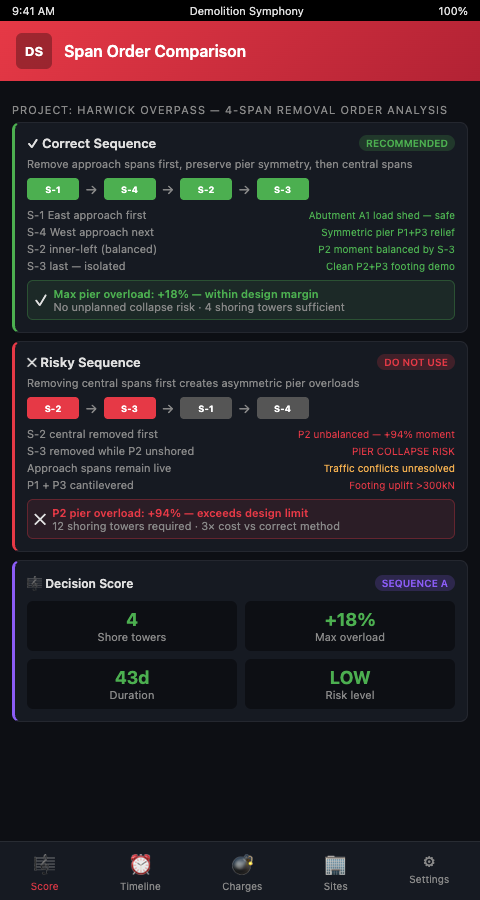
The Demolition Symphony Planner writes each span removal as a numbered measure in the bridge demolition score. The measure records not just what is being removed but the structural state before and after the removal — the load picture at the beginning of the measure and the load picture at its end. This before-and-after annotation at every measure is the operational core of span-by-span demolition planning: the team knows what the bridge looks like structurally at every point in the sequence, not just at the start and finish.
The Reverse-Construction Starting Point. For bridges where the construction sequence is documented, the Demolition Symphony Planner begins by populating the score in reverse construction order as the default for optimal span sequencing during demolition. This gives the structural engineer a starting sequence to validate, not a blank sheet to fill. The validation step checks each intermediate state against load capacity: does the reverse-construction sequence pass structural review at every intermediate measure? If it does, the score is confirmed. If a specific measure fails the structural check, the sequence is adjusted for that measure and re-validated. The bridge span extraction strategy is embedded in this validation process — not assigned arbitrarily but derived from the structural analysis of each intermediate configuration.
Critical Span Identification. Not all spans are equally critical to the stability of the remaining structure. NCHRP Report 319 on Redundancy in Highway Bridge Superstructures identifies load redistribution as the mechanism by which span removal creates structural demands on adjacent elements. The Demolition Symphony Planner's score includes a critical span register at the top of the sequence — a key that identifies which critical spans must be removed first from the bridge to prevent load redistribution into elements approaching capacity. These critical spans are marked with a high-priority notation in the score. Any change to the sequence that affects a critical span measure requires explicit structural engineer review before the revision is accepted.
Structural Verification at Every Measure Gate. Extreme Loading for Structures (AEM software) simulates span removal sequences and identifies the configurations that produce excessive deformation or element overstress. The Demolition Symphony Planner integrates AEM or equivalent simulation results as gate annotations at each span removal measure: the simulation must confirm the structural state is safe before the next measure opens. This converts software analysis from a pre-project report into a real-time constraint on sequence advancement.
Controlling the Collapse Footprint. A Scientific Reports study on rapid demolition of a crossline arch bridge demonstrates that span removal order can be optimized specifically to control the collapse footprint — limiting debris scatter and protecting adjacent infrastructure. The Demolition Symphony Planner encodes the collapse footprint as a geometric constraint per measure: the removal method and the expected fall direction must keep debris within the approved zone. When the span removal order is selected partly for footprint control, this constraint is annotated explicitly in the affected measures.
The connection to multi-span phasing is direct: the span removal order score is the operational detail layer below the phase plan. The phase plan identifies which group of spans is addressed in each project phase; the span removal order score specifies the individual extraction sequence within each phase and verifies structural state at each individual removal step.
Advanced Tactics for Complex Span Sequences
Asymmetric span bridges. Bridges where span lengths vary significantly across the structure — common in grade-separated interchanges with curved alignments — require per-span structural analysis rather than a uniform reverse-construction default. The tributary area carried by each span and its relationship to the adjacent pier cap geometry differ across the structure. The Demolition Symphony Planner accommodates asymmetric structures by writing per-span load annotations rather than applying a single load model to all measures.
Post-tensioned continuity interruption. Bridges with post-tensioned tendons that cross span joints must interrupt post-tensioning before span removal in the zone of the tendon. Failing to de-tension or cut the tendon before removing the connected span transfers energy into the adjacent span in an uncontrolled manner. The Demolition Symphony Planner writes tendon interruption as a sub-step within the span removal measure — a required note before the physical removal note.
Span-skipping for traffic access. In some projects, non-adjacent spans are removed in sequence to maintain a travel path across the bridge while demolition proceeds on alternating spans. This approach requires the score to track two active structural states simultaneously: the spans under removal and the spans carrying traffic. The Demolition Symphony Planner handles this with a dual-track annotation — one track for the demolition sequence, one track for the traffic-carrying spans — so conflicts between the two are visible before they occur.
Connecting to cantilever removal logic. Teams with experience in cantilever removal order for structural stability from stadium work will recognize the moment-balance discipline in span sequencing. Removing a span that creates a moment discontinuity in an adjacent continuous-beam section is structurally analogous to removing a cantilever without addressing the back-span reaction. The score format captures this analogy explicitly.
Documentation for NCHRP-compliant structural review. The span removal order score, with its per-measure load annotations and simulation gate results, creates a documentation record that satisfies the structural review requirements documented in NCHRP publications on bridge demolition. Regulatory agencies reviewing the project file find a traceable decision record for every span's removal position in the sequence — not a narrative description of the contractor's approach.
The Score That Prevents the Viaduct Failure Mode
The Hongqi Viaduct collapse is the clearest documented case of what span removal order failure looks like. Nine deaths. Unplanned progressive collapse. And a sequence that would have been identified as unsafe if the intermediate structural states had been analyzed before work began.
The Demolition Symphony Planner is built to prevent that failure mode by making the intermediate structural states visible, verified, and gated — so the sequence advances only when the current state is confirmed safe and the next state has been validated before it begins.
Optimal span sequencing for demolition is not a decision made once at the start of the project. It is a decision that must be confirmed at each phase gate as the partial structure's load distribution evolves. A sequence that was optimal when three spans remained may no longer be optimal when two spans remain — if a temporary support has shifted, if a shoring tower has been removed ahead of schedule, or if a load reading from a structural sensor has come back higher than predicted. The Demolition Symphony Planner's gate notation creates a reconfiguration checkpoint at each measure: the sequence is re-evaluated against the current partial structural state before the next bridge span extraction step is authorized. That reconfiguration checkpoint is the mechanism that makes optimal span sequencing for demolition an adaptive discipline rather than a fixed plan executed regardless of what the structure is actually doing.
Score the Sequence Before You Schedule the Crane
Bridge and overpass demolition teams planning span-by-span work should write the removal order score before finalizing crane schedules and traffic management plans. The span removal order determines crane positioning, traffic window timing, and shoring requirements — all of which depend on knowing which span is being removed at which stage.
The critical span removal sequence is not just the structural team's concern — it is the logistical spine of the entire project. A crane scheduled to begin on span 4 on day 14 is committed to that date. If the span removal score later reveals that span 4 cannot be safely accessed until span 2 and span 3 are cleared, the crane schedule must be rebuilt from the sequence analysis, not the other way around. Writing the sequence before scheduling the crane prevents this conflict from emerging after equipment is mobilized, subcontractors are committed, and traffic management permits are filed.
Score your span removal sequence with the Demolition Symphony Planner and give your bridge and overpass demolition team a critical span register, a validated reverse-construction default, and a structural check at every intermediate state — so your crane schedule is built on a sequence that engineering has confirmed safe at each step. Build your bridge span extraction strategy with the Demolition Symphony Planner before the first permit is filed.