Progressive vs Simultaneous Collapse Strategies for Skyscrapers
Progressive vs Simultaneous Collapse Strategies for Skyscrapers
In urban high-rise demolition, simultaneous removal of lower-floor columns produces unpredictable debris scatter; sequential removal allows the collapse front to develop directional momentum before the structure contacts adjacent material (ASCE). That finding from CDI case documentation is the core practical argument for progressive collapse in most urban skyscraper implosions. But simultaneous strategies have legitimate applications, and the controlled collapse strategy comparison between the two methods requires clarity on what each achieves and at what cost.
The distinction matters most for buildings above 15 stories, where the height-to-width ratio means a building in the wrong collapse mode can scatter debris 50 meters beyond the intended debris field. Below that height, both approaches can work within typical urban site constraints. Above 20 floors, the sequential vs simultaneous detonation choice becomes a primary design decision with significant safety, regulatory, and logistical consequences. Skyscraper implosion collapse method selection must be resolved before the charge design begins — the two strategies produce different charge weight requirements, different delay network architectures, and different exclusion zone geometries.
Progressive Collapse: How It Works and What It Requires
Progressive collapse, in the controlled demolition context, means firing structural element charges in a sequence that propagates a collapse front from one zone of the building to another. The most common implementation for skyscrapers is a lower-floor-first sequential strategy: perimeter columns on the south face fire first, then the center columns, then the north face, with each firing line separated by a delay that allows the building to drop 1-2 meters before the next line fires.
A 1-second delay between sequential column lines produces approximately 5.2 meters of drop per interval (IJIRSET). At 35ms delay intervals — the standard for millisecond-accuracy electronic detonators — the drop per interval is roughly 6mm. The choice of delay interval determines how much structural movement occurs between sequential firings and therefore how much directional momentum the structure develops before each subsequent column line engages.
Design criteria for sequential blast notch initiation specify that the delay timing must account for the height of the blast notch above grade: taller notch positions require longer delay intervals to achieve the same horizontal displacement at the base (ScienceDirect). For a 30-floor building with a notch at Floor 3, the delay between south-face and center-column firings is different than for the same building with a notch at Floor 5. Progressive collapse planning is not a lookup table exercise; it is a geometry-specific calculation.
Simultaneous Collapse: When It Applies
Simultaneous collapse fires all perimeter and core charges within a very short window — typically under 50ms total across the firing sequence. The entire structural support at the blast notch level is removed near-instantaneously, and the building above the notch drops as a largely intact mass onto the rubble below.
This approach can produce a smaller debris footprint in one specific condition: a symmetric, compact building on a site with adequate vertical clearance and no adjacent structures within the debris radius. The simultaneously-collapsed building falls straight down, concentrating the debris within the building's own footprint plus a modest scatter margin. The J.L. Hudson implosion, at 29 floors and a compact city-block footprint with managed clearances, used a variant of this approach to keep debris within the site boundary.
Progressive collapse mechanics are documented in the structural engineering literature as the mechanism by which a partial failure can propagate through a building when the design lacks adequate redundancy (Wikipedia). In demolition, the distinction is that the propagation is deliberate and controlled rather than accidental. The progressive demolition vs simultaneous blast decision is, at its core, a question of whether the coordinator needs directional fall-line control — which only the progressive approach can reliably provide for buildings above 15 stories.
The sequential vs simultaneous detonation skyscraper choice also carries different exclusion zone geometries: a progressive sequence concentrates debris along the fall line, while simultaneous collapse distributes energy radially from the base. Coordinators must communicate this distinction clearly to permitting authorities, because the exclusion zone geometry that regulators approve is based on the collapse strategy submitted — switching strategies after permit approval requires re-review.
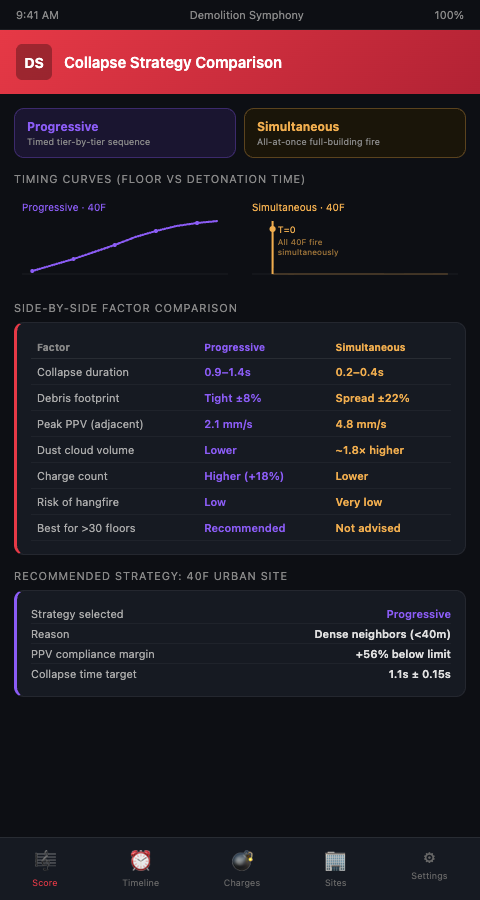
In the Demolition Symphony Planner, the collapse strategy comparison between progressive and simultaneous is presented as a visual score difference. A progressive score looks like a staircase — each column line's note offset to the right of the previous one, reading like a melodic sequence. A simultaneous score looks like a chord — all column line notes stacked vertically at the same time position. The coordinator can toggle between the two representations and see immediately how the debris and vibration predictions change.
For delay detonator configuration, the progressive collapse strategy requires that each delay interval be precise to within a defined tolerance — typically ±1ms for modern electronic detonators — or the sequential column line firing order may invert under timing variance, converting an intended progressive sequence into a partially simultaneous one.
Failure Mode Comparison
When poorly designed collapse strategy is the root cause of a demolition failure, the failure mode differs by strategy type (Stott Demolition). Progressive collapse failures typically present as loss of fall-line control — the building falls in an unintended direction — because the delay sequence was insufficient to establish directional momentum before the collapse front reached an intermediate column line. Simultaneous collapse failures typically present as incomplete structural failure — some columns remain standing after the primary charges fire — because charge weight calculations underestimated the actual column strength.
In urban environments, fall-line control failure is generally more dangerous than incomplete structural failure. A building that partially collapses and leaves a standing stub can be re-entered with additional charges under controlled conditions. A building that collapses in the wrong direction may damage adjacent structures, injure personnel outside the exclusion zone, or destroy critical infrastructure with no recovery option.
The HowStuffWorks documentation of building implosion practice describes the lower-floor-first strategy as the standard for controlling fall direction in tall buildings (HowStuffWorks). The underlying logic is that establishing horizontal momentum in the lowest floors of the structure — where the mass-to-height ratio provides the most leverage — controls the fall line more reliably than any other approach.
Decision Criteria for Strategy Selection
Use progressive collapse when: the site has adjacent structures within 60-80 meters on any side; the building's height-to-width ratio exceeds 3:1; the structural system includes a stiff RC core that will resist fall-line deviation; or the regulatory framework requires documented PPV reduction via delay interference.
Use simultaneous collapse when: the site has symmetric clearances on all sides exceeding the debris scatter radius; the building height is below 15 floors; the structural system is uniform steel frame without a dominant shear core; and the primary planning priority is minimizing the total charge count.
Use a hybrid approach for mixed-use or geometrically complex towers: the podium demolishes simultaneously while the tower above collapses progressively, or the RC core collapses on a four-phase sequential schedule while the perimeter frames fire simultaneously at each floor level. The hybrid strategy combines the debris concentration of simultaneous collapse at the podium with the fall-line control of progressive collapse in the tower.
For multi-phase core scoring, the hybrid strategy requires the core sub-score and the perimeter score to be written as independent but coordinated sequences — exactly the two-staff composition approach described in that post.
For cross-structure comparison, the top-down vs bottom-up arch bridge demolition decision involves the same structural logic: does the structure's load path support a sequential approach that propagates from one end to the other, or must the primary structural elements be removed simultaneously to prevent an uncontrolled partial failure?
Planning Requirements by Strategy
Progressive collapse requires: delay timing accuracy to ±1ms or better; a site-specific simulation that validates fall-line control through the full delay sequence; PPV monitoring at the nearest adjacent structure with real-time display; and a documented abort protocol if the collapse trajectory deviates from the predicted fall corridor after the first firing line.
Simultaneous collapse requires: charge weight verification by structural element type, not by building zone; a symmetric exclusion zone with confirmed clearances on all sides; a debris containment barrier at the scatter radius boundary; and an incomplete-collapse response plan including re-entry protocol and secondary charge specifications.
Urban high-rise implosion coordinators selecting between progressive and simultaneous collapse strategies for skyscrapers need a planning platform that makes the consequences of each choice visible before the blast design is committed. The Demolition Symphony Planner's strategy comparison view shows collapse trajectory, debris scatter, and vibration contours for both approaches on the same site, so the strategy selection is driven by data rather than convention. Join the waitlist to run a side-by-side collapse strategy comparison on your next high-rise project.