Best Practices for Steel Recycling Logistics in Arena Demolition
SteelConstruction.info's recycling survey documents a remarkable fact: structural steel from demolition projects achieves a 98–100% recovery rate in the UK market — a near-total material circularity that no other major building material approaches. In practice, however, that rate is a ceiling achieved by projects with structured steel recycling logistics, not a baseline that all arena demolition projects reach by default. Projects that lack a sorting and transport plan at mobilization routinely see structural steel contaminated with non-ferrous debris, cut to non-standard lengths that recyclers penalize, or sorted inconsistently across shifts — costing project owners tens of thousands of dollars in reduced scrap value on material they were counting as revenue.
Steel recycling logistics arena demolition planning is the operational discipline that closes the gap between the theoretical 99% recovery rate and what actually gets realized on the weigh ticket at the recycling facility. At current scrap steel prices of $350–$550 per ton (Okon Recycling, 2025), a 10,000-ton structural steel inventory represents $3.5–$5.5 million in potential recovery — a figure where logistics quality directly translates to project economics. Steel recovery logistics cannot be planned in isolation: the material recycling workflow for the entire stadium must define how steel, concrete, and specialty material streams are physically separated across the site so that each stream reaches its intended processor without contamination from adjacent demolition operations.
Why Arena Steel Salvage Loses Value
Structural steel salvage venue teardown operations lose value at three predictable failure points. First, sorting quality breaks down across shifts: day shift crews sort steel by grade and form, but night shift crews — working under pressure to move tonnage — comingle structural wide-flange sections with light-gauge miscellaneous steel, forcing the recycler to apply the lower-grade price to the entire load. Second, cutting practice is inconsistent: some crews cut members to recycler-specified lengths, while others cut to convenience, generating non-standard pieces that must be cut again at the recycling facility at the project's cost. Third, transport is uncoordinated: trucks are dispatched as material accumulates rather than as full sorted loads, increasing transport cost per ton and reducing the predictability of material delivery that recyclers use to schedule their processing equipment.
The Richmond Steel on-site sorting methodology documents that projects with a defined sorting protocol — grade identification, grade-specific stockpile locations, recycler-approved cutting dimensions, and dispatch triggers based on load weight rather than accumulation — consistently achieve 8–12% higher per-ton prices than projects that rely on crew judgment for sorting decisions. Nucor's steel recycling process documentation confirms that on-site shearing, baling, and electromagnet sorting to prepare structural steel for transport to electric arc furnace mills is the gold standard for large-venue demolition projects — because mill input quality directly determines the alloy efficiency and premium pricing that recyclers pass back to the demolition contractor.
The Demolition Symphony Score for Steel Logistics
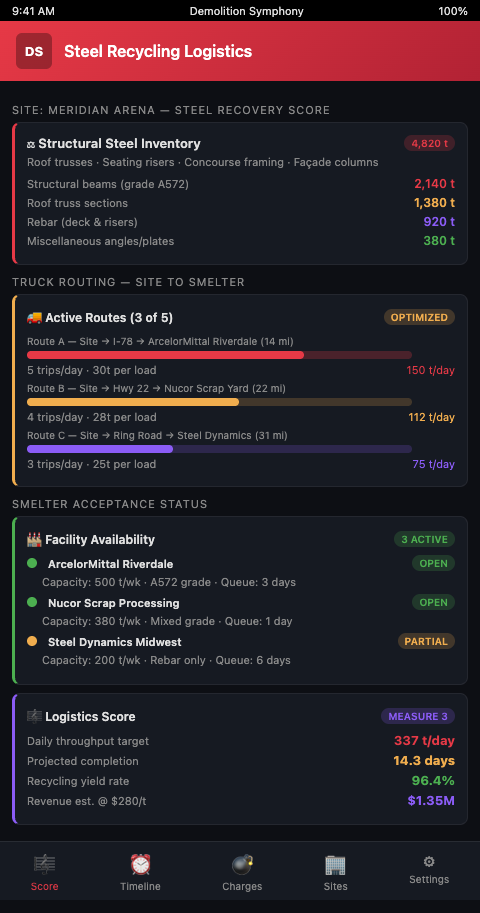
Demolition Symphony Planner scores steel recycling logistics as a parallel track running alongside the structural demolition sequence: every salvage window, recycling stream, and structural cut becomes musical notation on a visual demolition score, and the steel processing track is notated measure-by-measure to show which grade of steel is being generated by the active demolition work and how it flows through sorting, cutting, weighing, and dispatch.
The framework structures steel logistics across four operational movements.
Movement 1 — Pre-Demolition Steel Grade Inventory. Before the first structural member is cut, the steel in the venue is inventoried by grade, form, and estimated tonnage. Wide-flange sections, hollow structural sections, miscellaneous plate, rebar, and light-gauge secondary framing all have different recycler value profiles and different sorting requirements. Demolition Symphony Planner generates a grade map that overlays the demolition sequence — showing which steel grades are generated in which phases and in what quantities — so sorting resources can be staged before the material arrives at the stockpile.
Movement 2 — Sorting Protocol Assignment. Each steel grade and form receives a sorting protocol: designated stockpile zone, cutting dimension specification, contamination prohibition (no non-ferrous hardware attached), and load dispatch trigger weight. The protocol is embedded in the demolition score as a processing annotation attached to each measure that generates that steel type. Crews working a given demolition measure see the sorting protocol for the steel they're producing, not a generic instruction to "sort at the staging area."
Movement 3 — Transport Cadence Coordination. Scrap steel removal stadium deconstruction projects fail their transport economics when trucks arrive on-demand rather than on schedule. Demolition Symphony Planner generates a transport dispatch schedule based on production rate projections — how many tons of each grade will be generated per shift — and coordinates truck dispatch with recycler receiving windows. Coordinated dispatch with pre-confirmed receiving windows is the primary logistics lever for reducing the per-ton transport cost on large demolition projects — because mills and processors optimize their intake scheduling around predictable delivery volumes, not variable on-demand arrivals.
Movement 4 — Weigh Ticket Reconciliation. Every load dispatched is reconciled against the demolition score's production projection. Consistent variance between projected and actual weigh tickets flags a sorting or cutting compliance problem — material is being lost to contamination, commingled into lower grades, or cut to non-standard dimensions that reduce accepted weight. Demolition Symphony Planner surfaces weigh ticket variance as a score annotation so project managers can address compliance issues within the shift, not at month-end reconciliation.
Advanced Tactics for Maximizing Scrap Steel Revenue
Three advanced tactics separate arena steel recycling projects that achieve ceiling recovery rates from those that leave significant revenue on the table.
Segregate reusable structural sections before scrap processing. Not all structural steel from an arena demolition is destined for the electric arc furnace. Wide-flange sections in excellent condition — particularly from low-stress secondary framing — may be sold as structural steel for reuse at 2–3x the scrap price. Demolition Symphony Planner flags sections that meet reuse criteria based on the pre-demolition condition survey, routing them to a separate staging area before the scrap cutting process begins. The SteelConstruction.info recycling and reuse guidance notes that reuse extends the material's value life by an additional 50–100 years compared to recycling.
Coordinate steel removal with the site's material stream boundaries to prevent cross-stream contamination. On a stadium demolition site, steel, concrete, wood, and non-ferrous metals are all generated simultaneously. Without defined material stream boundaries, steel stockpiles accumulate concrete debris from overhead breaking operations that reduces the effective scrap grade. The material recycling workflow plan must assign physical separation between steel staging areas and concrete crusher operations, with a minimum buffer distance that accounts for debris trajectory from elevated breaking equipment. Richmond Steel's on-site sorting methodology documents the floor-by-floor approach where electromagnets, shears, and balers work together to reduce steel volume for logistics before contamination from adjacent demolition can occur. The concrete crushing and sorting methodology for on-site reuse defines the crusher operating zones and discharge patterns that drive these buffer distance requirements.
Align post-tensioned steel handling with the post-tensioned girder cutting methodology. Some stadium structures use post-tensioned concrete with high-strength steel tendons. Those tendons require de-tensioning before cutting — an operation that is hazardous if approached with the same protocol as mild structural steel. Demolition Symphony Planner scores post-tensioned steel operations as separate measures with specialist protocol annotations, ensuring that scrap steel removal stadium deconstruction crews don't treat high-stress tendons as ordinary rebar.
Delivering the Steel Recovery Rate the Budget Assumes
Metal sorting demolition site quality is not a secondary concern — it is the primary driver of whether the steel recovery revenue the project budget assumes is actually realized. Nucor's steel recycling process documentation confirms that scrap quality determines electric arc furnace efficiency and alloy output quality, which in turn determines the premium or discount applied to each load delivered.
Demolition Symphony Planner exports shift-level steel processing work orders that include grade identification criteria, stockpile location, cutting specifications, and dispatch trigger quantities in field-readable format. Every crew member processing steel works from the same protocol. Every truck dispatch is coordinated with the recycler's receiving window. Every weigh ticket is reconciled against the production projection before the next shift begins. Score Your Stadium Teardown with Demolition Symphony Planner and build the steel logistics plan before the first beam falls. Get started with a grade-segregated scrap steel workflow that maximizes the recovery revenue your demolition budget is counting on.